
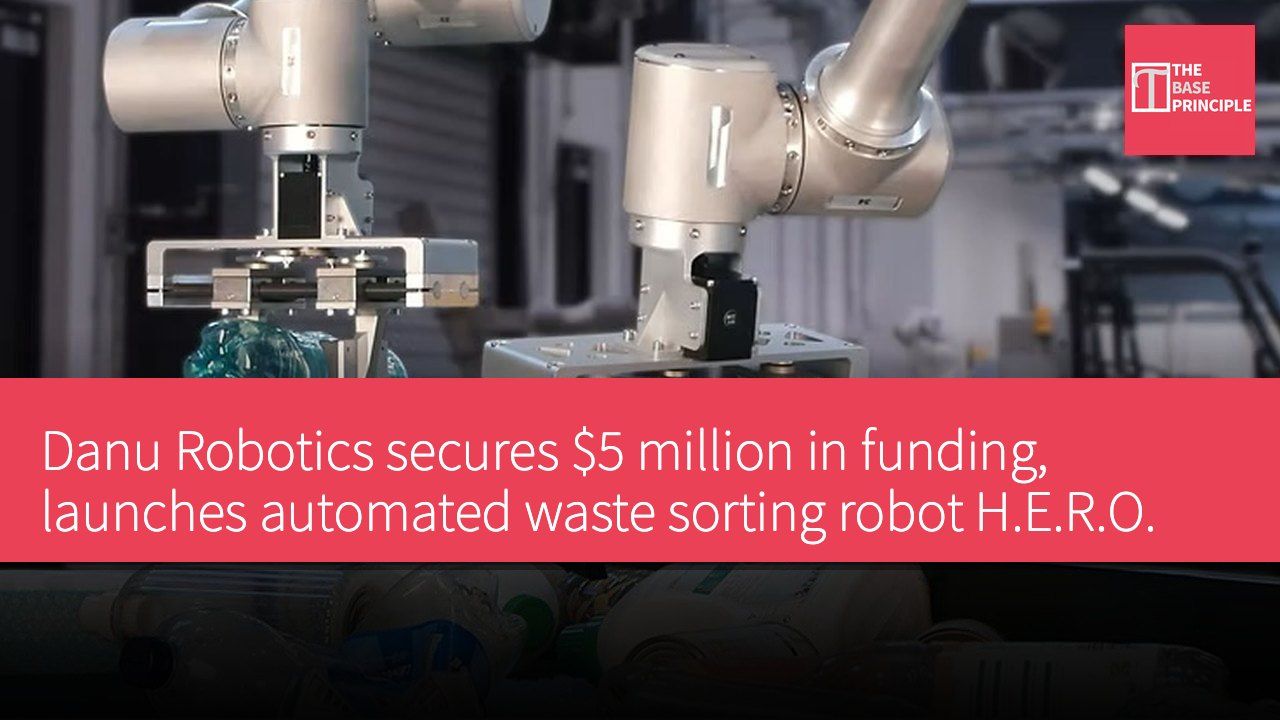
- Danu Robotics secures $5 million in funding for its waste-sorting robot H.E.R.O.
- H.E.R.O. can automatically identify and sort recyclable materials, improving recycling efficiency.
- The robot uses cameras and AI to work continuously without fatigue.
- Danu's technology could be applied to multiple scenarios in the future, such as shopping malls and airports.
Scotland-based Danu Robotics recently secured $5 million in seed funding for its innovative waste-sorting robot "H.E.R.O." The system is designed to automatically identify and sort recyclable materials, and such systems promise to make the recycling process more profitable and efficient. Currently, when users place items in recycling bins, it does not necessarily mean those items will actually be recycled. The first challenge is whether the item can reach a recycling facility, because recyclable waste is often mixed with general trash. However, even if it reaches a recycling facility, multiple problems still need to be overcome.
Challenges in the Recycling Process
First is the potential contamination problem. Recyclable bulk waste is typically mixed, containing plastics, paper, food waste, and other materials. To recycle effectively, these materials need to be sorted, cleaned (where applicable), and processed centrally. Recycling requires a H.E.R.O., and this is typically performed by trained human workers on conveyor belts — a process that is not only time-consuming but also error-prone, especially since human workers are prone to fatigue and boredom.
By contrast, Danu's H.E.R.O. robot does not feel fatigue and can theoretically work continuously. To achieve this, Danu's robot uses a combination of cameras, artificial intelligence, and robotic arms to identify and sort waste much like a human. The cameras serve as the robot's "eyes," continuously feeding visual data of items on the conveyor belt to its internal AI. The AI then identifies and sorts waste based on "recycling value." This means not all materials can be economically recycled, so expending effort and time to recycle them is usually a losing proposition.
Advantages of Robotic Technology
Once identified, the AI directs the robot's grippers to pick items from the waste stream for processing. Grippers are critical here because they can handle heavier and bulkier items than suction cups. For Danu, grippers are a more effective approach, as suction cups often struggle in this regard. According to Danu Robotics, this can significantly improve the bottom line of recycling facilities. They believe facilities using these systems can easily increase revenue by at least US$485,000 (approximately HK$3,783,000).
Market Demand Potential
The initial investment cost is approximately US$160,000 (about HK$1,248,000), with ongoing maintenance costs of about US$24,000 (about HK$187,200), making for a quite substantial return on investment. The market also appears to be taking notice. Beyond the seed funding, the company announced it has received at least two letters of intent to purchase and has signed contracts worth approximately US$500,000 (about HK$3,900,000). The company has roughly 200 potential customers in its sales pipeline — a solid showing for a company founded just six years ago. Although no sales have been confirmed yet, this indicates very strong market demand potential for the technology once it matures.
Looking ahead, Danu also sees potential applications for its robotics technology in many other places beyond recycling centers. Once scaled down to a sufficiently small size, it could be deployed in locations such as shopping malls, airports, or office buildings. Danu Robotics founder Amy Ma told TechCrunch in an interview: "Once miniaturized, it can serve as a standalone recycling solution for events, shopping malls, hospitals, or airports to recycle waste at the source." She added: "This is precisely how we can truly change the way packaging waste is managed."
Future Potential of Automated Waste Sorting
As environmental awareness grows, demand for automated waste-sorting technology is increasing. Danu Robotics' H.E.R.O. robot not only improves recycling efficiency but also reduces labor costs and error rates. Challenges facing current recycling systems, such as mixed items and contamination, are expected to be addressed through this technology. Moreover, the technology's wide range of potential applications can further drive sustainable development, which holds significant importance for the future of waste management.