
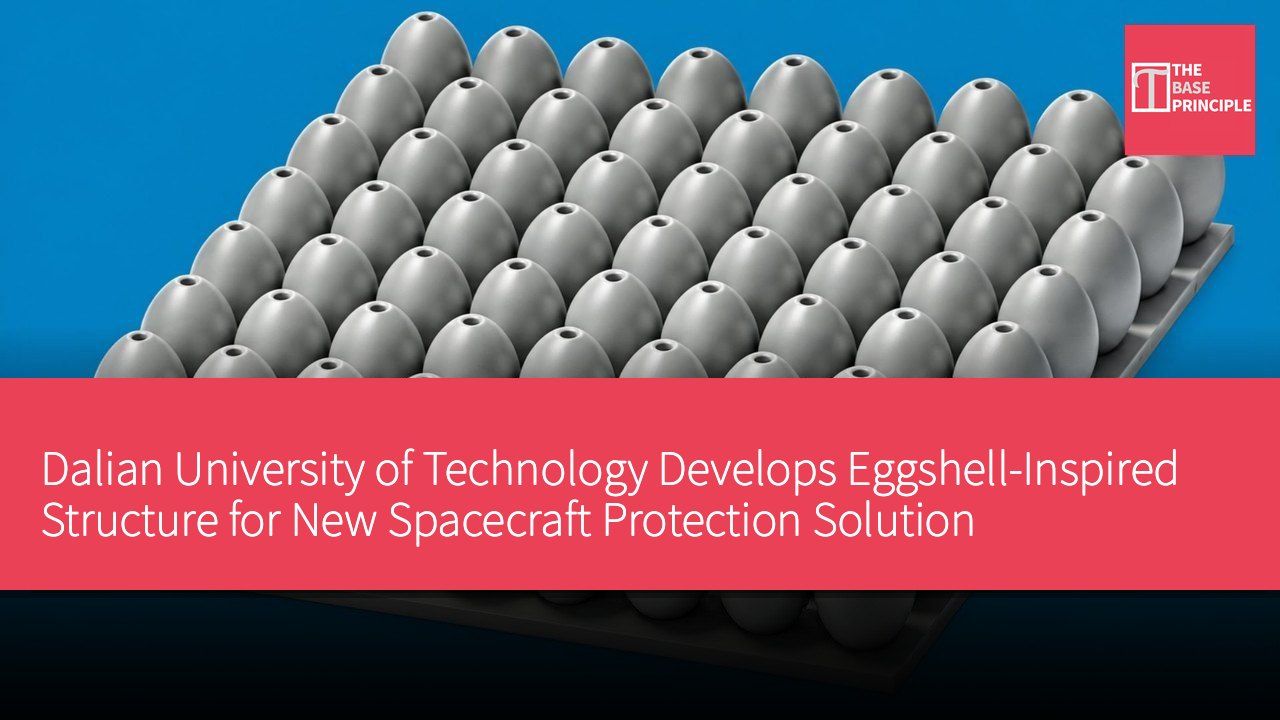
- Dalian University of Technology has developed an eggshell-inspired metamaterial design to protect spacecraft from space debris impacts.
- The new design uses 3D printing technology to create hollow aluminum eggshells that effectively absorb intense shock waves.
- Water-filled eggshell structures performed best in impact tests, slowing projectile speeds by nearly 65%.
- The research team is refining the material design to maximize protection while minimizing weight, aiming to prevent Kessler Syndrome.
Inspired by eggshells, a new design could soon be used to shield spacecraft from high-speed orbital collisions. Researchers from Dalian University of Technology have developed a bio-inspired lightweight metamaterial design based on "eggshell" structures to protect spacecraft from space debris impacts. As the number of launches increases, Earth's orbit is gradually turning into a junkyard. Currently, nearly one million pieces of metal, paint, and broken rocket parts larger than one centimeter are hurtling through Earth's orbit at extremely high speeds. Even tiny fragments, if traveling at speeds of tens of thousands of miles per hour, can produce explosive forces akin to a grenade, threatening critical satellites, expensive space telescopes, and inhabited space stations.
Engineers have spent decades searching for lighter, more durable armor to withstand these cosmic bullets, and the answer may lie in eggshells.
Design and Performance of Eggshell Structure
The Dalian team has proposed a spacecraft protection system modeled after eggshells. They used 3D printing technology to create arrays of hollow aluminum eggshells, which were then sandwiched between two metal impact plates. This design effectively absorbed intense shock waves that would otherwise shatter traditional armor. Author Wang Yuxin stated, "Natural biological structures, after long-term adaptation, exhibit excellent energy absorption performance."
The concept of liquid damping may sound impractical. Eggs are known for their fragility, easily cracking when lightly touched on a countertop. However, nature has designed the shape of eggs as a geometric masterpiece. When organized into arrays, they form an unexpectedly robust structure. Researchers placed water-filled aluminum eggshells, blunt side down, between two plates. This design dispersed the impact force across the entire system. The result was that each eggshell collapsed in sequence, gradually absorbing and dissipating kinetic energy. Wang explained, "A single eggshell is prone to breaking under localized force, but the protection mechanism of the eggshell array is entirely different."
The coordinated deformation of these eggshell units transforms localized impact loads into energy dissipation distributed within the metamaterial, significantly enhancing the target plate's impact resistance.
Improving Materials for Enhanced Protection
Adding water inside the aluminum eggshells further boosted the armor's performance. In high-speed collisions, the trapped liquid churns internally, mitigating subsequent shock wave propagation. To evaluate the design, the researchers conducted 3D printing tests and simulations, comparing solid aluminum plates, water-filled aluminum spheres, and eggshell metamaterials. The water-filled eggshell structure outperformed all other designs, slowing the impact projectile's speed by nearly 65%, while the solid aluminum plate managed only 51%. Placing the eggshells upright, with the pointed end facing the top plate, yielded the best results.
Wang stated, "This work demonstrates that bio-inspired lightweight metamaterials are a promising solution for high-speed impact protection. We hope this research will draw more attention to bio-inspired protective structures." However, the material is not yet ready for the launch pad. The team is actively refining the metal shell's thickness, layout, and aspect ratio to maximize protection while minimizing weight, which is crucial for rocket payloads. This could prevent the Kessler Syndrome, a dangerous chain reaction where collisions between space objects produce thousands of high-speed fragments that collide with other satellites and rockets, generating even more debris faster than atmospheric drag can eliminate it.
If this bio-inspired approach is adopted, it could become an invisible shield protecting humanity's greatest cosmic endeavors from the deadly halo of junk encircling the Earth.
These research findings were published in the Journal of Applied Physics on September 8th.
The Potential of Bio-Inspired Design for Spacecraft Protection
The research from Dalian University of Technology showcases the potential of bio-inspired design in spacecraft protection, particularly against the growing threat of space debris. As space activities increase, the need to protect spacecraft from high-speed impacts becomes more urgent. The eggshell structure design not only effectively absorbs impacts but also enhances performance through liquid damping. The success of this research could provide new solutions for the safety of future spacecraft and draw more attention to bio-inspired materials, driving the development and application of related technologies.