
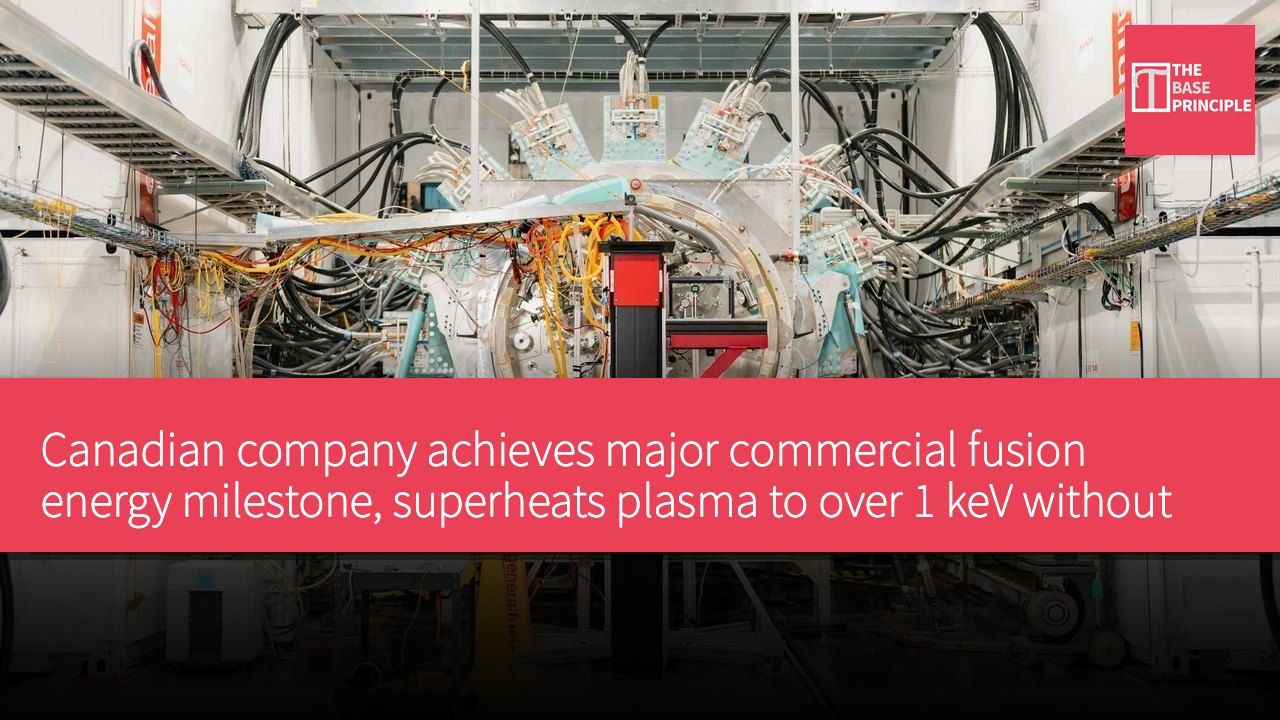
- General Fusion achieves electron temperature exceeding 1 keV in Lawson Machine 26.
- The company employs magnetized target fusion technology, requiring no superconducting magnets or high-power lasers.
- Engineers collaborate with UK Atomic Energy Authority to overcome plasma temperature measurement challenges.
- This breakthrough will advance commercial fusion energy development and could lead to a pilot plant in the future.
Scientists have heated confined plasma to over 12 million degrees Celsius (21.6 million degrees Fahrenheit). The milestone crosses a critical threshold for commercial fusion energy. This benchmark was achieved by Canadian technology company General Fusion inside its experimental prototype, Lawson Machine 26 (LM26). The device reached an electron temperature of 1.1 kiloelectron volts (keV) before achieving peak compression. In fusion physics, exceeding 1 keV is an internationally recognized milestone.
Only a handful of experimental reactors worldwide have ever reached this standard. "General Fusion has a 20-year record of industry-first milestones in magnetized target fusion, backed by a substantial body of peer-reviewed scientific literature," said General Fusion CEO Greg Twinney. "We built LM26 to achieve a critical technical milestone that will help us establish a first-of-its-kind plant within the next decade and advance along that path."
A new mechanical approach to fusionGeneral Fusion's Innovative Technology
Until now, every laboratory to reach this standard has used massive superconducting magnets or high-power lasers. General Fusion took a different path. It uses a mechanical approach called magnetized target fusion (MTF). This is the first device in history to use low-velocity physical compression to reach this temperature. Most modern fusion projects rely on extreme conditions. Some fire massive lasers at fuel pellets for a few nanoseconds; others confine plasma in complex magnetic cages. By contrast, General Fusion injects a magnetically confined plasma into a chamber and compresses it with an imploding solid metal wall over a few milliseconds.
Mechanical compression of the fuel avoids the need for rare, fragile materials. A commercial plant will use a flowing liquid metal blanket. This layer absorbs harmful neutron radiation and intense heat. As a result, engineers can build the reactor using conventional industrial metals.
Overcoming diagnostic challengesCollaboration to Overcome Technical Challenges
Proving the reaction's temperature required a precise diagnostic setup. The plasma sits inside a collapsing metal liner. Because of this tight enclosure, measuring the core without disturbing the reaction posed a major technical hurdle. To solve it, engineers partnered with the UK Atomic Energy Authority (UKAEA). The UK national laboratory operates the flagship fusion facility at Culham. The joint team deployed Thomson scattering, a gold-standard diagnostic method that fires a laser beam through the plasma. By measuring how light scatters off high-energy particles, researchers can calculate temperature with high precision.
The diagnostic hardware relied on a custom-built polychromator constructed at Culham's Centre for Diagnostic Innovation Excellence. Test data has now been published on the company's portal and submitted to an academic journal for peer review.
The international fusion raceAddressing Global Power Demand
The breakthrough comes as nations race to deliver limitless, low-carbon power to grids facing unprecedented demand. The Vancouver-based company is backed by Canada's Strategic Innovation Fund and advised by US firm General Atomics. Technicians have already begun modifying the LM26 machine. Engineers are now upgrading the device's compression system to target 10 keV, or roughly 100 million degrees Celsius. That milestone would help satisfy the Lawson criterion — the balance of heat, density, and confinement time required to produce net electricity.
If those engineering milestones are met, General Fusion expects to build its first operational grid-connected pilot plant around 2035.
Item Specification Temperature achieved Over 12 million degrees Celsius Electron temperature 1.1 keV Target compression system 10 keV
Future Outlook for Commercial Fusion Energy
General Fusion's breakthrough marks a major advance in fusion technology, particularly in achieving high-temperature plasma without traditional high-cost equipment. This not only demonstrates the company's potential for technological innovation but also reflects the world's urgent need for sustainable energy. With modifications to LM26 and future pilot plant plans, this could become a significant step toward fusion commercialization, with profound implications for solving the energy crisis and reducing carbon emissions.