
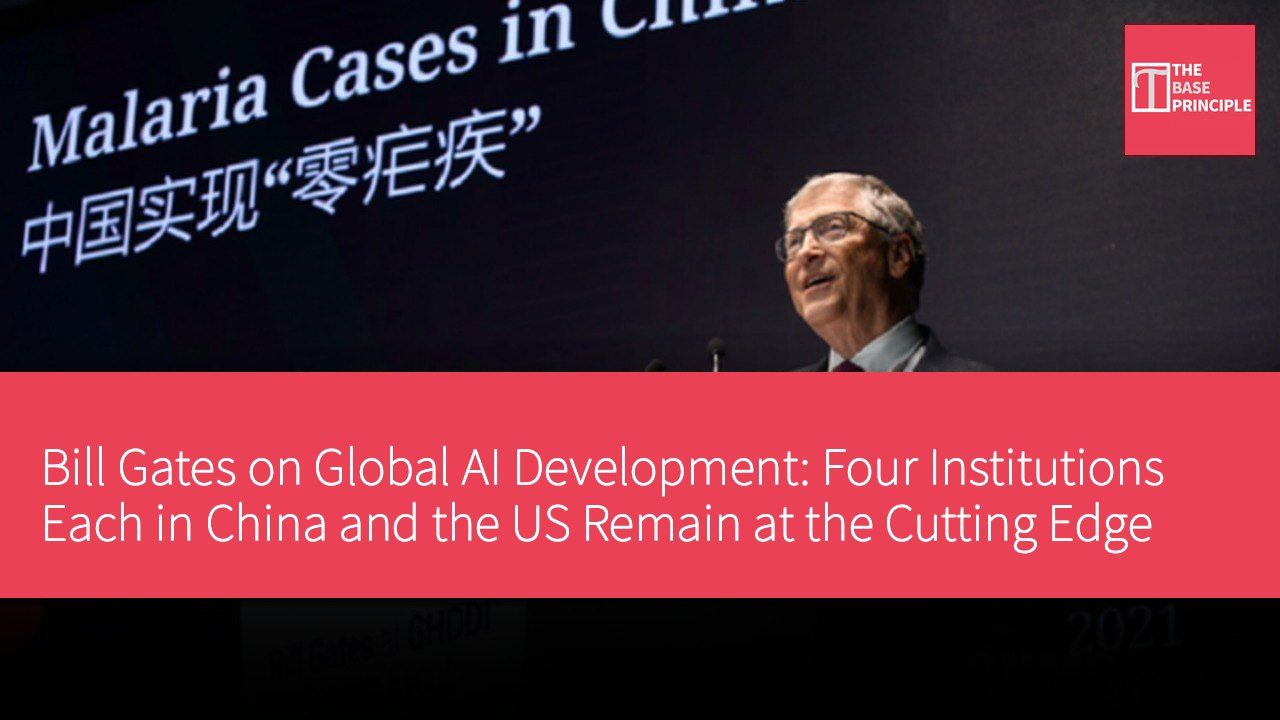
On September 15, according to Sina Technology, the Gates Foundation announced it will invest US$1 billion over the next two years to bring artificial intelligence technology to the world's poorest communities. Ahead of the announcement, foundation chair Bill Gates spoke with Sina Technology, sharing his views on the global development of artificial intelligence, computing power distribution, environmental impact and labor market disruption.
Bill Gates first offered his assessment of China's large models, calling their performance "very impressive." He noted that, depending on the benchmark, four or more institutions in China and the US each have models that remain at the most advanced level, and that the gap between the highest-scoring model and the next seven leading models is small. He projected that the capabilities of frontier models from China and the US will more than double within six months. Gates argued that AI competition between China and the US is "good news" for low-income countries such as those in Africa, as it will give them more options that deliver solid performance at lower cost.
The Gates Foundation to Invest US$1 Billion to Advance AI Technology
On computing power distribution, Gates suggested that some technologically leading countries should set aside 5% of their data center compute and provide it free of charge as "digital aid" to poorer countries for use in healthcare, agriculture and education. He said the world should draw a baseline to ensure that everyone can access a minimum level of AI services.
Addressing concerns about the energy and environmental impact of AI, Gates acknowledged that many US data centers run on natural gas, adding 3% to 4% to carbon emissions. He nonetheless struck an optimistic tone about long-term climate effects, arguing that AI's contributions outweigh its negative impacts, and noted that most newly built data centers use closed-loop water cooling designs, meaning concerns about water resources can essentially be resolved.
On labor market disruption, Gates predicted that humans will go through roughly 20 years of turbulent transition. He proposed designating roles that require a human touch, such as personal caregiving, as "exclusively human," and floated levying a "token tax" to subsidize ordinary workers who lose their jobs because of AI. He also offered his take on China's humanoid robot games, calling them "very interesting and very well organized," and pointed out that hand dexterity remains the toughest current challenge, urging society to consider how to properly look after manual workers who are affected.
According to the report, the Gates Foundation plans to spend down its US$200 billion endowment and shut its doors by 2045.