
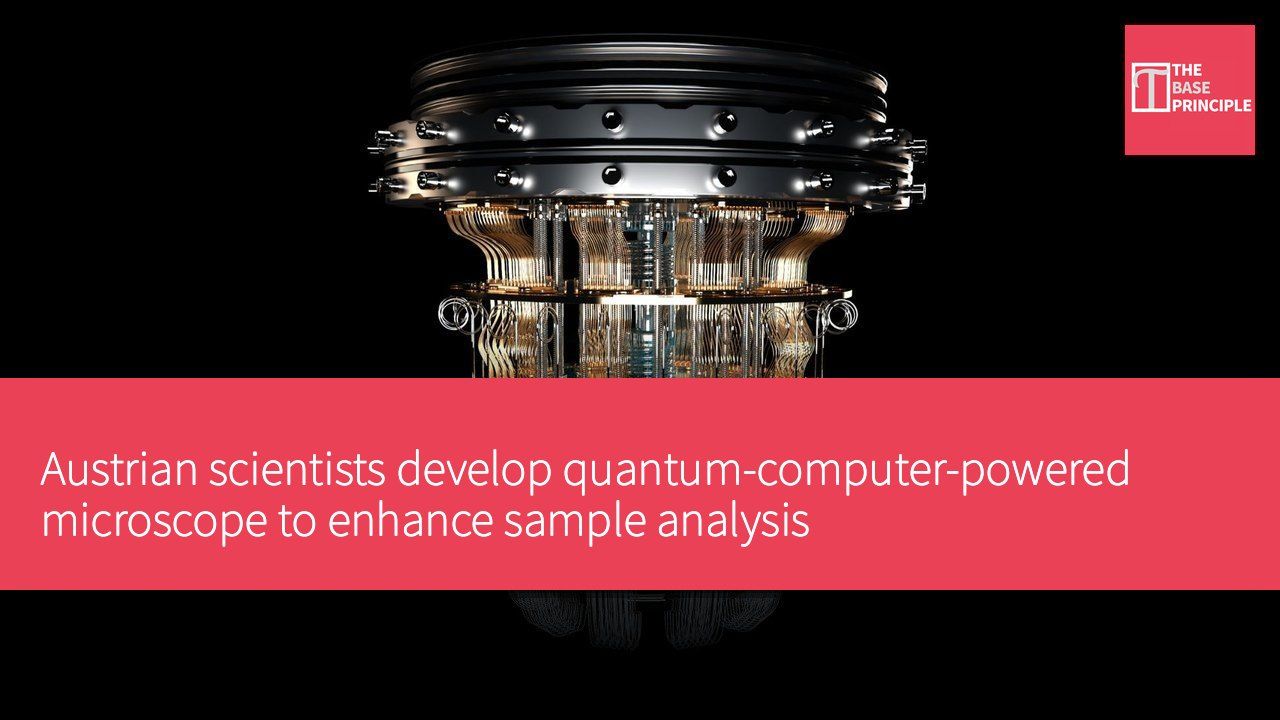
- Scientists have developed a quantum-computer-powered microscope to enhance sample analysis capabilities.
- Quantum entanglement can extract more information than conventional microscopes.
- Electron microscopes face limitations when observing tiny objects, especially biological samples.
- Researchers are integrating electron microscopes with quantum computers to validate their approach.
Scientists from TU Wien, the University of Vienna, Johannes Kepler University Linz, and the University of Innsbruck have teamed up to develop a microscope that uses a quantum computer to extract information from samples under analysis. The researchers plan to harness quantum entanglement to obtain more information than conventional electron microscopes can provide. Ever since Dutch spectacle-makers Hans and Zacharias Janssen placed multiple lenses inside a tube in 1590, creating the first microscope, German scientists Ernst Ruska and Max Knoll built the first electron microscope. These devices operate on the same principle but differ in the materials used to create images.
In a conventional microscope, light passes through lenses to produce a magnified image of a tiny object. While this approach works for most objects on Earth, it is ineffective for objects smaller than the wavelength of light.
Ruska and Knoll turned instead to electron beams, the smallest particles in atoms, which can observe objects 100,000 times smaller than the wavelength of light. Electron microscopes are widely used across many research fields. "Today we can see tiny details at the atomic scale," said Philipp Haslinger, associate professor at TU Wien's Institute of Atomic and Subatomic Physics. "However, this requires a large number of electrons, and not every sample can withstand that many electrons without being damaged. This frequently becomes a problem when imaging biological samples, especially individual proteins."
Limitations of electron microscopes
To address this problem, the researchers propose extracting more information from each electron used for imaging, which would also help reduce the total number of electrons needed to produce an image.
The research team suggests using quantum entanglement to achieve this goal. This would require connecting an electron microscope to a quantum computer that uses trapped ions. "The idea is to combine electrons with a quantum computer," explained Elias Pescoller, a doctoral student at TU Wien's Institute of Theoretical Physics and Institute of Atomic and Subatomic Physics involved in the work. "We have them interact with ions stationed along the electron beam's path." Doing so would entangle electrons passing through the microscope with ions in the quantum computer, and store the information from the electrons in the trapped ions through quantum entanglement.
Each electron passing through the sample can be entangled with the quantum computer, and appropriate quantum operations can then be used to extract information from the trapped ions. "We can optimally combine the information from multiple electrons so that we obtain a signal with maximum intensity even with a relatively small number of electrons," added Denis Rätzel, a theoretical physicist at TU Wien, in a press release.
Progress on integrating quantum computers
Researchers at Johannes Kepler University Linz helped develop the algorithms needed to achieve this goal. To date, the researchers have only mathematically demonstrated that this approach offers several advantages. They are now working to integrate the electron microscope with a trapped-ion quantum computer to experimentally verify these mathematical calculations. The mathematical calculations have been shared on the preprint server arXiv.
Item Specification Processor Quantum computer Technology Quantum entanglement
How quantum technology could transform microscope applications
The introduction of quantum computers opens up new possibilities for microscope technology, particularly when analyzing tiny biological samples. While conventional electron microscopes can observe details at the atomic scale, the risk of damaging samples limits their applications. By using quantum entanglement, the researchers hope to reduce the number of electrons required while improving the quality of the information obtained. This could not only enhance existing microscope technology but may also drive advances in fields such as biomedical and materials science, demonstrating the potential of quantum technologies in experimental science.