
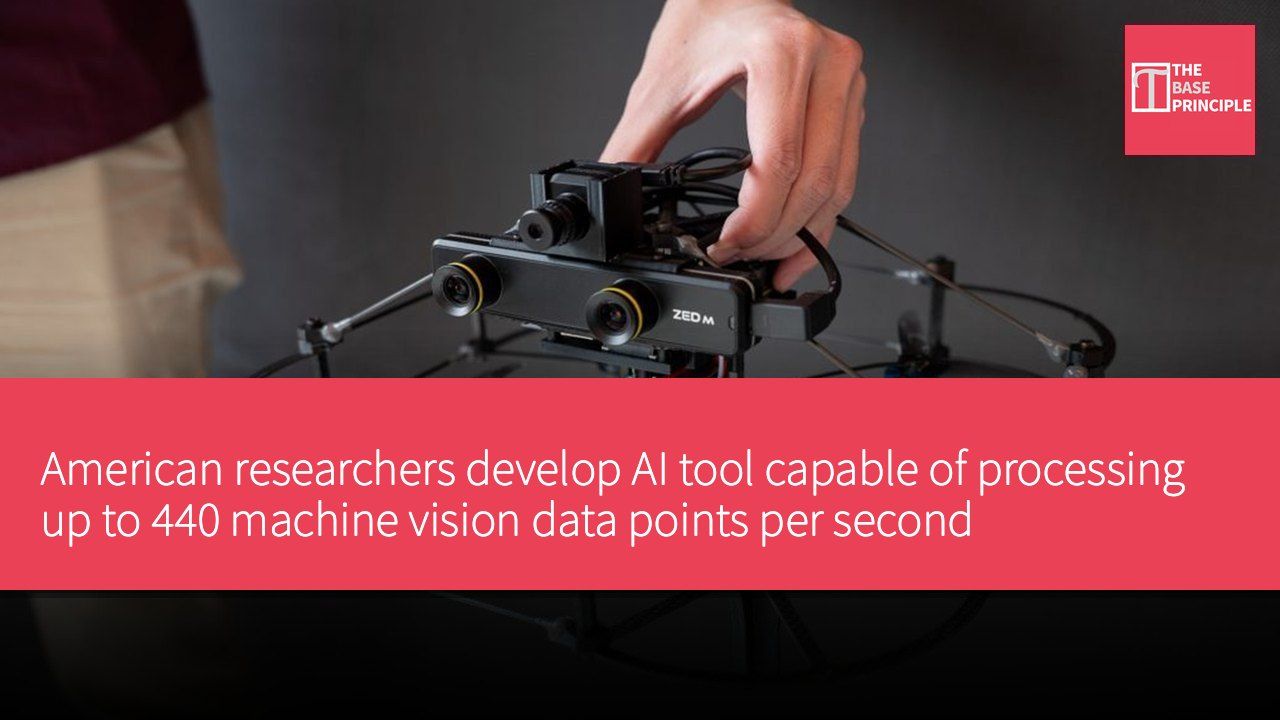
- The F³ system can process up to 440 machine vision data points per second.
- This technology helps robots identify objects and track motion more efficiently.
- Researchers developed a neural network to recognize patterns in event camera data.
- F³ makes event cameras more practical for automated systems, simplifying their use.
American researchers have developed an artificial intelligence tool capable of processing machine vision data at speeds of up to 440 times per second, potentially enabling drones, autonomous vehicles, and other robots to respond more quickly to their surroundings. This system, developed by engineers at the University of Pennsylvania, is called Fast Feature Field (F³) and processes information from event cameras, which operate by detecting changes in light rather than capturing traditional images. In tests, the speed of algorithms using F³ was approximately two to five times faster than previous methods.
The system processes high-definition event camera data at a rate of 120 frames per second, while achieving 440 frames per second at lower VGA resolution. Researchers state that this technology can help robots more efficiently identify objects, estimate distances, and track motion, particularly in low-light conditions.
How the F³ System Works
Unlike traditional cameras that capture complete images at fixed time intervals, event cameras continuously monitor changes in light intensity at individual pixels. This allows them to capture fast motion without recording complete frames. However, interpreting their output remains challenging, as these cameras generate millions of signals rather than recognizable images. Existing methods typically require specialized algorithms for different tasks, limiting their widespread application in robotics. Researchers at the University of Pennsylvania addressed this issue by developing a neural network that learns to identify useful patterns in event camera data.
The research team did not program separate algorithms for object recognition, motion tracking, or distance estimation; instead, they trained F³ to predict future events based on prior signals.
Richeek Das, the lead author of the paper, stated, "To accurately predict future events based on past events, the network must learn to represent the structure of the scene and the motion occurring within it." This approach enables the system to extract information about the scene and its motion without requiring different processing methods for each application. The researchers also found a way to reduce unnecessary computations. Although event cameras can generate millions of signals per second, about 95% of the data locations do not contain events. By processing only the locations where changes occur, F³ avoids wasting computational resources on blank areas.
This optimization helps researchers achieve the processing speed required for real-time robotic perception.
Future Applications and Integration
The team evaluated F³ using event camera data collected from cars, quadrupedal robots, and flying drones. Tests included object recognition, distance estimation, and motion tracking, with environments ranging from nighttime city streets to crowded indoor spaces. According to the researchers, the F³-based approach achieved state-of-the-art performance across multiple perception tasks, with running speeds significantly higher than earlier methods. The system also allows existing computer vision software to adapt to event camera data, potentially reducing the need for specialized algorithms for various applications. Researchers are currently integrating F³ into autonomous drones designed for navigating cluttered and low-light environments.
They ultimately hope to integrate this technology directly into event camera hardware, allowing raw signals to be converted into usable visual information without additional processing software.
Pratik Chaudhari, an associate professor at the University of Pennsylvania, stated, "Our goal is to make using event cameras as simple as using traditional cameras." Researchers believe this approach can make event cameras more practical for automated systems that must interpret rapidly changing environments. The findings have been published in the journal Science Robotics.
Item Specification Processing Speed 440 times per second Resolution VGA
Impact of the F³ System on Machine Vision Technology
The development of the F³ system marks a significant advancement in machine vision technology, particularly in the fields of autonomous driving and robotics. With its efficient data processing capabilities, the system can provide reliable perception in low-light environments, which is crucial for autonomous drones and other robots. The researchers' innovative approach not only enhances the speed of data processing but also reduces the need for specialized algorithms, which will help accelerate the adoption and application of related technologies. As F³ is integrated into event camera hardware in the future, this technology may further simplify the usage process and enhance the practicality of machine vision.