
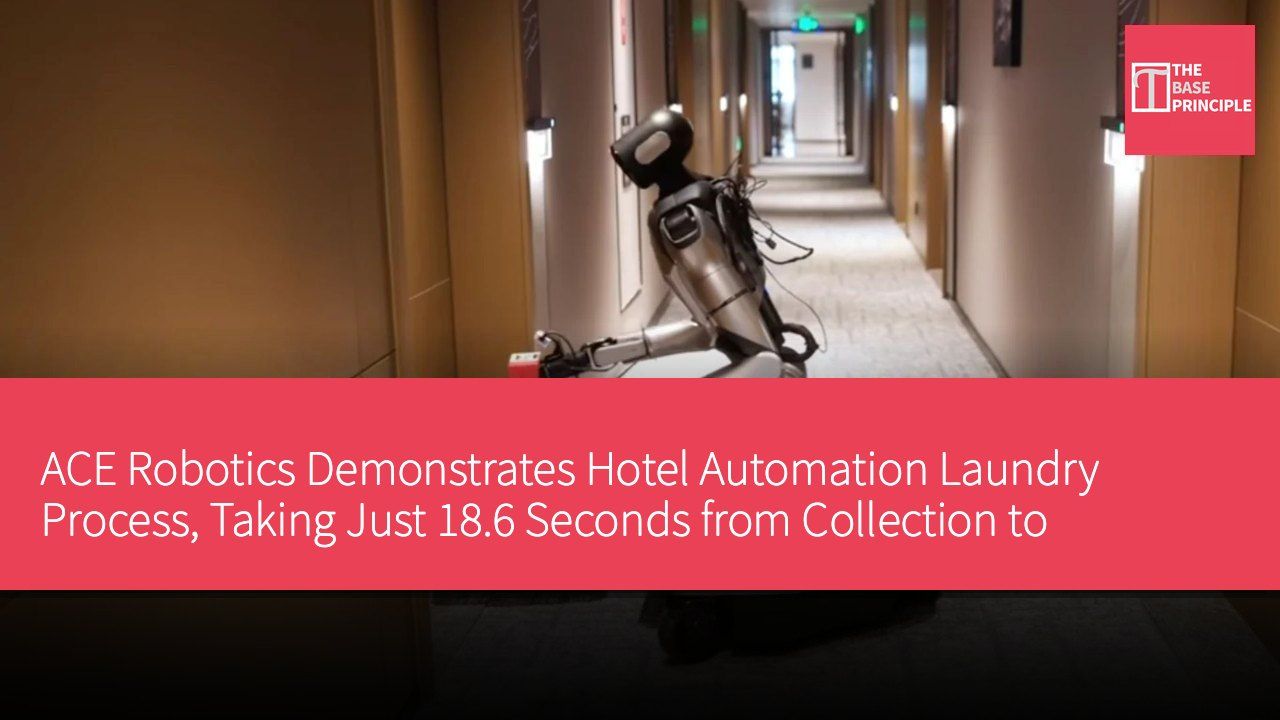
- ACE Robotics demonstrated an automated hotel laundry process, taking just 18.6 seconds from collection to delivery.
- The Mundo system enhances robotic learning capabilities through interactive digital twins that simulate environmental characteristics.
- The dual-model architecture separates planning from execution, reducing laundry operation time to 18.648 seconds.
- The system features a feedback loop that autonomously improves robot skills and action strategies.
China's ACE Robotics showcased a hotel laundry workflow that combines robotic skills with cloud planning through its Mundo world model, achieving an automated process from collection to delivery. The system enables robots to collect laundry baskets from guest rooms, transport them to the laundry room, operate washing machines and dryers, and return clean clothes. Mundo creates interactive digital twins of the hotel environment from photographs, allowing robots to simulate tasks and learn object behaviors before actual operation. According to the company, the self-improving skill system refines performance using feedback from real-world failures, shortening the entire laundry workflow to 18.6 seconds.
The Mundo system allows robots to collect laundry baskets from guest rooms, transport them to the laundry room, operate washing machines and dryers, and return clean clothes. This demonstration marks the first long-chain commercial application of the technology since ACE Robotics launched the Mundo world model in collaboration with Nanyang Technological University's S-Lab last month. At the core of the system is Mundo, which transforms photographs of hotel rooms, corridors, and laundry facilities into interactive digital twins. Unlike traditional visual simulations, these environments incorporate physical characteristics such as object mass and friction, enabling robots to learn how objects respond to contact and movement.
How the Mundo System Works
Each simulation generates data on robot trajectories, contact states, and visual feedback, which help refine action strategies before the robot attempts to perform the same tasks in a real hotel environment.
ACE Robotics employs a dual-model architecture that separates complex planning from real-time execution. A general cloud model, GPT-Astra, determined by QbitAI, handles task decomposition, reasoning, and strategy exploration. Once the system identifies a feasible approach, it stores the procedure as reusable robot skills. Another model running locally on the robot retrieves and executes these skills to perform individual actions. This separation aims to avoid delays caused by reliance on cloud computing. ACE Robotics states that its cloud-based approach takes over 30 minutes to complete a full laundry run, while the local execution model reduces the time to 18.648 seconds.
Scheduling System and Workflow
A scheduling system called BotAgent coordinates the workflow, dividing laundry operations into 53 atomic actions and 14 high-level semantic steps. It can schedule over 200 possible action sequences based on room location, elevator availability, and laundry machine queue status.
The system also includes a feedback loop designed to improve robot skills through repeated real-world attempts. When an operation fails, the cloud model reviews multiple camera recordings and sensor logs to identify the issue. It can then suggest changes to the robot's actions or select alternative camera angles to overcome visibility problems. For example, when the camera mounted on the robot's arm is obstructed, the system switches to an overhead camera. In another instance, when jeans get stuck in the dryer drum, it modifies the lifting trajectory of the gripper and the angle of the fingertips. The robot can also autonomously reset the environment between attempts.
Another model evaluates each round of operations, allowing the system to retain better-performing versions of skills and roll back ineffective changes. In the case of unloading the dryer alone, ACE Robotics reported conducting 165 real robot trials over 57 hours, resulting in 37 improvement suggestions and approximately 80 skill versions. The company stated that the unloading cycle ultimately stabilized between 170 and 210 seconds, with the average proportion of jeans remaining in the dryer dropping from 48% to 32%, and the best-performing run achieving 19%.
ACE Robotics has also identified instant retail as another potential application for the technology. However, the reported performance data comes from the company and has not been independently verified.
Significance of ACE Robotics' Automation Technology
ACE Robotics' laundry automation system demonstrates the potential applications of robotic technology in the hotel industry. Through the Mundo system, robots can learn and adapt in complex environments, enhancing efficiency while reducing labor costs. The design of the dual-model architecture allows the system to be more flexible in task execution, avoiding delays associated with cloud computing. Additionally, the introduction of the feedback loop enables robots to continuously self-improve, which is crucial for enhancing service quality and addressing real-world challenges.