
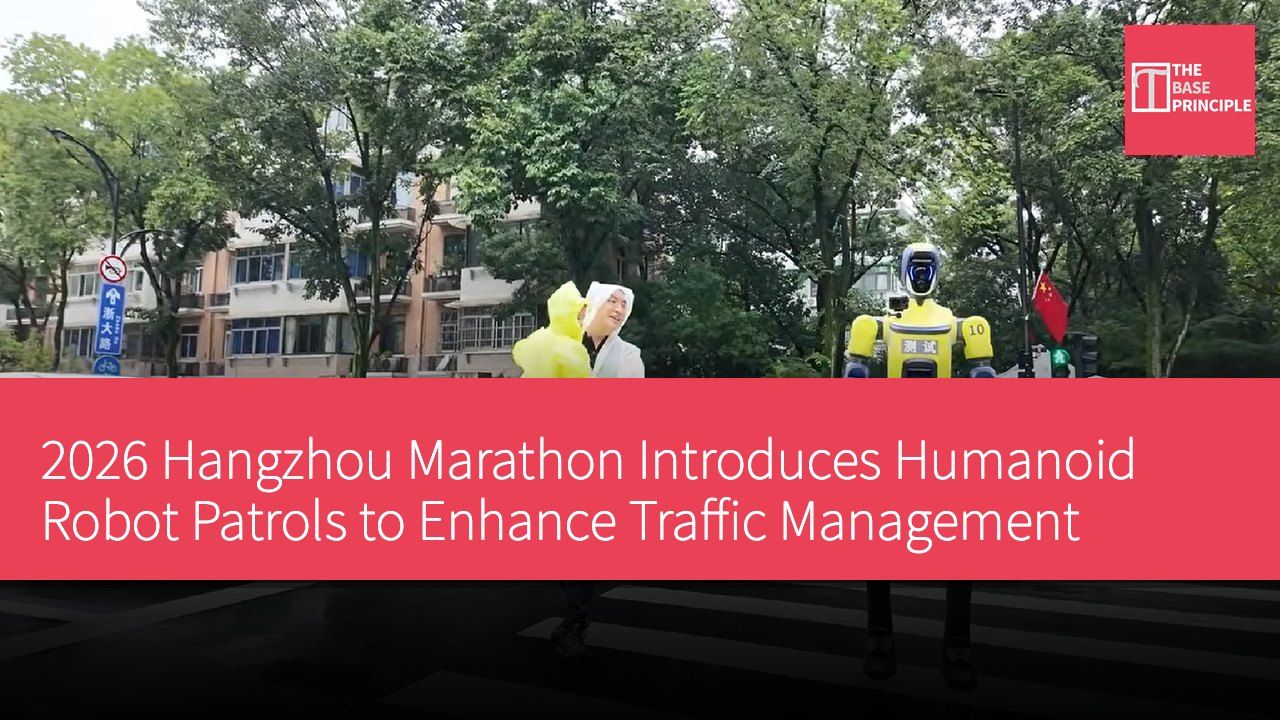
- The 2026 Hangzhou Marathon introduces humanoid robots for traffic management.
- The robots can patrol autonomously and monitor traffic violations.
- This deployment explores the application of humanoid robots at large events.
- Researchers note that robots enhance human capabilities rather than replace workers.
During the 2026 Hangzhou Marathon, a humanoid robot serving as a traffic officer joined the patrol team, responsible for monitoring intersections and guiding pedestrians around the Huanglong Sports Center in Zhejiang Province, eastern China. The robot, named "Navigation No. 2," was developed by DEEP Robotics in Hangzhou and collaborated with local traffic authorities to form a four-point patrol unit. Its tasks include intersection monitoring, autonomous patrolling, issuing traffic violation warnings, and answering public inquiries, the company stated. This is one of the most notable traffic management measures in this year's event.
"Navigation No. 2" is based on DEEP Robotics' DR02 humanoid robot, standing 178 cm (approximately 5 feet 10 inches) tall. The robot has an IP66 rating, meaning it is dustproof and can withstand heavy rain and high-pressure water jets, operating in temperatures ranging from -20 to 55 degrees Celsius (-4 to 131 degrees Fahrenheit). Its onboard 275 TOPS computing unit, combined with LiDAR, depth cameras, and wide-angle cameras, enables it to observe its surroundings.
Robot Functions and Technical Specifications
This marathon attracted over 300,000 registrants, with 36,000 runners participating. The crowds and dynamic environment around the venue put pressure on traditional security systems, which the organizers stated could not cover every blind spot at all times. The robot aims to transform fixed monitoring points into mobile patrol units, moving along predetermined routes between guard posts. It can also detect pedestrian jaywalking and vehicles cutting in line, utilizing multi-sensor perception and precise motion control. It can perform standard traffic directing gestures and automatically broadcast safety recommendations, which the company said helps police manage pedestrian flow and reduces the burden of repetitive tasks on frontline officers.
Exploring Applications of Humanoid Robots
Meng Yuan, a representative from DEEP Robotics, stated, "Marathon security is time-sensitive, with crowded crowds and highly repetitive tasks, making it a good scenario for the initial implementation of robots." He noted that this deployment also explores a standardized model for using humanoid robots in large marathons.
This is not the first use of humanoid robots. In April, a "specific intelligence" robot directed participants at the Beijing Yizhuang Half Marathon. In October, Unitree Robotics released its H2-X humanoid robot named "Kung Fu Legend Guardian." The company stated that in the future, it could play roles in security and rescue, such as protecting personnel from attacks, lifting the front end of vehicles with its hands, or responding to simulated traffic accidents.
Wang Peng, a researcher at the Beijing Academy of Social Sciences, noted that security, inspection, logistics, and home services appear to be early application areas for commercial humanoid robots. He mentioned that the value of robots lies in enhancing human capabilities rather than replacing workers, and large events are good testing grounds due to the dense crowds and clear tasks. He pointed out that the shift from factories to marathon courses marks a move from technology demonstration to practical application. Currently, the company's performance statement has not specified how many violations the robot has marked or the extent of human officers' supervision over it.
How Humanoid Robots are Changing Security at Large Events
As participation in large events increases, traditional security systems face challenges in covering all blind spots comprehensively. The introduction of humanoid robots not only enhances monitoring efficiency but also alleviates the workload of human officers. This innovation is not just a showcase of technology but an exploration of future security models, demonstrating the potential of robots in the field of public safety. With advancements in technology, humanoid robots may play significant roles in more scenarios, further driving transformation in the security industry.