
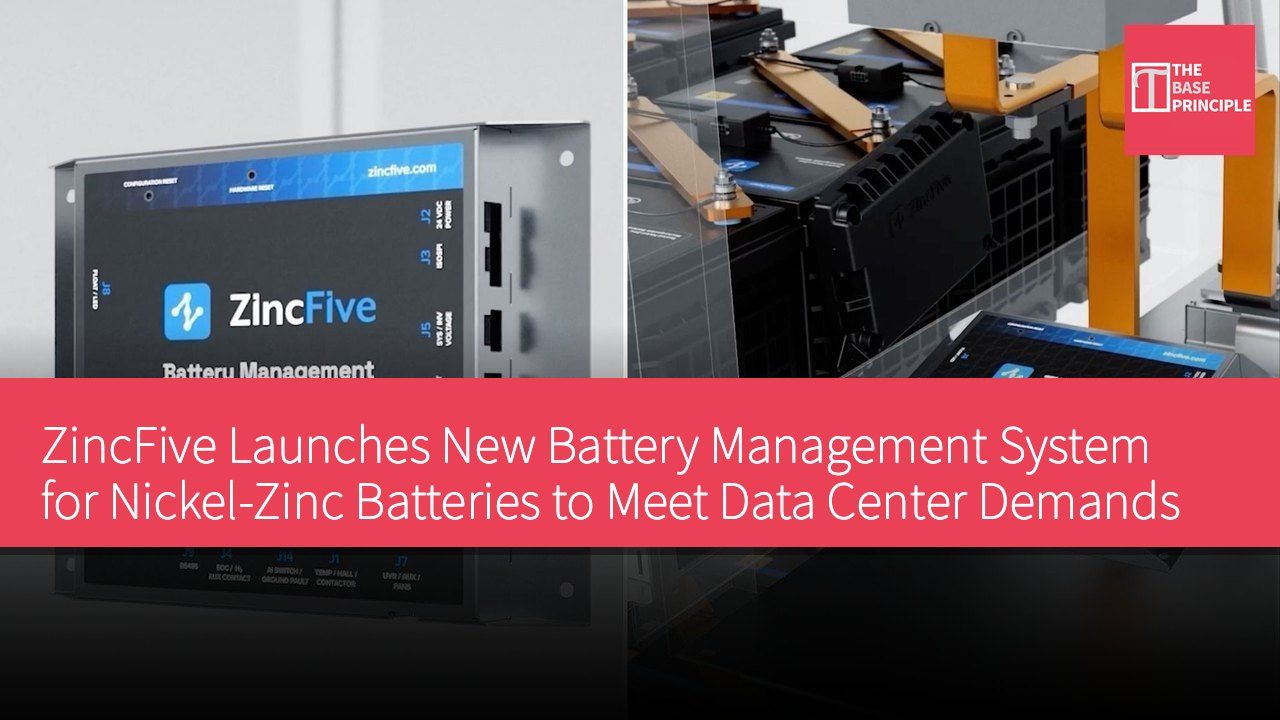
- ZincFive introduces a new BMS specifically designed for nickel-zinc batteries to meet data center demands.
- The new BMS features a dual-layer hardware architecture, reducing installation time and costs.
- The system can integrate with building management systems, providing state-of-charge and alert information.
- Cybersecurity design includes encryption and authentication to meet operational technology security requirements.
ZincFive has launched a new Battery Management System (BMS) specifically designed for its nickel-zinc (NiZn) batteries to address the growing power demands of data centers due to artificial intelligence workloads. The company stated that the new ZincFive BMS is designed and assembled in the United States and will be shipped as standard with its BC Series battery cabinets. This system serves as the primary interface for data center operators, uninterruptible power supply (UPS) original equipment manufacturers (OEMs), and system integrators to monitor and manage the battery system.
Unlike battery management platforms adapted for lithium-ion or lead-acid systems, ZincFive stated that its BMS is built around the chemistry of nickel-zinc and draws on years of deployment experience in data center environments.
New System Architecture and Advantages
The new system employs a dual-layer hardware architecture, including the ZincFive Controller and the ZincFive Tray Monitor. The tray monitor uses the isoSPI protocol to measure each battery's voltage and temperature, while the cabinet connects via dual Ethernet ports. According to ZincFive, this eliminates the need for unmanaged third-party network switches and additional data aggregation layers. The company claims this approach reduces cabinet wiring, installation time, infrastructure complexity, and hardware costs while providing high-resolution telemetry across the entire battery cabinet.
The BMS can also integrate with the data center's building management systems, providing operators with information including state-of-charge, voltage, time-series data, alerts, and advisories.
For multi-site deployments, the redesigned interface offers overall visibility and user and permission hierarchies. Operators can also remotely configure the system and deploy firmware updates. One notable feature is AI Pulse Intelligence, enabled through the ZincFive BMS in the company's BC 2 AI UPS battery cabinets. ZincFive states that this feature allows the system to respond to high-frequency power pulses associated with AI training and inference workloads. AI data centers pose new challenges to power infrastructure as increasingly dense computing systems demand more from uninterruptible power supplies and backup power systems.
These systems not only need to provide stored energy during prolonged power outages but must also manage rapid changes in power demand. The company states that its BMS design aims to provide the necessary monitoring and control to handle these varying power configurations.
Emphasis on Cybersecurity
ZincFive also emphasized cybersecurity as part of the new BMS architecture. The system integrates encryption, authentication, hardened communications, and access controls, which the company claims are designed to help meet increasingly stringent operational technology security requirements. Since the hardware, software, and firmware are all developed by ZincFive, the company states that it can manage upgrades and customer-requested improvements without relying on third-party vendors. The BMS is also assembled in the United States, and the company states that its hardware, software, and firmware are entirely developed at its U.S. headquarters.
ZincFive CEO Tod Higinbotham said that the platform reflects the company's experience in deploying nickel-zinc batteries at scale and gives it greater control over how the system evolves with changing customer needs. ZincFive stated that it has delivered or contracted over 2 gigawatts of nickel-zinc power globally. The new BMS will be provided with its BC Series UPS battery cabinets, expanding the company's existing NiZn battery platform and specifically designing a management system for this chemistry.
The company positions nickel-zinc as a safer and more sustainable alternative for mission-critical real-time power applications, although this announcement primarily focused on BMS architecture, monitoring, cybersecurity, and AI-related power management rather than providing comparative performance data with competing battery chemistries.
Item Specifications Battery Capacity Not Provided Connectivity Dual Ethernet Ports
Market Potential of Nickel-Zinc Battery Management Systems
As the demand for artificial intelligence and data centers increases, ZincFive's new Battery Management System (BMS) designed for nickel-zinc batteries becomes particularly significant. The system not only effectively addresses the rapid changes in power demand but also provides high-resolution telemetry, which is crucial for modern data centers. Additionally, the enhanced cybersecurity design ensures that the system can better protect operators' data and resources in the face of increasingly stringent security requirements. These features make ZincFive's BMS competitive in the market, especially in the context of pursuing sustainable and secure power solutions.