
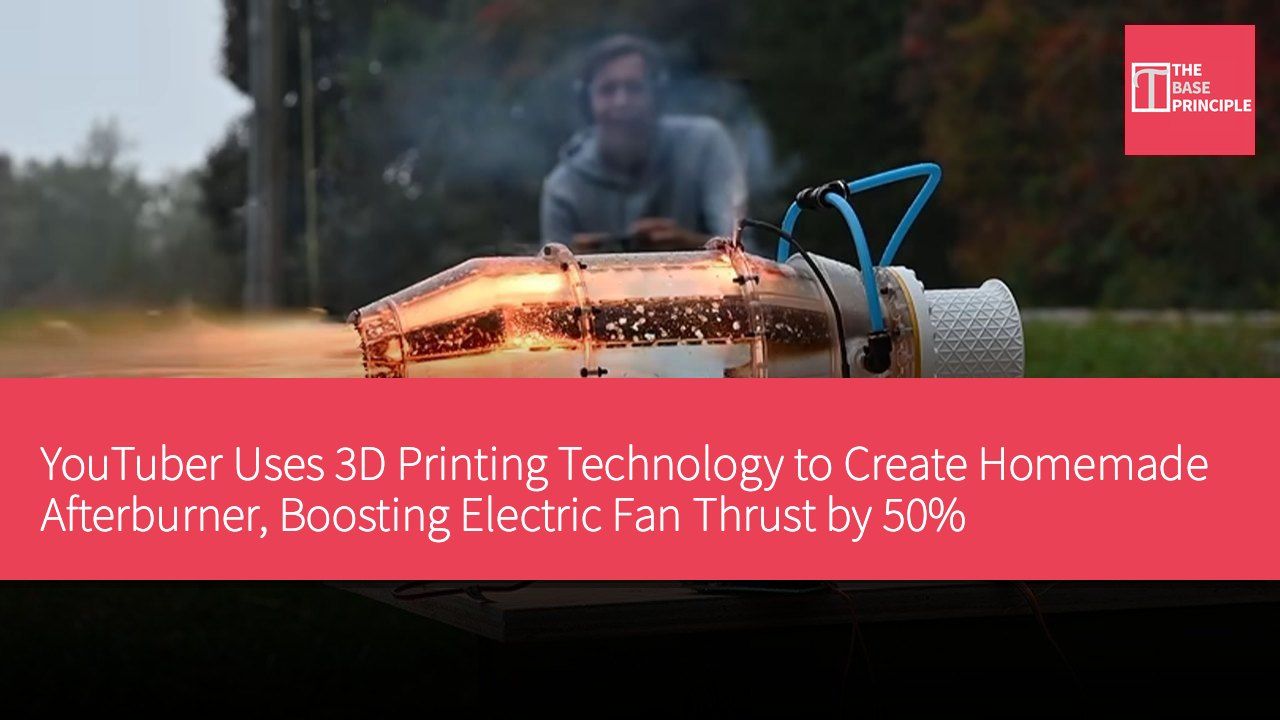
- YouTuber utilizes 3D printing technology to create an afterburner, enhancing electric fan thrust.
- The afterburner injects propane to heat the air, with a sound theoretical basis for increasing thrust.
- Tests show thrust increased from 2 pounds (9 N) to 3 pounds (13.3 N), a 50% increase.
- Rechtin plans to release an upgraded design made from metal.
A YouTuber has created a functional homemade afterburner primarily made from 3D-printed parts. He essentially uses an electric ducted fan (EDF) to inject propane into the exhaust, generating additional thrust. For those unfamiliar, an EDF is essentially a high-speed electric fan installed within a duct. These devices are typically used to simulate jet engines in aircraft. Unlike traditional jet engines, EDFs do not burn fuel; instead, they are powered by an electric motor that drives the fan to accelerate air backward, producing thrust. In his latest project, YouTuber Michael Rechtin decided to add a combustion chamber to the back.
The process is theoretically quite simple.
How the Afterburner Works
The 3D-printed afterburner should be able to accelerate air through the duct as usual. After that, propane can be injected into the flowing air downstream of the fan. A certain ignition source will ignite the propane, which will heat the air dramatically, expanding its volume and expelling hot gases at a higher velocity than normal. Theoretically, this acts like an afterburner and should increase the thrust generated by the "engine." The physics makes sense, but for it to be viable, the "cost" of the fuel must generate enough additional thrust to make it worthwhile.
The fundamental principle of jet engines and propulsion is momentum. The faster you expel a given mass of air backward, the more forward thrust you can generate. When propane burns, it adds thermal energy to the airflow. If the duct and nozzle can convert enough energy into additional exhaust velocity, thrust will increase. However, merely heating the air does not automatically mean there will be more thrust. The added combustion chamber may introduce pressure losses, turbulence, and drag that could offset the gains. In a "real" afterburner, jet engines or turbojet engines significantly compress the air before combustion.
When the air reaches the afterburner, it still has enough pressure to accelerate.
In contrast, EDFs compress very little of the incoming air. This creates two problems. The first is combustion stability; the airflow may extinguish the flame, especially if the fuel mixture is uneven. The second is that without sufficient pressure (and the right nozzle), much of the additional heat may be expelled without increasing thrust. Therefore, simply adding a combustion chamber behind the fan does not automatically make it an afterburner.
Experimental Results and Future Plans
So, does it work? According to his video, the thrust from the fan alone is 2 pounds (9 N). With the afterburner activated, this figure jumps to 3 pounds (13.3 N). That's a 50% increase! After testing, the 3D-printed parts showed significant scorching but appeared to withstand the temperatures generated by combustion. Since the components are primarily made of plastic, prolonged use could theoretically lead to permanent damage, especially considering that most 3D-printed plastics soften at temperatures far below the combustion point of propane. Rechtin is aware of this, and his design incorporates clever geometries to at least improve its chances of surviving the experiment.
Nevertheless, since it is 3D printed, producing replacements is not the biggest concern for this YouTuber. As a result, Rechtin plans to release an upgraded design made from metal rather than 3D-printed plastic.
Potential Applications of 3D Printing Technology in Propulsion Systems
This project showcases the potential applications of 3D printing technology in innovative propulsion systems. Through the homemade afterburner, the YouTuber not only enhanced the thrust of the electric fan but also explored the possibilities of improvements based on existing technology. Despite facing challenges related to material heat resistance and combustion stability, this innovation demonstrates how DIY projects can push the boundaries of engineering by leveraging new technologies. With the design upgrades, similar technological advancements may be seen in broader applications in the future.