
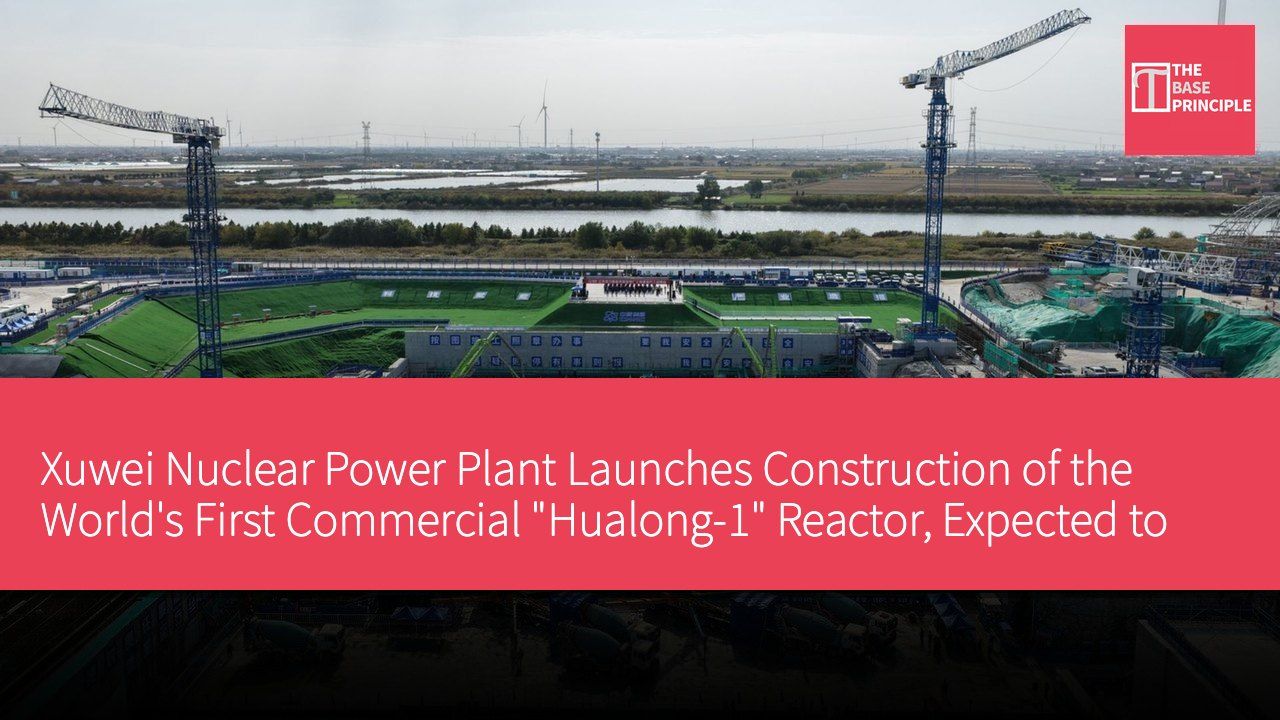
- Xuwei Nuclear Power Plant has initiated the construction of the world's first commercial "Hualong-1" reactor.
- The project will reduce the use of 7.26 million tons of standard coal and prevent the emission of 19.6 million tons of carbon dioxide.
- The plant will operate both "Hualong-1" and "Hualong-1" reactor technologies simultaneously.
- The Hualong-1 reactor emphasizes passive safety, maintaining safe operation during faults.
Located in Jiangsu Province, the Xuwei Nuclear Power Plant has begun pouring the first batch of concrete for the nuclear island, marking the official start of construction for the world's first commercial "Hualong-1" reactor. This project sets a precedent for using nuclear energy to drive large-scale chemical manufacturing. Unlike traditional nuclear power plants, which are almost exclusively built for the grid, the Xuwei complex will primarily serve as an industrial steam supplier, directly providing heat to nearby petrochemical refineries while sending excess electricity to the regional grid. Once fully operational, it is expected to provide 32.5 million tons of industrial steam annually and generate over 11.5 billion kWh of electricity.
In place of fossil fuels, this will reduce the use of 7.26 million tons of standard coal each year. According to official estimates, this will prevent nearly 19.6 million tons of carbon dioxide emissions.
Reducing Fossil Fuel Use
The plant achieves this output through an unconventional hybrid design. It will be equipped with two different nuclear technologies at the same site: the "Hualong-1" pressurized water reactor and the "Hualong-1" high-temperature gas-cooled reactor. The system employs a coordinated control architecture, operating in sequence to produce steam with precise thermodynamic characteristics. The main steam from the third-generation Hualong-1 reactor first converts deionized water into saturated steam, which is then superheated by the fourth-generation Hualong-1 reactor to generate three types of high-temperature steam for petrochemical refining. To safely manage this dual operation, the plant will use a unified "Reactor-Machine-Heat" coordinated control architecture.
This marks the first time commercial facilities will operate two types of reactors under a single integrated thermal supply framework.
Design Emphasizing Passive Safety
The Hualong-1 reactor was jointly developed by China National Nuclear Corporation (CNNC) and Tsinghua University, relying on principles of fourth-generation nuclear energy that emphasize passive safety. The reactor design can maintain safety during severe system failures without the need for active operator intervention or external power supply. Even in the complete loss of coolant, the core's physical characteristics can prevent meltdown and block the release of significant amounts of radioactive material. The reactor features a modular layout, with individual units generating relatively moderate power, but engineers can connect multiple modules based on regional energy demands.
In addition to supplying thermal energy for industrial processes, the high temperatures generated by the core make this reactor highly suitable for large-scale hydrogen production and efficient electricity generation. China Nuclear Power Investment Company, a subsidiary of CNNC, is responsible for managing the Xuwei site. The initial phase includes two Hualong-1 reactors and one Hualong-1 unit. Construction of the first Hualong-1 reactor began on January 16. "This opens a new chapter in providing a replicable and scalable 'Chinese solution,' injecting strong momentum into the low-carbon transformation of global energy-intensive industries and contributing to achieving global carbon peak and carbon neutrality goals,"
the Global Times reported at the time. Once completed, the plant will serve as a permanent low-carbon thermal and power support for the Lianyungang petrochemical industrial base.
Innovative Significance of the Dual Reactor System
The construction of the Xuwei Nuclear Power Plant marks a significant advancement in nuclear technology, particularly in integrating different types of reactors within the same facility. This not only enhances the flexibility and efficiency of energy production but also provides new solutions for industrial steam supply, demonstrating the potential of nuclear energy in reducing carbon emissions. As global demand for low-carbon energy increases, this innovation may serve as a reference model for other countries and regions in promoting low-carbon transitions, further advancing the development and application of nuclear energy.