
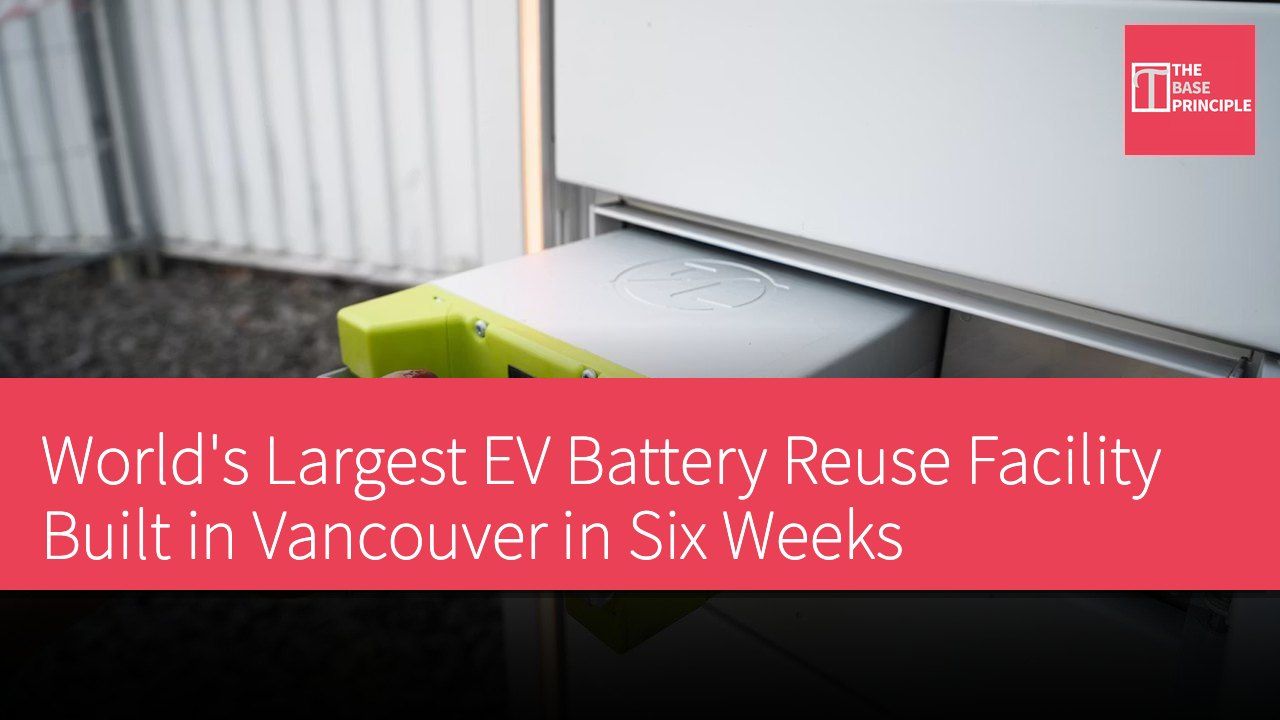
The rise of electric vehicles is bringing a new challenge that is only now beginning to emerge. In the coming years, as battery performance gradually degrades, more and more batteries will be removed from electric vehicles. While these batteries may no longer provide the driving range that owners expect, many still retain a significant portion of their original storage capacity. The question is, how to handle this growing stockpile of used batteries. A major project recently completed in Vancouver, Canada, aims to provide a solution. Just six weeks after its announcement, clean technology company Moment Energy has launched Megafactory 1, touted as the world's largest facility dedicated to giving retired electric vehicle batteries a second life.
Moment Energy's CEO, Edward Chiang, stated, 'This is part of building the infrastructure needed to support the next generation of energy demand.' The facility will convert retired EV batteries into energy storage systems to support the grid, factories, hospitals, and data centers.
Reusing Retired EV Batteries Will Be a Key Solution for Future Energy Storage
The reason retired EV batteries are becoming an opportunity is that the rapid adoption of electric vehicles over the past decade indicates that in the coming years, millions of battery packs will eventually reach the end of their automotive life. For example, according to a 2023 study, 'By 2030, there will be 1 million EV battery packs retired, and by 2040, that number will reach 1.9 million. The International Energy Agency (IEA) estimates that by 2030, there will be 100 to 120 GWh of EV batteries retired, a volume roughly equivalent to current annual battery production.'
Most experts discuss recycling these batteries to recover valuable materials like lithium, nickel, and cobalt. However, some researchers and industry experts increasingly point out that many EV batteries still have a significant amount of usable life left when they leave the road. This is because, typically, batteries in cars must meet demanding performance requirements. Drivers expect long range, fast charging, and reliable operation under various conditions. Once a battery's capacity falls below these expectations, it may be replaced even if it can still store and release a substantial amount of power. This remaining capacity is valuable for stationary energy storage applications.
Stationary energy storage systems, unlike EVs, are installed next to buildings or connected to the grid. Their primary task is to store power when supply is abundant and release it when demand rises. The Moment Energy team states, 'These second-life battery systems represent a scalable, near-term solution to the energy storage shortage.' However, the challenge lies in scale. Each used battery has its unique history. Some have undergone thousands of charge cycles, while others have faced extreme temperatures or high-intensity use.
Therefore, determining which batteries are still safe and suitable for reuse requires extensive testing, sorting, and certification. These complexities have slowed the growth of battery reuse despite years of interest in the concept.
Moment Energy's Megafactory 1 aims to industrialize a process that is still largely limited to small-scale projects. The facility will receive retired EV batteries and put them through a series of inspections and evaluations for reuse, rather than manufacturing new battery cells. The batteries will be tested to determine their health, safety, and remaining capacity. Units that meet performance requirements will be integrated into commercial battery energy storage systems. The facility is designed to handle the entire workflow, from battery reception and assessment to system assembly and deployment. Currently, the facility is the largest battery reuse facility in the world and is one of the few operating under the UL 1974 certification standard.
According to the project plan, this Vancouver location will become the world's largest battery reuse facility, with a capacity expected to reach 1 GWh by 2030 and create more than 100 technical jobs.' Moment Energy's team claims.
Megafactory 1 will also rely on North American supply chains, keeping retired batteries local rather than sending them overseas for processing. The timing of the project is significant. As utilities increase renewable energy projects, the demand for energy storage is rising rapidly, while electricity consumption is also increasing. The expansion of data centers, including those supporting AI applications, is putting additional pressure on electricity infrastructure. As a result, energy storage systems are becoming increasingly important in balancing electricity supply and demand. If projects like Megafactory 1 succeed, they could change the battery industry's view of the end of battery life.
Batteries will no longer move directly from vehicles to recycling facilities but can play different roles in energy systems for years. Reuse helps reduce costs, extend the value of mined and processed materials, and alleviate pressure on the battery supply chain. It may also offer a faster way to deploy energy storage when electricity demand is rising and new battery manufacturing capacity is still under pressure. The Moment Energy team notes, 'This expanded solution leverages existing battery resources to provide the reliable, affordable power that is currently crucial.'
However, significant challenges remain. The industry still needs effective ways to assess battery health, ensure safety, and manage batteries from different manufacturers and models. Economic factors will also determine when reuse makes more sense than immediate recycling. Megafactory 1 will not immediately solve all these problems, but as the number of retired EV batteries begins to rise, it represents the largest attempt yet to turn a potential waste problem into an energy asset. Chiang states, 'The demand for energy storage is accelerating, and the supply of retired EV batteries is increasing.
We have demonstrated that the right technology can re-shore domestic manufacturing in North America in weeks, not decades, creating thousands of jobs and economic prosperity.' Its success or failure may help determine whether battery reuse becomes a niche practice or a major pillar of the future energy storage industry.
Project Specifications Battery Capacity 1 GWh (expected by 2030)