
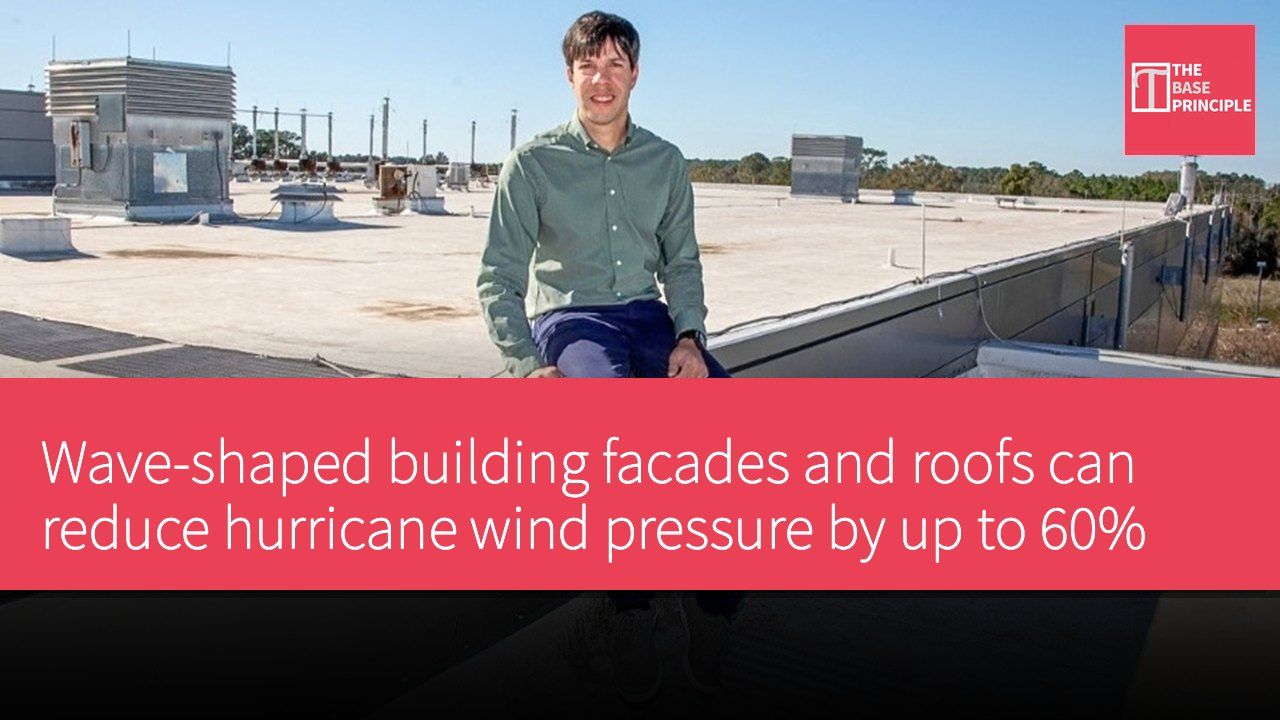
- Wave-shaped facades and roofs can reduce hurricane wind pressure by up to 60%.
- Conventional structures are vulnerable during hurricanes; wave design provides a passive solution.
- Aerodynamic principles have broad applications across multiple engineering fields.
- The research team plans to further optimize the wave geometry design.
Buildings with wave-shaped facades and roofs perform far better than conventional structures in resisting hurricane-force winds, with peak wind pressure reduced by up to 40% to 60%. The finding offers architects and engineers a geometry-based passive method to improve structural resilience without adding more material or reinforcing the building.
How wind damages buildings: When wind strikes a flat structure, it flows across the surface and separates at sharp edges, forming vortices that concentrate intense suction at roof corners and edges. These localized low-pressure zones generate powerful upward forces that lift roof panels. During a hurricane, the highest suction loads on a typical low-rise building occur precisely at these corners and edges. Current mitigation strategies include rounded corners, sloped walls, setback designs, and simply building thicker, stronger walls. All of these approaches add cost and are often ill-suited for retrofitting existing structures.
Research methodology of wave geometry
The wave geometry approach was led by a research team headed by Pedro Fernandez-Caban, an assistant professor of civil engineering at the FAMU-FSU College of Engineering. They 3D-printed wind-tunnel models of low-rise buildings with wave-shaped exterior roofs and walls, replacing conventional flat designs. They tested designs with wave amplitudes ranging from 5% to 10% of building height and compared them with standard flat designs. Researchers measured wind pressure data on the model surfaces as wind blew from multiple directions. The model with the greatest wave depth performed best.
When wave amplitude reached 10% of building height, peak wind pressure near roof and wall corners dropped by 40% to 60%, regardless of wind direction.
The mechanism behind this improvement is aerodynamic. Instead of flowing smoothly across a flat surface and separating at the edge into a single large coherent vortex, air flowing over a wave-shaped surface encounters a series of hills and valleys. The airflow traverses the undulating contours, breaking into multiple smaller separation zones rather than forming a dominant vortex. These smaller, dispersed zones produce far less concentrated suction at any single point than conventional designs. Fernandez-Caban described the effect: "These unconventional building shapes reduce damage in the most severe weather scenarios.
This is another tool for engineers and designers to guard against wind damage."
Broader implications of wave geometry
The research team noted that the aerodynamic principles behind wave geometry are not limited to wind engineering. How fluid dynamics affects the interaction between air and rippled surfaces shares the same fundamental physics as other fields such as aeronautics, environmental science, and physical oceanography. Fernandez-Caban said: "We are dealing with air; other engineers and scientists may be dealing with waves and water, but an understanding of fluid dynamics can guide design and engineering across disciplines."
The research team is currently conducting additional wind-tunnel experiments to better characterize airflow behavior around wave-shaped envelope systems, not just measure surface pressures. They also plan to use computational fluid dynamics modeling to further optimize wave geometry and test surface profiles not covered in the preliminary study. The study was co-authored by Associate Professor Qian Zhang, doctoral student Arezoo Bakhshizadeh, and alumnus Peter Tsouroukdissian, with support from Florida State University and the FAMU-FSU College of Engineering.
As hurricane intensity increases with rising ocean temperatures, relying on passive aerodynamic solutions rather than adding structural mass represents a step toward more resilient building design. The study was published in the journal Engineering Structures.
The importance of wave-shaped design for building safety
As climate change drives increasing hurricane intensity, conventional building designs face greater challenges. Wave-shaped facades and roofs not only effectively reduce wind pressure but also enhance structural resilience without increasing material costs. This innovative aerodynamics-based approach offers architects and engineers a new line of thinking, particularly for retrofitting existing structures. In the future, this technology may also play an important role in other engineering fields, driving broader design innovation.