
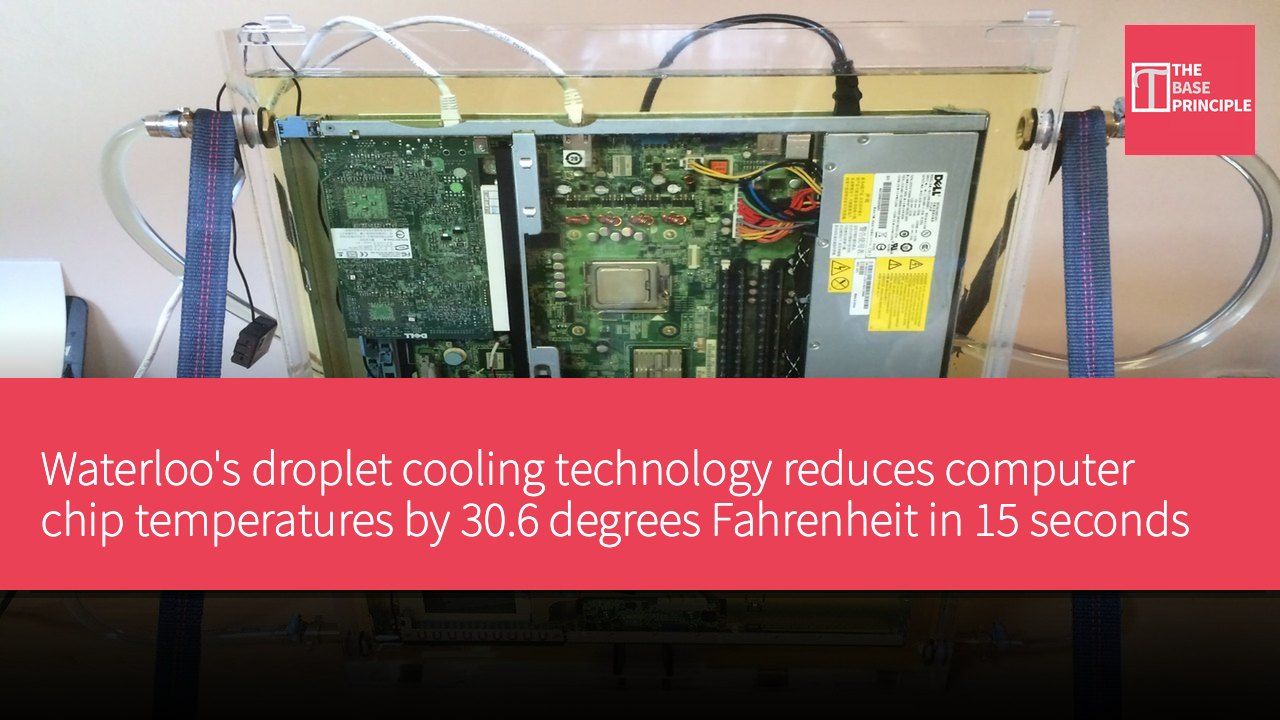
- The University of Waterloo has developed a hybrid cooling method to enhance chip cooling efficiency.
- The new design uses deionized water and expensive coolant to reduce cooling costs.
- The research team selected a low-boiling-point coolant that effectively absorbs heat.
- This technology could be applied in areas such as electric vehicles and high-power equipment.
Engineers at the University of Waterloo have developed a hybrid cooling method that combines a water bath with single droplet boiling coolant to cool hotspots on computer chips. According to a report from the university on November 10, laboratory tests showed that a droplet of coolant can reduce the temperature of a simulated hotspot by up to 30.6 degrees Fahrenheit (17 degrees Celsius) in just 15 seconds. Data centers running artificial intelligence (AI) workloads generate significant heat, prompting operators to increasingly immerse chips in coolant. However, small areas of the chips can still run very hot within seconds, leading to reduced performance, shortened lifespan, and decreased reliability.
The university noted that the flow of coolant reacts too slowly. Waterloo's design separates the tasks, with inexpensive deionized water handling stable heat levels, while a droplet of expensive coolant addresses heat peaks. This design aims to use the costly coolant only when and where it is needed on the chip, potentially lowering cooling costs in AI data centers.
Design Concept of the New Cooling Technology
Professor Sushanta Mitra from the University of Waterloo's Mechanical and Mechatronics Engineering department collaborated with postdoctoral researcher Tian-Yu Zhang and doctoral student Arnav Banerjee on the peer-reviewed research covering the experimental tests. The research team selected a coolant with a boiling point lower than that of water. This coolant is also heavier, preventing it from mixing and allowing it to stay on the hotspot. Mitra stated that boiling can absorb a large amount of heat, and the rising bubbles stir the water, enabling it to carry heat away more quickly. He added, "We achieve the boiling effect, but only where and when it is needed."
The research team subsequently encapsulated the coolant droplet in a silicone oil shell, with tiny thermally conductive ceramic particles helping to control the droplet's boiling rate. According to the paper's abstract, under a heat flux of approximately 93 watts per square inch (14.4 watts per square centimeter), the center of the hotspot cooled by about 30.6 degrees Fahrenheit in 15 seconds.
Potential Applications and Challenges
Microsoft described a two-phase immersion cooling tank in 2021, where the coolant boils over the servers. Researchers envisioned two delivery pathways. The coolant droplets could circulate freely in the water and activate upon reaching hotspots; alternatively, sensors could detect hotspots and deliver droplets directly to those locations. The university also listed electric vehicles, batteries, high-power lasers, and LED lighting as potential application areas. Other teams are addressing the issue internally within chips. Researchers at Peking University described an embedded cooling design that boils insulating liquid near hotspots, while researchers at the Korea Advanced Institute of Science and Technology have carved water channels into silicon.
These results come with certain limitations. The 30.6-degree data applies to a simulated heat flux on a chip, rather than an actual operating server. The report did not specify how the droplets are replaced, how much coolant a data center would require, or the costs of cooling. The two delivery pathways were only described as concepts. The system is still under development, and the report did not provide a timeline for actual chip testing. Related research findings were published in Volume 725 of the Journal of Colloid and Interface Science.
Potential and Challenges of the New Cooling Technology
The hybrid cooling technology from the University of Waterloo demonstrates how to effectively address chip overheating issues in data centers and high-performance computing. By combining deionized water with specific coolants, this technology not only enhances cooling efficiency but also has the potential to reduce operational costs. However, the technology is still in development and faces unresolved challenges, such as the frequency of droplet replacement and the demand for coolant. These factors will impact its feasibility in practical applications, especially in the operation of large data centers.