
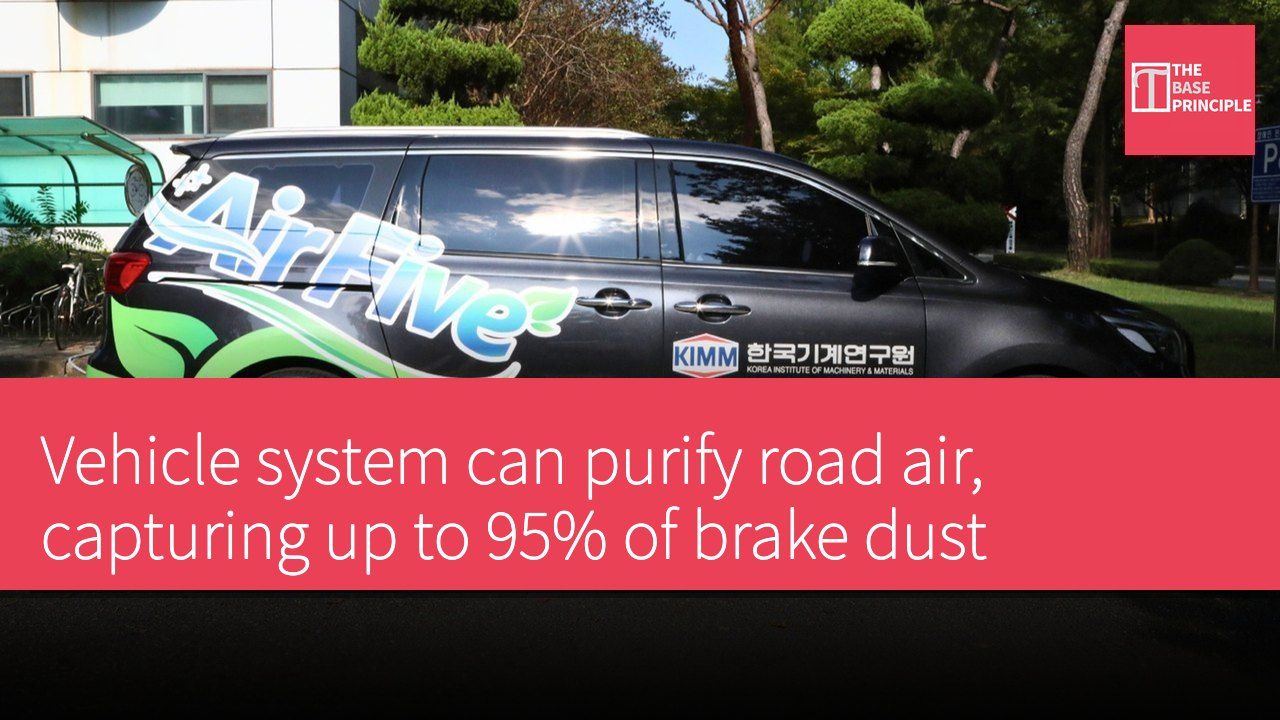
- The system developed by KIMM cleans air while driving and captures brake dust.
- The grille system effectively removes PM2.5 particles without requiring high-power fans.
- The brake dust collector automatically captures particles without additional equipment.
- This technology aims to improve urban air quality and has applied for patents in multiple countries.
The Korea Institute of Machinery and Materials (KIMM) has developed a vehicle system that cleans roadside air while driving, simultaneously capturing brake dust to prevent its dispersion. This technology utilizes the existing structure of vehicles, transforming ordinary cars into mobile air purifiers for urban streets. Led by Dr. Han Bang-woo from KIMM's Urban Environment Research Division, the team constructed three systems, including a grille-type electrostatic dust collector, a caliper-type brake dust collector, and a wireless power supply system for air purification while parked. Engineers installed these systems on vehicles including the Kia Carnival and Hyundai Sonata to verify their performance.
The grille system is capable of charging incoming fine particles and adsorbing them onto collection plates. The diameter of the carbon fibers is much smaller than that of human hair, allowing for effective particle collection with low current while reducing ozone generation. During operation, the system relies on the airflow generated by the vehicle's movement, eliminating the need for additional high-power fans. When the vehicle is parked in a space equipped with wireless power, its existing cooling fan can be used to purify the surrounding air. At a speed of 18.6 mph (30 km/h), the grille system removes at least 95% of PM2.5 and at least 99% of larger PM2.5–10 particles.
Operation Principle of the Grille System
The system maintains the same performance at a speed of 31 mph (50 km/h), purifying approximately 63,600 cubic feet (1,800 cubic meters) of air per hour per vehicle. After installation, the fuel efficiency of the Carnival and Sonata changed by no more than 1%.
Brake dust is captured through a collector installed behind the brake caliper. The friction between the brake pads and the brake disc naturally charges the particles, so the system does not require additional particle chargers or vacuum fans. In the Worldwide Harmonized Light Vehicles Test Cycle (WLTC), the collector captures 22.2 mg of brake wear particles per kilometer per vehicle, equivalent to about 35.7 mg per mile. This amounts to approximately 0.35 ounces (10 grams) over 280 miles (450 kilometers).
Brake Dust Capture Technology
Traditional automotive pollution control primarily focuses on engine exhaust. Non-exhaust particles from brakes and tires also come from electric and hydrogen-powered vehicles, and brake particle emissions are currently regulated under Euro 7 standards. Researchers point out that electrostatic dust collection provides low air flow resistance and can adapt to existing vehicle spaces and components, minimizing additional power demands and structural changes.
Future Applications of the Technology
Dr. Han Bang-woo stated that a key feature of the system is its ability to clean roadside air while driving, while also directly reducing brake wear particles at the source. Senior researcher Lee Geon-hee noted that utilizing the vehicle's structure and driving airflow "minimizes the demand for additional power." KIMM plans to further validate the system's performance and long-term durability under real driving conditions. This is a significant achievement of AirFive, one of KIMM's five flagship brands, which plans to expand the application of this technology to improve urban air quality. The project is titled "Mutually Beneficial Collaborative Air Purifying Vehicles for Atmospheric Fine Particles," supported by core technology development plans in the automotive industry.
Related research findings have been published in the International Journal of Tribology and Atmosphere, and patent applications have been submitted in South Korea, the United States, and Germany. The title of the brake research is "A Non-Charging Electrostatic Dust Collector for Collecting Friction-Charged Brake Wear Particles."
Item Specification Brake Wear Particle Capture Amount 22.2 mg/km PM2.5 Removal Rate 95% Larger PM2.5–10 Removal Rate 99%
Impact of This Technology on Urban Air Quality
As urbanization accelerates, the issue of air pollution caused by vehicles has become increasingly severe. The vehicle system developed by KIMM not only purifies roadside air while driving but also effectively captures brake dust, which is significant for improving urban air quality. Traditional pollution control has primarily focused on engine exhaust, while this technology expands the scope of control to address non-exhaust particles. With the promotion of this technology, it may be implemented in more vehicle models in the future, further reducing harmful particulate matter in cities and enhancing public health.