
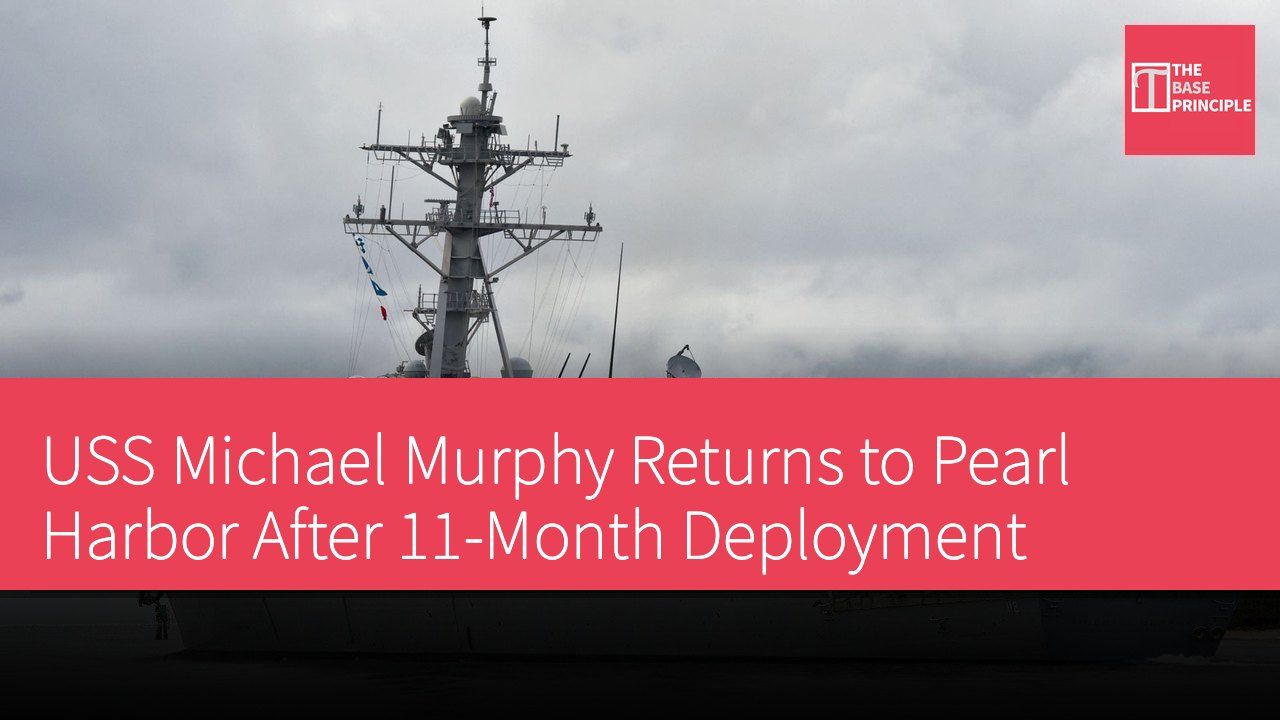
- USS Michael Murphy completes 11-month deployment and returns to Pearl Harbor.
- The ship escorted commercial oil tankers through the Strait of Hormuz and launched Tomahawk missiles.
- The commander praised the courage and professionalism of the sailors.
- The destroyer is capable of multi-mission operations to address various threats.
The USS Michael Murphy (DDG 112), a U.S. Navy guided missile destroyer, has returned to Pearl Harbor after completing an 11-month deployment, covering over 97,000 nautical miles. The U.S. Third Fleet stated that this homecoming highlights the ship's operational role during heightened tensions in the Persian Gulf and revealed some previously undisclosed mission details during the deployment. The destroyer returned to Joint Base Pearl Harbor-Hickam on November 12, operating within the areas of responsibility of the U.S. Third, Fifth, and Seventh Fleets, supporting what the Navy described as "the first naval blockade operation in 60 years."
Main Missions During Deployment
According to the Navy, this Arleigh Burke-class destroyer completed 12 controversial transits through the Strait of Hormuz, safely escorting four commercial oil tankers, coordinating the protection of 14 U.S. and allied vessels, and launching dozens of Tomahawk land-attack cruise missiles during Operation Epic Fury.
The USS Michael Murphy departed Pearl Harbor on December 1, 2025, as part of Carrier Strike Group 3 and entered the area of responsibility of U.S. Central Command by the end of January. Subsequently, the ship served as the surface combatant commander of Task Force 50, overseeing maritime security operations in the Northern Arabian Sea, Gulf of Oman, and Strait of Hormuz. In the conflict zone, the ship's duties extended beyond escorting commercial shipping to coordinating the protection of 14 U.S. and allied vessels, including guided missile destroyers, coastal combat ships, six U.S. Coast Guard fast response cutters, and supply tankers operating in contested waters.
The 12 transits through the Strait of Hormuz are regarded as one of the defining achievements of this deployment. According to Navy data, each transit faced threats from drones, missiles, fast attack craft, and naval mines, while the destroyer escorted commercial oil tankers through one of the world's most strategically significant shipping channels.
Operational Capabilities of the Vessel
Commander David Nicholas of the USS Michael Murphy stated, "The sailors of Michael Murphy demonstrated unparalleled courage, professionalism, and operational excellence during this deployment. Whether repelling incoming aerial and surface threats or leading operations in contested waters, this team never hesitated. They answered every call from our nation, protected our allies, and lived up to the name of heroes. I am immensely proud of this team."
The USS Michael Murphy possesses offensive and defensive strike capabilities, designed for multi-mission operations that combine long-range strike capabilities with layered air, surface, and subsurface defenses. The ship can quickly switch between offensive strikes, fleet air defense, and anti-submarine missions. Its onboard Mk 41 vertical launch system can fire Tomahawk cruise missiles to strike long-range land targets. The same launcher can also be used for standard surface-to-air missiles, evolved Sea Sparrow missiles to intercept nearby aircraft and incoming missiles, and vertical launch anti-submarine rockets to launch torpedoes at enemy submarines.
The destroyer is capable of simultaneously detecting, tracking, and responding to multiple aerial and surface threats, supported by its Aegis weapon system integrated with AN/SPY-1D(V) phased array radar.
The ship is also equipped with a 5-inch Mk 45 naval gun and Phalanx close-in weapon system as a last line of defense against incoming missiles and drones, and has two MH-60R Seahawk helicopters that extend its surveillance and anti-submarine range beyond the horizon. The Navy stated that these capabilities enabled the USS Michael Murphy to launch dozens of Tomahawk strikes during Operation Epic Fury, continuously protecting allied forces and commercial shipping from aerial and maritime threats.
Strategic Role and Challenges of USS Michael Murphy
The deployment of USS Michael Murphy in the Persian Gulf underscores its significance amid current geopolitical tensions. The ship not only participated in escort missions but also conducted multiple controversial transits, showcasing the U.S. Navy's commitment to protecting commercial shipping and allies. These actions are not only a test of the vessel's capabilities but also reflect the strategic need for the U.S. to maintain maritime security in the region. As the global security environment evolves, similar missions may become routine, placing higher demands on the Navy's operational readiness and technological capabilities.