
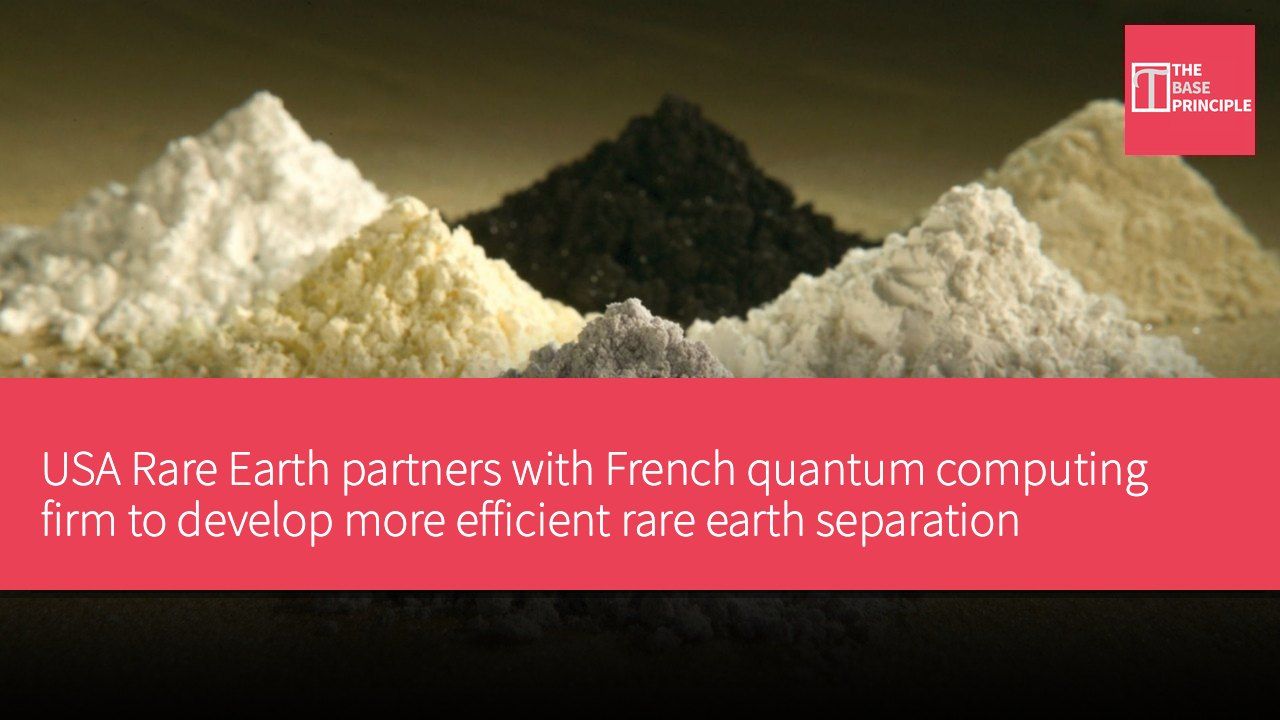
- USA Rare Earth is partnering with French companies to develop rare earth element separation technology.
- The collaboration plans to leverage quantum machine learning and automated laboratory experiments.
- More effective extractants could lower costs and reduce environmental impact.
- The partnership aims to boost the competitiveness of the Western rare earth materials supply chain.
USA Rare Earth has partnered with French quantum computing company Pasqal and industrial AI specialist Riven Systems to develop more efficient methods for separating rare earth elements. Announced on September 17, the project will use quantum machine learning and automated laboratory experiments to identify molecules that bind more effectively with rare earth elements. The companies hope the approach will enable smaller processing facilities to operate, consuming less energy and reducing operating costs. The project targets an important processing gap involving the conversion of mixed materials into individual oxides, which are widely used in advanced manufacturing and other strategic industries.
China currently leads this part of the supply chain, particularly for heavy rare earth elements such as neodymium, erbium and yttrium.
Technical Background of the Collaboration Plan
Alex Moyes, Senior Vice President of Upstream Operations at USA Rare Earth, said: "The main challenge for the rare earth industry outside Asia is separating the mixed rare earth carbonate (MREC) produced in upstream operations into individual oxides." Rather than relying primarily on time-consuming trial-and-error testing, the partners plan to build a data-driven system for discovering extractants. These chemical molecules selectively bind with specific rare earth elements during processing, helping operators separate them from mixed feedstocks.
More effective extractants can reduce the number of processing stages required, as well as the amount of equipment and raw materials used. USA Rare Earth says this will lower the capital and operating costs of future facilities while shrinking their environmental footprint.
Automated Laboratory Experiments
Under the plan, Riven Systems will run thousands of automated experiments at its autonomous mineral separation laboratory. The resulting chemical data will be used to train machine learning models that predict how selectively different extractants bind with rare earth elements. Pasqal will use its neutral-atom quantum processing units to benchmark quantum machine learning models against those running on classical computers. The findings will help USA Rare Earth identify promising extractants for further testing. "Rare earth materials are essential, and improving how they are processed has an impact that extends well beyond any single industry,"
said Wasiq Bokhari, CEO of Pasqal.
The experiments will target materials that USA Rare Earth expects to process, including feedstock from the Round Top deposit in Sierra Blanca, Texas, third-party mixed rare earth carbonates, and recycled swarf generated during magnet manufacturing. The initial machine learning project could eventually evolve into an integrated extractant discovery pipeline spanning computational modeling, automated experimentation and physical validation. Within that system, Pasqal's quantum machine learning models will identify high-potential molecules before Riven tests them at its autonomous laboratory.
The most promising candidates will be validated at USA Rare Earth's research and development facility in Wheat Ridge, Colorado, and could then be incorporated into the company's processing workflow. "AI and autonomous labs are the next frontier in critical minerals processing," said Dr. Orion Archer Cohen, Chief Technology Officer and co-founder of Riven Systems.
The partnership combines American rare earth and automation expertise with French quantum computing capabilities, and its broader goal is to help build a more efficient and competitive Western rare earth materials supply chain.
Strengthening Global Competitiveness in the Rare Earth Supply Chain
The United States faces intense competition from China across the rare earth element supply chain, particularly in the production of heavy rare earths. This collaboration not only draws on quantum computing and AI, but also seeks to improve extraction efficiency through a data-driven approach. It could lower production costs while reducing environmental impact, which is critical for the United States and its allies as they work to build a more competitive rare earth materials supply chain. As demand for rare earth materials grows, the success of this technology could reshape the global market landscape.