
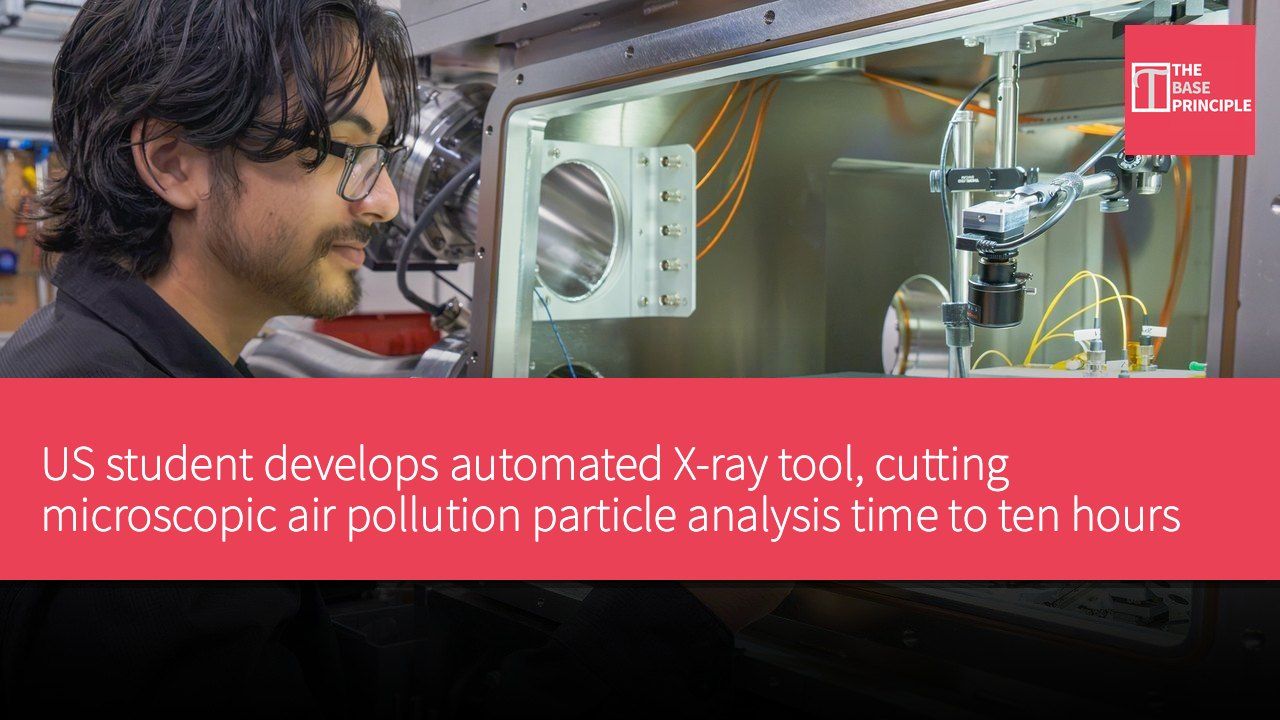
- New automated X-ray tool reduces analysis time to 10 hours.
- The tool can automatically identify particles and investigate their chemical composition in depth.
- Using the software improves the efficiency and accuracy of air pollution analysis.
- The team plans to improve the software to identify more materials and particles.
A US student has developed a new automated X-ray tool capable of reducing the time to analyze 500 microscopic air pollution particles from 44 hours to just 10 hours. The technology, named X-AutoMap, was designed by Carlos DeLeon during an internship at the National Synchrotron Light Source II at Brookhaven National Laboratory (BNL). DeLeon participated in the US Department of Energy's (DOE) Science Undergraduate Laboratory Internships (SULI) program.
Under the guidance of laboratory beamline scientist Dr. Ajith Pattammattel, DeLeon worked to automate the X-ray analysis process. The tool enables the X-ray microscope to automatically identify particles of interest and investigate their chemical composition in greater depth. The software could help understand the impact of air pollution on human health and could also be used to study batteries and electronic products.
Advantages of automated X-ray analysis
Pattammattel said: "If we can determine detailed chemical composition without the need for personnel to control the experiment, it would be far more efficient."
Air pollution contains thousands of microscopic particles with varying chemical compositions, which may include soot, dust, pollen, and airborne microplastics that people inhale daily. Depending on their chemical composition, some particles may pose greater health risks. However, identifying these particles takes days because researchers must manually examine large numbers of samples and select individual particles for more detailed analysis. To accelerate this process, the team developed the X-AutoMap software for use with the facility's Hard X-ray Nanoprobe (HXN).
The HXN is a powerful microscope capable of examining materials at extremely small scales. It first performs a rapid, low-resolution scan of the sample. The software then analyzes X-ray fluorescence signals to detect particles matching specific chemical patterns. When the software finds these particles, the microscope automatically initiates high-resolution scans to reveal their chemical composition and structure. Pattammattel explained that the software follows scientific rules set by researchers in advance. He explained the rationale for this approach: "We believe that if we can encode and integrate combinations of different expert knowledge into a computer model, allowing the microscope to use this information to automatically identify areas requiring high-resolution scans, it would be much easier."
Laboratory test results and challenges
In laboratory tests, scientists used particulate matter samples collected from urban air pollution. The software successfully analyzed approximately 500 particles within 10 hours, while manual data collection took a total of 44 hours. The system also revealed significant differences between two types of iron-containing particles. Some particles contained tightly mixed iron, chromium, and manganese, and many were spherical, which is associated with high-temperature industrial processes. Other particles contained iron, calcium, and silicon arranged in clusters of separate particles, a structure typically associated with natural or geological materials. According to the team, these differences may be difficult to detect in low-resolution scans.
However, because the software can only identify particles specified by scientists, it may miss very small particles or those with weak chemical signals. The team plans to improve the software and explore AI models to detect more materials.
DeLeon reflected on his internship experience and encouraged hesitant students to apply for similar opportunities. He said in a news release: "Many people often doubt themselves or underestimate their abilities, missing out on opportunities like this. I encourage anyone interested to apply and see what happens." The research has been published in the journal Advanced Intelligent Discovery.
Application prospects of automation technology in environmental science
The development of automated X-ray tools marks an important advance in environmental science research. With growing concern over the health impacts of air pollution, the ability to rapidly and accurately analyze microscopic particles in the air has become crucial. This new technology not only improves detection efficiency but also helps researchers better understand the chemical composition of different particles and their potential risks. Although current identification capabilities remain limited, future integration with AI models may further expand its application scope, bringing positive impacts to environmental monitoring and public health.