
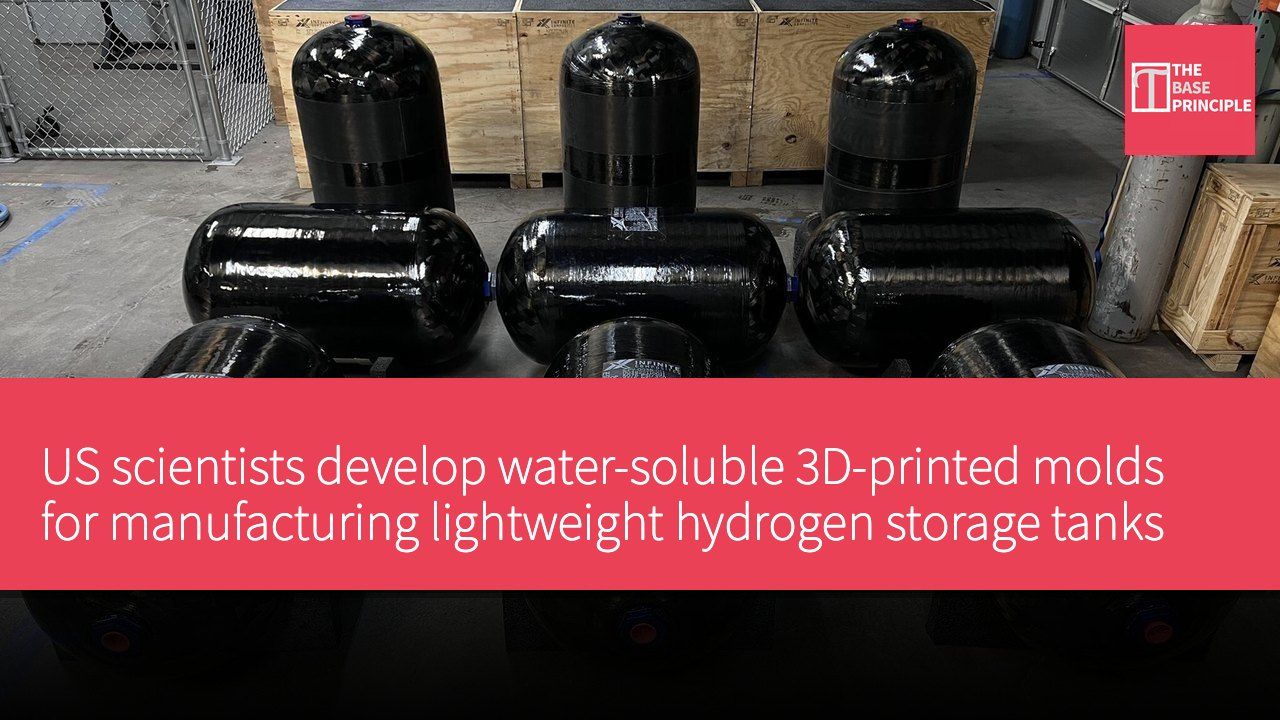
- Scientists develop water-soluble 3D-printed molds for hydrogen storage tank manufacturing.
- Molds made from water-soluble polymer can withstand high-pressure gases.
- New technology simplifies production of large pressure vessels, reducing complexity.
- Achievement demonstrates commercial potential of advanced manufacturing.
Scientists have developed a new type of 3D-printed mold that dissolves in water, enabling the production of linerless, lightweight hydrogen storage tanks that can also withstand high pressures from other gases. The mold, also known as a mandrel, was designed by a team of researchers at the U.S. Department of Energy's (DOE) Oak Ridge National Laboratory (ORNL). For this project, the team collaborated with aerospace company Infinite Composites, additive manufacturing firm JuggerBot 3D, and Oklahoma State University.
Project lead Dr. Ahmed Arabi Hassen revealed that the technology uses a specially formulated water-soluble polymer to produce the mandrel, which is then used to manufacture Type V composite pressure vessels. These vessels are made entirely of composite materials and require no permanent liner. They can also store hydrogen, compressed natural gas, nitrogen, and helium, making them suitable for the aerospace, defense, transportation, and energy industries.
Challenges and Solutions of the New Technology
Production of lightweight gas storage tanks is relatively difficult, particularly when creating and removing the internal molds used for shaping. Engineers have relied on expensive metal molds or complex tooling that must be disassembled for removal. Hassen discussed the importance and potential of Type V composite pressure vessels. "Type V linerless composite pressure vessels represent the next frontier in lightweight, high-pressure gas storage, but their manufacture remains extremely challenging, especially in the production and removal of complex internal tooling," he said.
To address this challenge and create a sacrificial mandrel, the researchers turned to large-scale additive manufacturing, commonly known as 3D printing. They used a specially formulated water-soluble polymer to print the mandrel in the required shape. Engineers then wound carbon fiber over the mandrel to create the vessel's outer structure. Once the composite cured, they dissolved the temporary mandrel in water. The team thus produced a hollow carbon-fiber tank with no permanent liner and applied a gas-barrier coating to the vessel.
Design Advantages and Commercial Significance
The research team noted that the technology eliminates the need for complex mechanical systems to remove internal tooling and removes the requirement for solvents during mandrel extraction, simplifying production of large pressure vessels. Hassen explained that the approach also ensures high dimensional accuracy. "Our water-soluble 3D-printed mandrel represents a significant step in overcoming this barrier and enables scalable, cost-effective production of Type V vessels," he added.
The design also reduces the tank's overall weight and avoids problems caused by a permanent liner. In addition, replacing traditional metal tooling with 3D-printed molds reduces manufacturing complexity, shortens production time, and lowers costs. This will be significant for industries that require lightweight gas storage systems operating at high pressure. "This achievement demonstrates how advanced manufacturing and strong industry partnerships can help bring these technologies closer to commercial realization," Hassen summarized in a press release. The team conducted the research at the DOE's Manufacturing Demonstration Facility, and the project received support from the DOE Office of Critical Minerals and Energy Innovation.
Technological Breakthrough in New Hydrogen Storage Tanks
This new technology significantly simplifies the manufacturing process for lightweight gas storage tanks through water-soluble 3D-printed molds. Traditional methods require expensive metal molds, and the process of removing internal molds is cumbersome. The emergence of this technology not only reduces manufacturing complexity but also lowers costs and production time. As demand for high-pressure gas storage such as hydrogen increases, the commercial potential of this technology rises accordingly, with significant implications for the aerospace, defense, and other industries.