
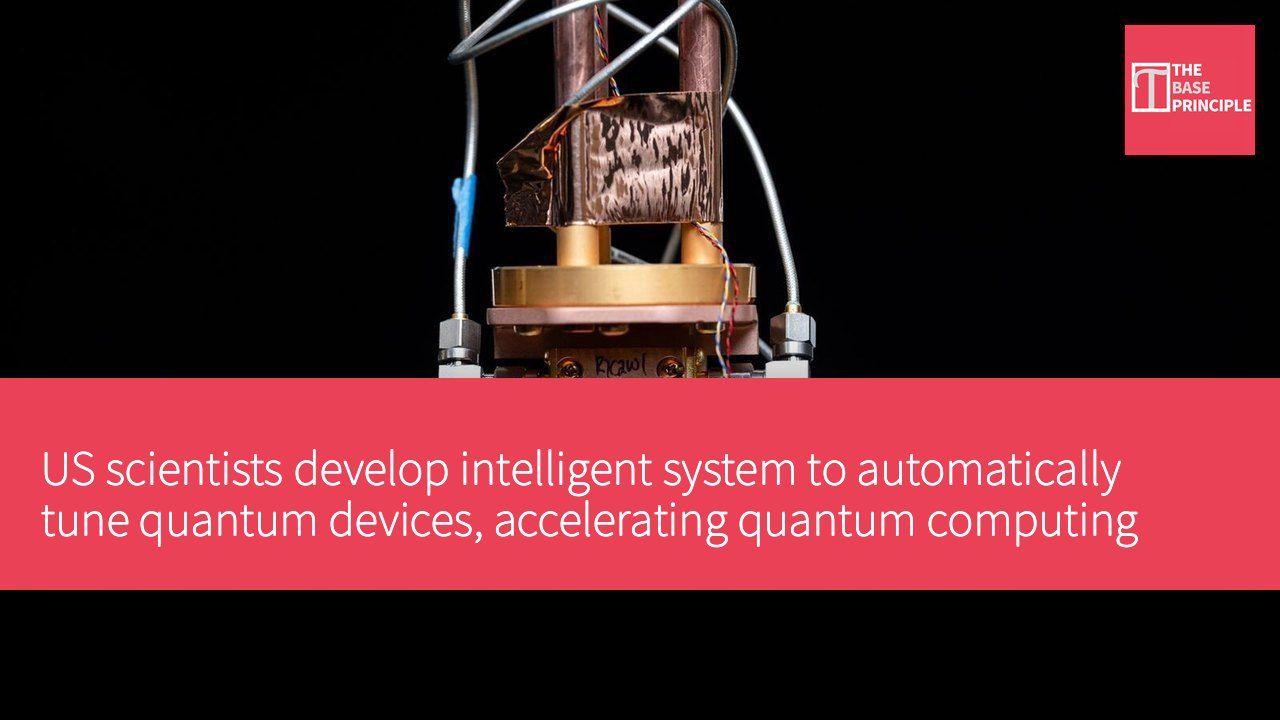
- AI system developed by US scientists can automatically tune quantum devices.
- AQUA-WOLF project aims to improve quantum computing efficiency and dark matter exploration.
- The system can make decisions based on physical principles, reducing manpower needs.
- Researchers plan to release the AI agent as open-source software.
US scientists are developing an intelligent agent capable of automatically tuning sensitive quantum devices, thereby accelerating quantum computing and the search for elusive dark matter. This artificial intelligence (AI) system is currently being tested at the Pacific Northwest National Laboratory (PNNL) in Richland, Washington. According to reports, the agent can control quantum-noise-limited parametric amplifiers. These ultra-low-noise microwave devices are used to amplify the extremely weak signals set by quantum mechanics while introducing almost no additional noise. They are also used in experiments searching for dark matter and in systems that read out information from superconducting quantum bits (qubits).
AI automates quantum device tuning
However, operating these devices typically requires skilled physicists to adjust settings and test results, a process that can last hours. To solve this problem, a PNNL team led by Dr. Christian Boutan has proposed an AI system to automate this task. The project, named AQUA-WOLF (Autonomous Quantum Amplifier Workflow Optimization and Learning Framework), is supported by the US Department of Energy's Genesis Mission.
The new technology could support the Axion Dark Matter Experiment (ADMX), which aims to search for hypothetical particles called axions. This experiment is rather unusual for a dark matter detector because it is not located deep underground. ADMX uses a microwave cavity placed in a large, strong magnetic field to search for cold dark matter axions in the local galactic dark matter halo. If they exist, the team hopes they will convert into microwave photons, which can then be captured by highly sensitive quantum electronic devices. The experiment must scan a range of possible axion masses, making the time the device spends collecting data especially critical.
According to Boutan, tuning the amplifiers is the "primary source of wasted time" in the search process. But he believes AQUA-WOLF can automate this process through reinforcement learning. The AI agent will change settings on its own and learn from the results, no longer relying on physicists to repeatedly adjust the amplifiers.
Reasoning with physical principles
Initially, researchers will reward the system based on gain, which is measured in decibels to quantify how much the amplifier boosts the incoming signal. Subsequently, they aim to expand the process to account for other factors, including noise and stability. Scientists will also test the effectiveness of several algorithms to determine the most effective method. Meanwhile, automating the entire process could also benefit quantum computing. This is because amplifiers read out information from qubits. However, as quantum computers contain thousands of qubits, tuning them could become difficult. They also plan to teach the agent the physics behind the device and encode the system's Hamiltonian (the mathematics describing its energy) into the agent.
In this way, it can make decisions based on physical principles rather than merely exploring through trial and error of different settings.
Dr. Erik Lentz, a physicist at PNNL who teaches the AI agent to reason and make decisions using physical principles, said traditional algorithms are "quite inefficient" when exploring the available parameter space. Because parametric amplifiers operate on similar principles, the AI can learn to tune new devices with less training. The team plans to test on actual hardware, such as amplifiers from NIST, and transfer the tuning to other amplifiers that may ultimately be used in experiments like ADMX. Once validated, PNNL plans to release the AI agent as open-source software.
Its dataset will also support the Genesis Mission's shared scientific infrastructure. Researchers said in a press release: "The goal is not to remove scientists from the laboratory, but to free them from spending hours on tedious minutiae so they can spend more time discovering the mysteries of the universe."
The importance of automation for quantum research
The complexity of quantum computing and dark matter research makes the application of automation technology particularly important. The AQUA-WOLF project's AI system not only improves operational efficiency but also reduces reliance on specialized physicists, enabling scientists to focus on more creative research work. As quantum technology develops, such automated systems will help accelerate scientific discovery and may become key tools for future quantum computing and dark matter exploration.