
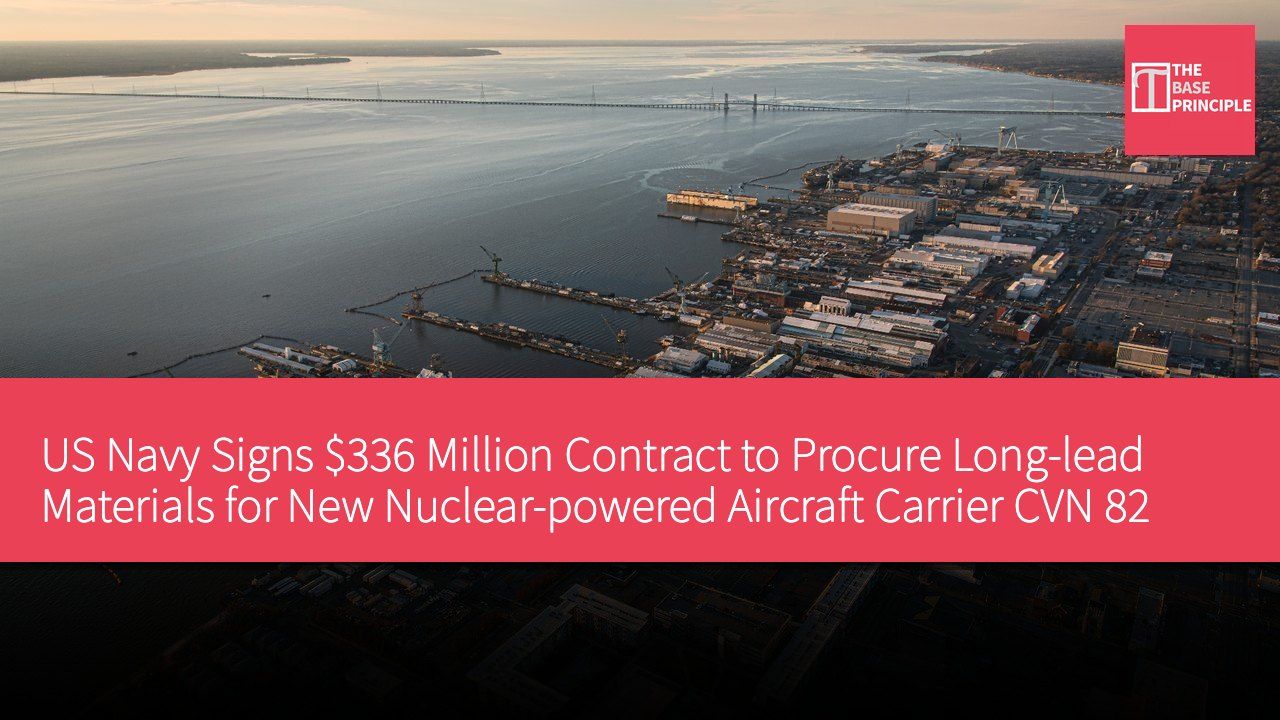
- The US Navy has signed a $336 million contract to procure long-lead materials for CVN 82.
- The contract covers the early procurement of propulsion plant materials to support the carrier's construction timeline.
- The contract is an undefinitized contract action, indicating the Navy has authorized work to begin.
- CVN 82 will continue the US Navy's nuclear-powered aircraft carrier fleet, enhancing global power projection capabilities.
The US Navy has awarded a $336 million contract to shipbuilder HII to begin procuring long-lead materials for CVN 82, the next nuclear-powered aircraft carrier in the US fleet. The contract covers the early procurement of propulsion plant materials that will be needed for future construction at HII's Newport News Shipbuilding facility. The purpose of securing these long-lead materials in advance is to help the CVN-82 program stay on schedule as the aircraft carrier moves into full construction. Starting the procurement process years ahead of time allows the Navy and shipbuilder to obtain specialized components that take a long time to manufacture and deliver, and to send an early signal to the supplier network that supports the US aircraft carrier industrial base, which encompasses thousands of companies nationwide.
The $336 million contract award focuses on long-lead materials (LLTM) related to the propulsion plant for CVN 82. These components must be ordered well in advance of installation because nuclear-powered aircraft carriers require highly specialized equipment and materials that typically take years to manufacture, validate, and deliver. Therefore, initiating procurement at this stage is an important early milestone for the future carrier. These materials will support the propulsion system, which will ultimately power the ship and its onboard systems, allowing it to operate for extended periods without conventional fuel.
Early Milestone for the Contract
Bryan Caccavale, Vice President of Program Management at Newport News Shipbuilding, described the procurement as the first step in the CVN 82 program and stated that it would provide an important demand signal to suppliers supporting the aircraft carrier industrial base. The contract is an undefinitized contract action, meaning the Navy has authorized work to begin without all contract terms and final pricing being settled.
CVN 82 will continue the US Navy's nuclear-powered aircraft carrier fleet, which is at the core of its global power projection capabilities. These carriers serve as mobile airbases, supporting fighter aircraft, surveillance platforms, and other aviation assets far from US shores. The new carrier will be part of the Navy's broader effort to sustain its nuclear-powered aircraft carrier fleet while continuing construction at Newport News, the only shipyard in the United States capable of building nuclear-powered aircraft carriers.
HII's Industrial Infrastructure
For HII, the contract also underscores the scale of industrial infrastructure required to build modern aircraft carriers. Newport News Shipbuilding works with a large network of national suppliers, while the shipyard itself handles the complex integration of the ship's nuclear propulsion, hull, aviation systems, and other major components. HII, the largest military shipbuilder in the United States, is also working on unmanned systems, C6ISR, electronic warfare, artificial intelligence, and other defense technologies. The company has been investing in automation and new manufacturing methods to meet the Navy's needs for increased shipbuilding output and to expand the US maritime industrial base.
The Importance of Nuclear-Powered Aircraft Carrier Construction
The US Navy's nuclear-powered aircraft carriers are at the core of its global strategy, providing sustained air support and power projection. The construction of CVN 82 is not only an enhancement of the Navy's capabilities but also a support to the US maritime industrial base. The early procurement of long-lead materials demonstrates the Navy's foresight into future needs and provides a stable demand signal to suppliers, which is crucial for ensuring the smooth progress of aircraft carrier construction. HII's role also reflects the complexity of the current military shipbuilding industry and its reliance on high-tech materials and equipment.