
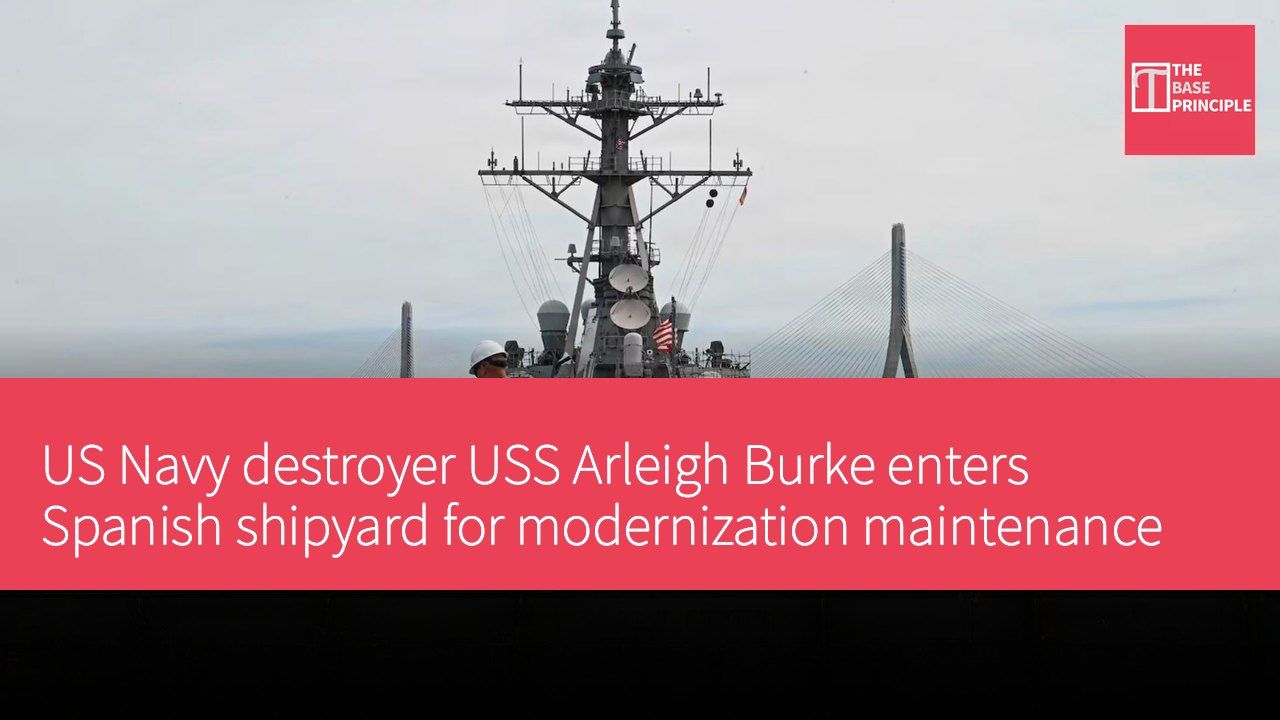
- USS Arleigh Burke destroyer enters Spanish shipyard for modernization maintenance.
- This is the first dry-dock maintenance in the region by the US Sixth Fleet.
- Maintenance work will enhance the ship's operational readiness and availability.
- The ship supports NATO's Integrated Air and Missile Defense architecture.
The US Navy's USS Arleigh Burke (DDG 51) destroyer, weighing approximately 9,700 tons, entered the Navantia shipyard in Cadiz, Spain on October 7 for scheduled repair and modernization work. This work marks an important step in the Navy's expansion of its forward-deployed warship servicing capabilities in Europe. The Navy stated that this is the first dry-dock maintenance conducted in the region by the US Sixth Fleet since forward-deployed naval forces entered the area. This work is expected to enhance the ship's future operational readiness and availability.
US Sixth Fleet Commander Vice Admiral J.T. Anderson stated: "The Arleigh Burke destroyer's dry-dock maintenance is an important milestone in expanding the US Navy's forward-deployed maintenance capabilities in Europe. By integrating dry-dock maintenance during scheduled overseas maintenance periods, the Navy is improving the materiel readiness of our forward-deployed warships."
Repair Team and Local Cooperation
The repair team is preparing the destroyer for future missions. Military and civilian personnel from the Forward Deployed Regional Maintenance Center are working with the ship's crew and Navantia staff to conduct scheduled repair and modernization work during the ship's dry-dock period. This work supports the Navy's efforts to maintain warships near deployment areas. Access to local shipyard facilities helps reduce the need to send ships elsewhere for major repairs, increasing their operational availability in European waters.
History of USS Arleigh Burke
USS Arleigh Burke is one of five forward-deployed destroyers homeported at Naval Station Rota, Spain, and operates under the command of Commander, Task Force 65, supporting NATO's Integrated Air and Missile Defense architecture. The destroyer shifted its homeport from Norfolk, Virginia to Rota in April 2021, ending nearly 30 years of service in Norfolk. It joined Destroyer Squadron 60 of the Sixth Fleet. These forward-deployed warships operate in Europe and Africa, from the Cape of Good Hope to the Arctic Circle, with missions including supporting maritime security and regional stability while contributing to US and NATO missions.
USS Arleigh Burke has served the Navy since 1991 and is the lead ship of the Arleigh Burke-class guided-missile destroyers. The ship was laid down on December 6, 1988 at Bath Iron Works in Bath, Maine, and launched on September 16, 1989 by Roberta Gorsuch Burke, wife of Arleigh Burke. Both attended the ship's commissioning ceremony in Norfolk on July 4, 1991.
At the ceremony, the Chief of Naval Operations told the crew: "This ship is built to fight, and you had better know how!" The ship is named after the Admiral who served in World War II and the Korean War, and later served as Chief of Naval Operations under Presidents Eisenhower and Kennedy. The ship's honors include three Navy Unit Commendations, three Meritorious Unit Commendations, and eight Battle Efficiency Awards, as well as the National Defense Service Medal, Armed Forces Expeditionary Medal, and Kuwait Liberation Medal, along with 13 Navy Sea Service Deployment Ribbons and 1 Overseas Service Ribbon.
US Sixth Fleet is assigned to US Naval Forces Europe-Africa, headquartered in Naples, Italy, and is responsible for overseeing US Navy operations in the US European Command and US Africa Command areas of responsibility.
Enhancement of US Navy Maintenance Capabilities in Europe
The modernization maintenance of USS Arleigh Burke marks an enhancement of the US Navy's forward-deployed capabilities in Europe. This not only helps improve the ship's operational readiness but also reduces the need to send ships to other regions for repairs, thereby increasing their availability in European waters. As the geopolitical situation evolves, such maintenance work is crucial for maintaining NATO's defense capabilities, demonstrating US military presence and commitment in Europe.