
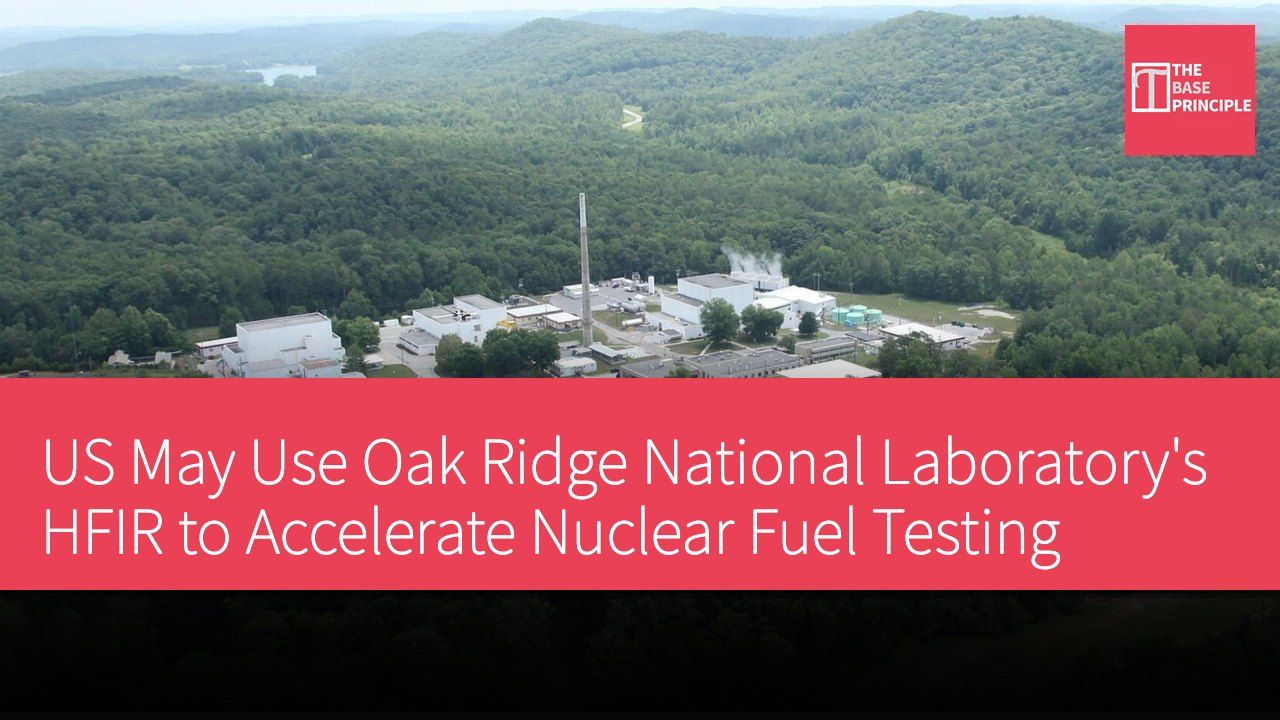
- HFIR is a critical facility for accelerating the development and validation of nuclear fuels.
- HFIR boasts one of the highest steady-state neutron fluxes of any research reactor in the world.
- Researchers can remotely monitor experiments and adjust operating conditions.
- Data from HFIR can be incorporated into NRC technical reports assessing new nuclear fuels.
The High Flux Isotope Reactor (HFIR) at the US Department of Energy's Oak Ridge National Laboratory (ORNL) is poised to become a key facility for accelerating the development and validation of fuels for both new and existing nuclear power plants. HFIR is one of the few research reactors in the US capable of exposing experimental fuels and materials to a high-intensity neutron environment, generating experimental data that can provide technical support for fuel developers, utility companies, and the regulatory validation process of the Nuclear Regulatory Commission (NRC).
HFIR is one of the highest flux steady-state research reactors in the world, with its powerful neutron flux enabling scientists to study material properties across different neutron energy ranges and simulate some of the conditions that fuels experience inside commercial reactors. The facility features three main irradiation regions: the smaller, relatively simple "rabbit" capsules can be quickly designed, assembled, and inserted into the reactor's central flux trap, exposing samples to the highest neutron irradiation doses; while the removable and permanent beryllium reflector regions can accommodate larger, more complex experimental setups, including sensors, instrumentation, and thermal neutron shielding devices used to adjust how neutrons reach the samples.
HFIR's Technical Capabilities and Applications
Researchers at Oak Ridge use the reactor to conduct separate effects tests, studying individual fuel behaviors, as well as integral tests to evaluate multiple interacting processes. Previous research at HFIR laid the groundwork for the development of tristructural-isotropic (TRISO) fuel particles used in high-temperature gas-cooled reactors. Modern upgrades have further expanded HFIR's capabilities for instrumentation and control experiments, improving their precision. ORNL's materials irradiation facility regulates experimental temperatures by controlling the mixture of purge gases and can independently manage multiple temperature zones within a single experiment, while automated systems continuously measure temperature, pressure, and gas composition.
Researchers can also remotely monitor experiment progress and adjust operating conditions during irradiation.
These technical capabilities have been applied to detect fission gases released by TRISO fuel during irradiation, while enabling HFIR to simultaneously support multiple sophisticated experiments, increasing the amount of data collected per test cycle. The reactor's flux trap can also accommodate large-scale fuel cladding irradiation experiments, helping scientists study how fuels and their surrounding materials behave under neutron irradiation. Data generated by HFIR can be incorporated into NRC technical reports assessing new nuclear fuels, covering areas such as fission gas release, changes in fuel microstructure, and interactions between the fuel and cladding.
Synergy Between HFIR and Related Facilities
HFIR is geographically close to several ORNL facilities, including the Coated Particle Fuel Development Laboratory, the Low Activation Materials Development and Analysis Laboratory, the Irradiated Fuels Examination Laboratory, and the Irradiated Materials Examination and Testing Facility, which are used for manufacturing, inspecting, and analyzing nuclear materials. The reactor and these laboratories together form a complete pathway from early experimentation to regulatory validation. A paper published in the journal Nuclear Engineering and Design noted that this Department of Energy research reactor, located in Tennessee, can help address the ongoing backlog of fuel testing needs, and suggested that with utilities pursuing longer plant lifetimes and developers preparing for the commercial deployment of advanced reactors, a more strategic use of HFIR
will help meet the rising demand for testing.
The Importance of HFIR for Nuclear Fuel Testing
As one of the few reactors in the US capable of providing a high-intensity neutron environment, HFIR is crucial for the development and validation of nuclear fuels. With the increasing demand for new nuclear fuels, HFIR's technical capabilities enable it to conduct multiple sophisticated experiments and effectively collect data to support the NRC's regulatory validation process. The synergistic operation of HFIR with surrounding facilities further enhances the detection and analysis of nuclear materials, which is significant for addressing the challenges of future nuclear power plants.