
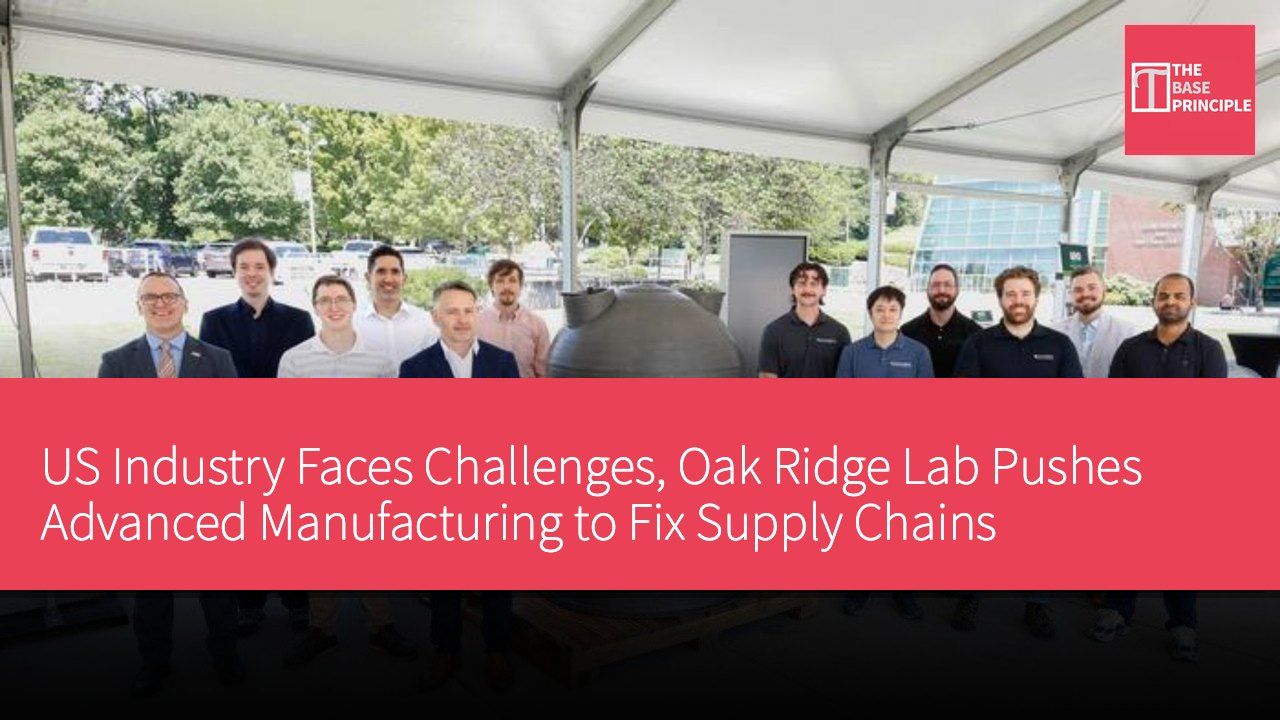
- Oak Ridge National Laboratory is pushing advanced manufacturing to fix supply chain issues.
- US industry faces operational hurdles, with irregular supply chains and worker shortages impacting infrastructure.
- The M2IND aims to remove barriers to advanced technologies and facilitate real-world factory adoption.
- ORNL is partnering with Idaho National Laboratory to standardize digital certification methods and speed up component certification.
The Oak Ridge National Laboratory (ORNL) and its industry partners are deploying advanced manufacturing technologies, such as heavy-duty 3D printing and AI-driven automation, to address issues in the US industrial supply chain. For example, at an advanced facility in Tennessee, a three-armed robot named MedUSA is fabricating a three-by-five-foot nuclear pressure vessel by guiding molten steel through assembly. Nearby, a large 12-foot impact limiter model is being made using strong plastics instead of traditional wood. These are real-world tests of the future of US industry.
The US industrial sector is facing severe operational hurdles stemming from irregular supply chains and a shortage of skilled workers, causing extreme delays in infrastructure areas like hydropower, with the time to obtain major custom components now exceeding a decade.
Goals of the M2IND Conference
More than 350 leaders gathered at ORNL for the Materials and Manufacturing Innovation Day (M2IND). They discussed methods to accelerate the adoption of advanced manufacturing technologies. The goal of M2IND is simple yet ambitious: to remove administrative and technical barriers that slow down advanced technologies and to translate laboratory breakthroughs into factory realities before time runs out. Ryan Dehoff, director of the Manufacturing Demonstration Facility (MDF), stated, "We want to make sure we are getting industry input to guide our research and ensure that the work at Oak Ridge and the MDF is valuable to US manufacturers and considers the supply chain needed to commercialize new technologies."
The event showcased two large 3D-printed nuclear components. Researchers collaborated with the University of Maine to print a fiberglass polymer impact limiter model. This large component protects containers used to transport spent nuclear fuel and replaces the traditional wooden design. Scientists also used a three-armed robotic system to print a steel pressure vessel with a complex dome geometry. This project demonstrated how additive manufacturing can produce large metal components that typically face production challenges. Standard reactor vessels use large forgings and welding but face severe limitations in domestic capacity.
The 3D-printed vessel serves as a case study to evaluate whether additive manufacturing is a viable alternative.
The Need for Supply Chain Resilience
Participants emphasized the urgent need for resilient supply chains, alternative materials, and faster parts certification. They also called for the integration of manufacturing with AI, robotics, and digital engineering. New partnerships are rapidly forming to translate laboratory research into practical tools for manufacturers. Representatives from four Department of Energy offices and defense officials joined leaders in energy manufacturing and technology at the event. Participants collectively identified several key barriers facing US industry, including limited local capacity for large metal components and long component delivery times.
ORNL is forming key industrial partnerships to bring research into practical factory applications.
However, as forum participants repeatedly emphasized, printing a part is only half the battle. The process of obtaining certification for its real-world use often loses momentum. To bridge this gap, ORNL announced a joint research effort with Idaho National Laboratory aimed at standardizing digital certification methods across different facilities. Researchers hope to provide regulators with the data needed to certify 3D-printed nuclear and energy components in months rather than years. They plan to achieve this by using real-time sensors, machine learning, and defect-tracking algorithms during the construction process.
New partnerships with energy giants like SLB and Kairos Power show a clear direction forward. The US is in a rush to rebuild its domestic manufacturing base, starting with laboratory work.
Key Challenges in Rebuilding US Industry
The US industrial sector is facing significant supply chain challenges that not only affect the operational efficiency of manufacturing but also cause delays in infrastructure construction. The efforts of the Oak Ridge National Laboratory, particularly through advanced manufacturing technologies like 3D printing, show the potential for transformation. At the same time, the emphasis on the need for alternative materials and faster parts certification highlights the fragility of the current industrial ecosystem. By establishing key industrial partnerships, ORNL and its partners hope to accelerate this transformation, thereby enhancing US manufacturing capabilities and competitiveness.