
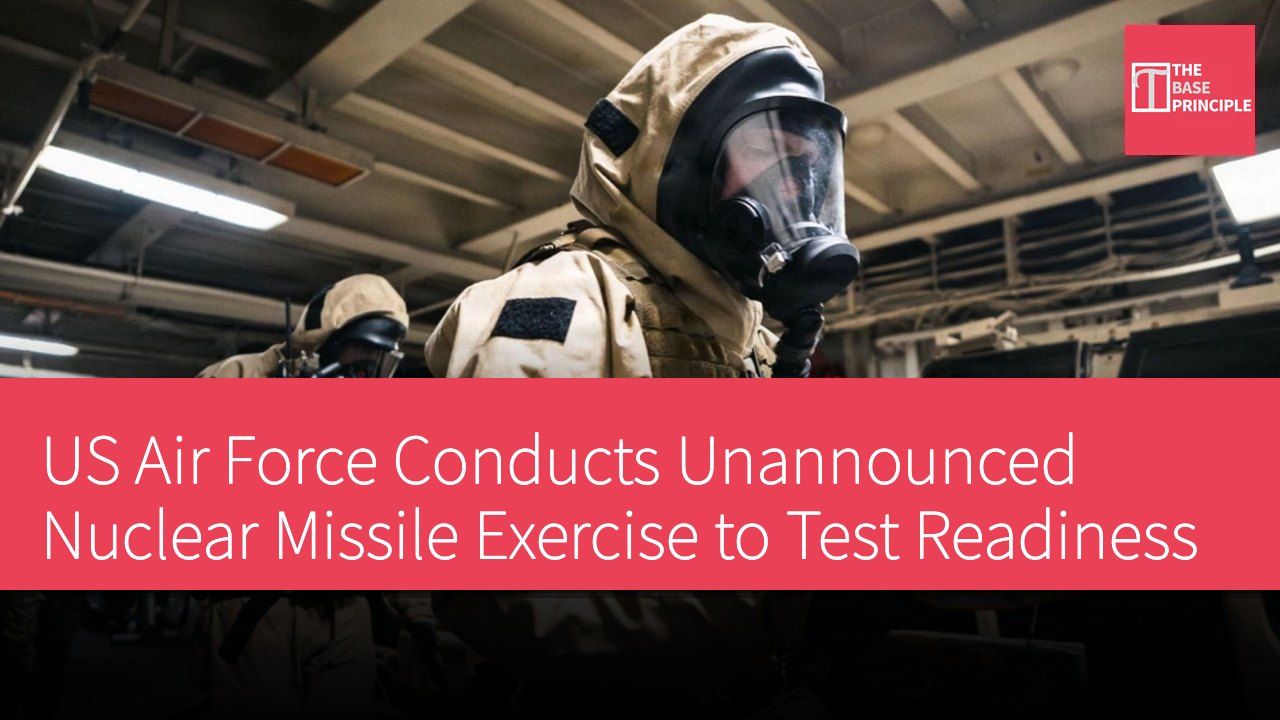
- The US Air Force conducted an unannounced nuclear missile exercise to test readiness.
- The exercise, named "Sentinel Dragon 26-02," involved units from the 20th Air Force.
- It focused on executing procedures and coordinated operations under pressure.
- The exercise's findings will be used to improve future training programs and standardized procedures.
The US Air Force recently conducted a test to evaluate how its nuclear missile force could rapidly shift from routine operations to a high-pressure combat scenario. This four-day突击 exercise, named "Sentinel Dragon 26-02," took place from August 4 to 7, 2026, and involved various units of the 20th Air Force. Unlike traditional large-scale exercises, most participants were not given advance warning. The exercise was designed to demonstrate how commanders and their operations, maintenance, and security teams would perform when unable to prepare for inspections or exercises days in advance.
Brigadier General Colin Connor, commander of the 20th Air Force, stated, "Effective nuclear deterrence must be ready at all times and in all places." He described this state of readiness as the normal operating condition of the force, rather than something specifically constructed for an exercise.
Lack of Preparation Time in Exercise
The defining feature of the exercise was the lack of traditional preparation time. Only a small number of planners knew the exercise was coming, so operational units had to rely on their normal command and control systems to respond to突发事件 and solve problems as they arose. The assessment focused on three main areas: simulated assessments of missile operators, maintenance activities conducted under pressure, and complex scenarios requiring security forces to retake launch facilities. The operator assessments used missile procedure training simulators based on guidance documents and technical requirements. The focus was on first-shift crew members, who make up the majority of the combat force.
The purpose of this test was not only to see if personnel knew what to do, but also to assess whether they could execute the required procedures accurately under pressure.
Testing Multi-Department Coordination
Major Jared Lind, director of exercises for the 20th Air Force, stated that being able to conduct complex exercises without advance notice, involving multiple wings, was one of the most important outcomes of the exercise. The scenario of retaking launch facilities added another layer, requiring security forces and air units to coordinate operations in a simulated tactical environment. Security forces had to manage complex airspace, respond to simulated drone threats, and coordinate tactical insertions and air support with the 582nd Helicopter Squadron. The scenario was designed to test the ability of different departments to operate as a cohesive unit, rather than treating missile security as an isolated ground mission.
Meanwhile, operations and maintenance personnel worked in launch capsules and on-site to ensure the weapon systems remained safe and mission-capable during the simulated response. As such, the exercise combined nuclear mission procedures with traditional security challenges, including unmanned aerial vehicle threats and the need to regain control of damaged launch facilities.
Improving Future Training Programs
The "Sentinel Dragon" exercise was also designed to generate lessons for the Air Force's future training programs. The 20th Air Force stated that it would use observations from the exercise to refine tactics and procedures, and plans to standardize simulator scripts and training products across its missile squadrons. According to the Air Force Global Strike Command, this will save instructors hundreds of hours of administrative work time by reducing the need for each squadron to develop and maintain similar training materials. This way, instructors can spend more time on operational performance and combatant training rather than administrative tasks.
The exercise ultimately tested a simple but important premise: whether personnel responsible for operating, maintaining, and protecting the missile force could effectively respond to changes in the environment without relying on pre-arranged preparation time. The answer is that these personnel were able to integrate operations, maintenance, security, and air support in a scenario specifically designed to eliminate the advantage of advance preparation.
The Importance of Unannounced Exercises for Nuclear Deterrence
The US Air Force's unannounced nuclear missile exercise reflects the complexity and uncertainty of the current global security environment. As geopolitical tensions rise, the effectiveness of nuclear deterrence increasingly depends on the immediate response capability of the force. This exercise not only tested personnel's ability to execute under pressure but also emphasized the importance of multi-departmental coordination, ensuring rapid integration of resources in突发事件. Furthermore, the lessons learned from the exercise will help optimize future training programs, enhancing overall operational efficiency.