
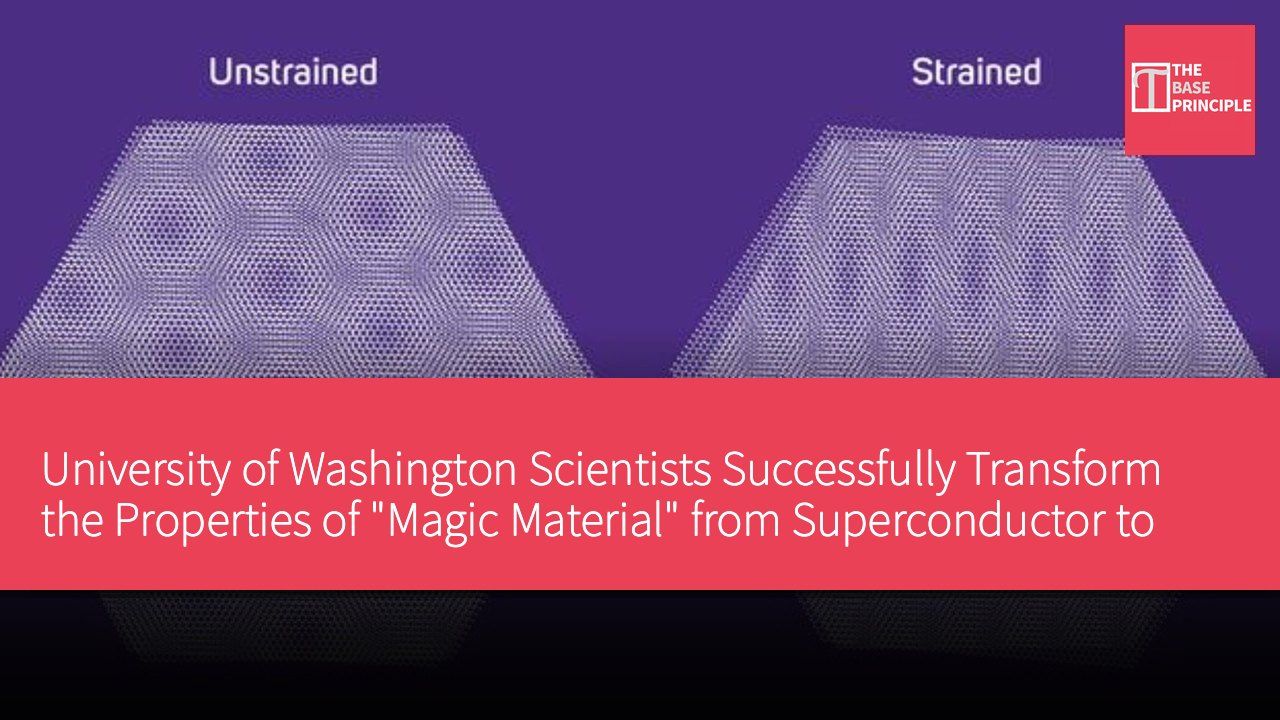
- The University of Washington successfully altered the properties of moiré patterns, achieving a transition between superconductor and insulator.
- Adjusting the strain in the material can lead to a change in resistance of up to one hundred times, demonstrating high predictability.
- The research team aims to improve the fabrication process of moiré patterns by controlling strain.
- The team is currently working to simplify the experiments so that other researchers can replicate the results.
Scientists at the University of Washington have developed a new method to alter the properties of a remarkable material known as moiré patterns. Made from graphene, these moiré patterns can switch between states of superconductor and insulator. Interestingly, researchers at the University of Washington found that adjusting the strain in the material can lead to a change in resistance of up to one hundred times. Moiré patterns are created by stacking single-atom-thick sheets of carbon using micro-mechanical hands. When the upper carbon sheet is rotated, the overlapping atomic lattices become twisted, forming a complex moiré pattern that expands and contracts with changes in angle.
In 2018, researchers at the Massachusetts Institute of Technology demonstrated that when the upper carbon sheet is rotated to 1.1 degrees and cooled to near absolute zero, the material becomes a superconductor. In this state, the material allows electrons to flow freely and can be used to develop superconducting materials for applications in computing, energy, and quantum sensing.
Transformation Properties of Moiré Patterns
Further research in this field has enabled scientists to transfer elements from carbon, creating atomically thin moiré patterns. These patterns can be adjusted through external factors such as temperature, voltage, and magnetic fields, allowing them to transition from superconductor to insulator, nearly halting the flow of electrons. Matthew Yankowitz, an associate professor of physics and materials science at the University of Washington, stated, "By adjusting these parameters, we can cycle between different material states in a very predictable and repeatable way. You can go from metal to insulator, then back to metal, then to insulator again, and then convert to superconductor."
This allows us to use a single device to represent an entire family of materials, enabling the observation of the relationship between superconductivity and surrounding states."
Impact of Strain on Materials
The team collaborated with Professor Zhu Junhao from the University of Washington to explore strain as another new factor to assist in the transformation of these materials. While constructing moiré patterns in materials science laboratories is relatively common, it is not straightforward. Handling atomically thin materials and stacking them often leads to deformation and distortion of one or both materials. In reality, the situation with moiré patterns is not as pristine as depicted in images, but rather more chaotic. Researchers at the University of Washington hope to change this by controlling the strain of the materials being processed.
The team applied the materials to a device that expands and contracts with applied voltage, discovering that they could control the strain of the lattice. By adjusting the strain, the team successfully achieved a change in the material's resistance that exceeded 100 times compared to ordinary metals. This change can be further enhanced by processing samples at ultra-low temperatures. Zhu Junhao stated in a press release, "This enormous response to strain is surprising, as it also appears in other exotic materials, including high-temperature superconductors, which is one of the great unsolved problems in physics. This common connection brings us closer to understanding the fundamental principles behind these fascinating and complex phenomena."
The team is currently working to simplify the experiments so that other researchers can replicate these results using different materials. The research findings have been published in the journal Science.
Potential Applications and Challenges of Moiré Pattern Technology
The research from the University of Washington highlights the significance of moiré patterns in materials science, particularly their ability to transition between superconductors and insulators. This transformation not only enhances the electrical resistance properties of materials but may also facilitate applications in computing, energy, and quantum sensing. However, the fabrication process of moiré patterns is not simple, and the research team's efforts focus on controlling the strain in materials to overcome the challenges of deformation in real-world applications. As experiments become simplified, the feasibility of this technology is expected to improve, opening new directions for future research.