
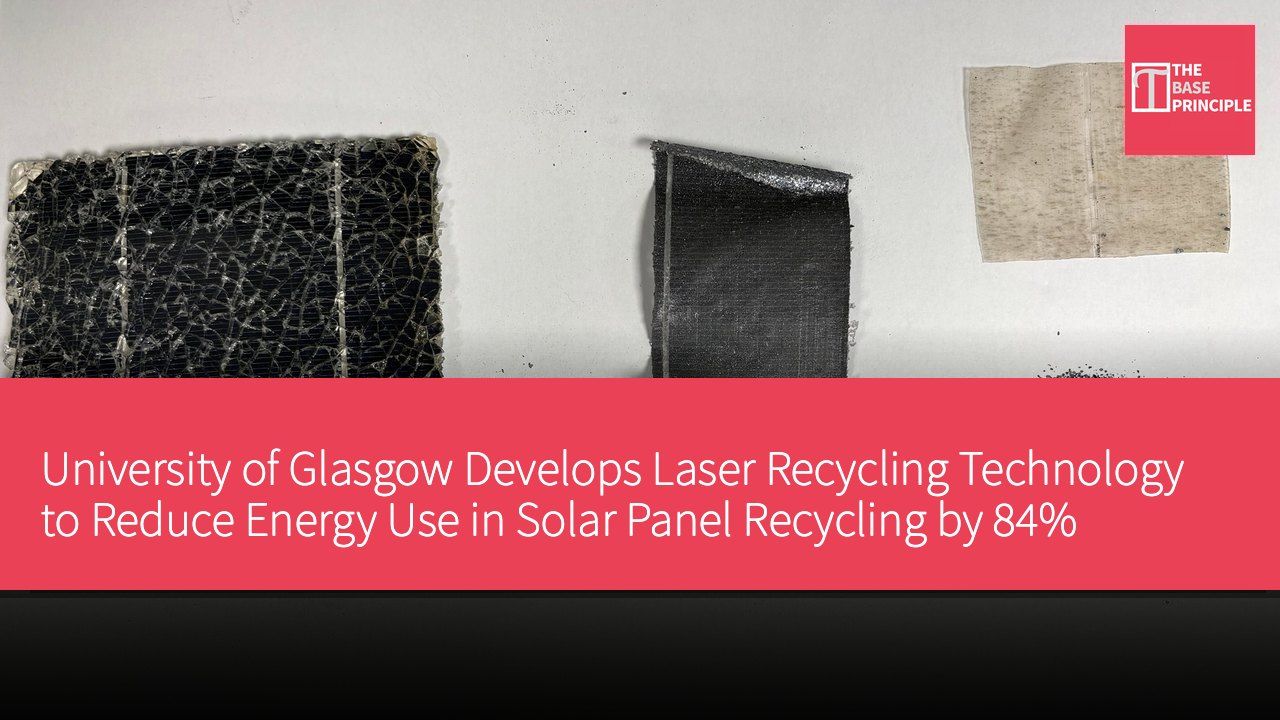
- The laser technology developed by the University of Glasgow can reduce energy consumption in solar panel recycling by about 84%.
- The technology effectively recovers valuable silver and silicon without the use of harmful chemicals.
- Researchers utilized standard industrial fiber lasers, which are widely used for marking and cutting.
- This technology has the potential to serve as the foundation for new laser processing equipment in the recycling industry.
Researchers at the University of Glasgow have developed a laser-based method that reduces energy consumption during the solar panel recycling process by approximately 84%, while recovering valuable silver and silicon. The university is collaborating with Watt Laser Ltd., based in Glasgow, to prepare this technology for commercialization. The global solar capacity is around 3 terawatts, and it is estimated that by 2030, solar panel waste will exceed 1 million tons, reaching 200 million tons by 2050. Although precious metals account for only 0.05% of the weight of the panels, they constitute about two-thirds of the waste's value.
Reasons for Recycling Difficulties
The difficulty in recycling stems from ethylene-vinyl acetate (EVA), a durable polymer that bonds the layers of the panels together. Traditional recycling methods require high temperatures of 450–600°C or the use of toxic chemicals to remove these polymers, consuming a significant amount of energy.
Researchers tested a 1064 nm fiber laser on decommissioned commercial solar cells provided by the Fraunhofer Silicon Photovoltaics Center in Germany. The laser can penetrate the transparent EVA and heat the underlying silicon, allowing the polymer to separate in complete membrane form. After removing the metal busbars, researchers obtained a powder containing silicon, aluminum, and silver. Diluted sodium hydroxide can remove aluminum, while iron chloride and choline chloride brine can dissolve silver. Tests on a specific type of panel achieved over 99% selectivity for silver recovery without the use of harmful nitric acid.
This method was developed by Bashayer Alsulami, a PhD graduate from the James Watt School of Engineering, during research on the metal recovery of decommissioned solar cells.
Dr. Joseph Cameron led much of the research and stated, "The plastic design that seals solar cells is meant to survive outdoors for decades. It performs excellently in this regard, but it is also why old panels are difficult to recycle. By using lasers, we can quickly release the encapsulating materials instead of burning or dissolving them. This allows us to handle cleaner materials at the recycling center. Silver can be selectively extracted through mild and simple chemical methods, while silicon is left behind for recovery."
Challenges and Potential for Commercialization
Declan Brannagan of Watt Laser Ltd. stated that the technology uses standard industrial fiber lasers, which are widely applied in marking and cutting. Commercial production will require multi-head systems to process entire panels. He noted, "Solar recycling is about to become a very large market, and the industry needs clean, selective, and economical processing methods. The standout aspect of this work is that it utilizes standard industrial fiber lasers, the same systems used on production lines for marking and cutting."
He added, "Scaling from a single laser head to a multi-head system capable of processing entire panels at commercial speeds is an engineering challenge we understand well. We see this technology has the potential to become the foundation for new laser processing equipment in the recycling industry, and we are excited about the opportunity to collaborate with the university to bring it to market. We anticipate that scaling this technology will take no more than a year, but at this stage, an industrial end-user is needed to stabilize production."
The research was conducted in collaboration with the EU APOLLO project and the REACT project led by the University of Glasgow. Jeff Kettle, the principal investigator and corresponding author of REACT, stated, "This project showcases the purpose of REACT. We have developed a process for a global issue that a laser company in Glasgow can help bring to commercial equipment."
He added, "We are pleased to work with Watt Laser to help refine this technology to make it more suitable for industrial use. We hope to see this technology ready for commercial use soon, making it part of the low-emission circular economy that REACT aims to help establish."
Prospects for Laser Technology in Solar Recycling
As solar installations become more widespread, the issue of solar panel recycling is becoming increasingly prominent. The laser technology from the University of Glasgow not only significantly reduces energy consumption during the recycling process but also efficiently recovers precious metals, which is crucial for environmental protection and resource reuse. The high energy consumption and use of harmful chemicals in traditional recycling methods limit their sustainability, while the emergence of this new technology could bring transformative changes to the industry, promoting cleaner recycling processes and supporting the establishment of a low-emission circular economy.