
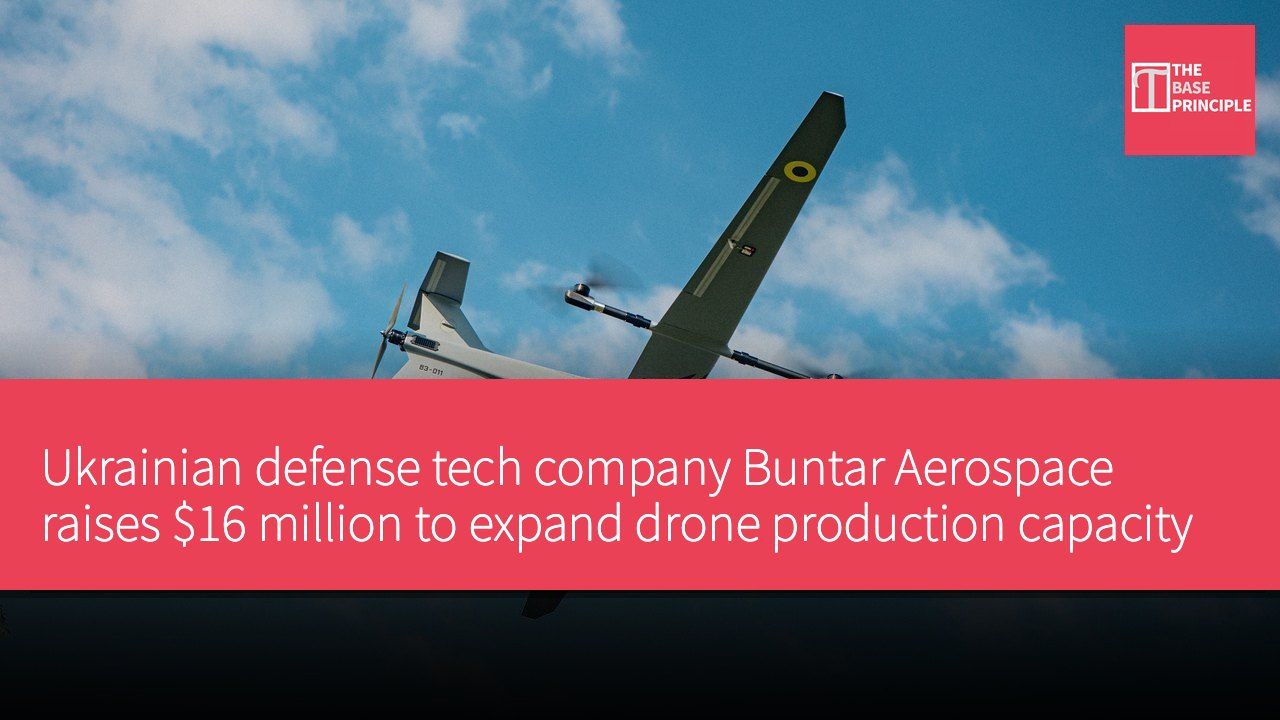
- Buntar Aerospace raised $16 million to expand drone production capacity.
- The company plans to hire talent and expand defense and civilian applications.
- Buntar will focus on missions for highly skilled operators, such as reconnaissance and precision strike support.
- The new funding will support product development and production integration.
Ukrainian defense technology company Buntar Aerospace has raised $16 million in a new funding round to expand production, develop autonomous systems and enter new markets. The investment brings the company's total funding to $30 million, and it plans further development based on its experience supplying reconnaissance technology to Ukrainian frontline units. The round was led by Freedom Fund and an international growth equity investor, with participation from Gardar, Iron Wolf and Autonomy Capital.
Expanding production and hiring talent
Buntar plans to use the funds to increase production capacity, hire engineering and operational talent, and expand its defense and civilian applications beyond intelligence, surveillance and reconnaissance.
Buntar's existing business is built on two products: the Buntar-3 reconnaissance drone and Buntar Copilot, an AI-driven software system designed to support drone operations in combat. The company says the combination has established a growing customer base among Ukrainian frontline units. Its next step is to extend that experience to broader autonomous defense systems. Co-founder Bohdan Sas said the company is focused on missions that place high demands on technical operators, including reconnaissance, counter-drone defense and precision strike support.
"Our goal is to target missions that rely most on highly skilled operators: reconnaissance, counter-drone defense and precision strike support. This is what Ukraine needs today, and what Europe must prepare for tomorrow," Sas said in a statement. The company's core thesis is to automate parts of those missions so personnel can focus on operational decisions rather than manually managing every aspect of a drone's flight or sensor operations. That will become critical as militaries deploy more uncrewed systems and face pressure to train operators faster.
Expanding dual-use product line
Buntar also plans to expand its dual-use product line, applying technology developed for defense to civilian markets. Autonomous systems have potential applications beyond the battlefield, though the company has not detailed the specific new products or commercial markets it intends to enter. Buntar's expansion comes as European defense technology attracts growing investor interest. According to data the company cited from Dealroom, European defense tech startups have raised $7.4 billion in venture capital this year, while drone startups secured $4.7 billion across 40 rounds.
U.S. investors accounted for 47% of European defense tech funding, underscoring the importance of international capital to the sector. However, the constraints involved in building defense technology for a Ukrainian company differ from the challenges faced by startups operating in more mature procurement systems. Sas argues that Europe's rising defense budgets should prioritize drones, software and trained operators rather than relying primarily on traditional military hardware. His argument reflects lessons from Russia's full-scale invasion of Ukraine, in which uncrewed systems have become central to reconnaissance, targeting and battlefield operations.
Buntar said the new funding will help it scale production while continuing to invest in research and development, rather than treating product development and production as separate phases. However, the company's long-term vision is to evolve from a reconnaissance technology supplier into a multi-domain defense autonomy business with international reach.
The importance of uncrewed systems in defense
As the conflict in Ukraine evolves, uncrewed systems have become increasingly critical in modern warfare. Buntar Aerospace's development strategy reflects the demand for highly skilled operators and the importance of automation in reconnaissance and combat missions. This is not only a response to current battlefield needs but also a forward-looking positioning for the future European defense market. As investor interest in defense technology grows, Buntar's dual-use product line expansion has the potential to open new commercial markets, further strengthening its position in the international defense sector.