
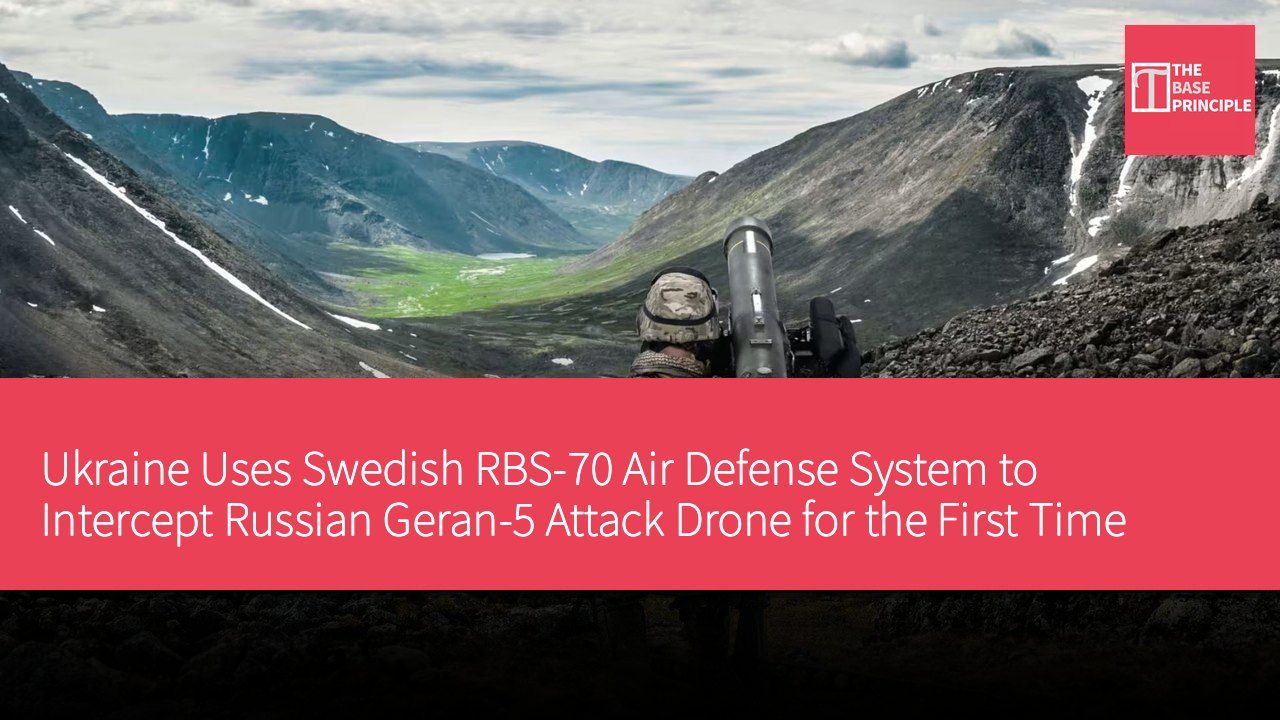
- Ukraine intercepted a Russian Geran-5 drone using the RBS-70 for the first time, demonstrating improved defensive capabilities.
- The Geran-5 flies at speeds exceeding 500 kilometers per hour, limiting interception response time.
- The RBS-70 system uses laser beam guidance, making it less sensitive to heat decoy signals.
- Sweden continues to support Ukraine's air defense by providing the RBS-70 system as military aid.
The Ukrainian military reported that for the first time in the Kyiv region, the Swedish RBS-70 air defense system intercepted a Russian jet-powered Geran-5 attack drone, underscoring Kyiv's efforts to tackle faster and harder-to-intercept Russian drones compared to traditional propeller-driven attack drones. The General Staff of the Armed Forces of Ukraine announced on November 13 that personnel from the 1027th Anti-Aircraft Missile and Artillery Brigade used the Swedish system to destroy the Geran-5, but did not disclose the specific location or time of the interception.
The RBS-70 operating team from the brigade described the interception during an interview with Ukrainian media LB.ua on November 11. The commander, who identified himself by the call sign Vigo, stated that the drone was flying at speeds exceeding 500 kilometers per hour (310 miles per hour) and descended within minutes of approaching its target, which limited the response time for the air defense forces.
Features of the Geran-5 Drone
Why is the Geran-5 harder to intercept? Unlike the propeller-driven Geran-2 drone commonly used by Russia, the Geran-5 employs a jet engine and a conventional aircraft configuration. The Ukrainian Defense Intelligence Agency (HUR) stated that the drone is similar to Iran's Karrar and incorporates components from other Russian Geran models. According to a technical assessment by HUR in January 2026, the Geran-5 has a maximum takeoff weight of approximately 850 kilograms (1,874 pounds), a cruising speed of 450-600 kilometers per hour (280-373 miles per hour), and an estimated range of up to 950 kilometers (590 miles).
These figures are estimates from Ukrainian intelligence and not independently verified performance measurements. Its higher speed reduces the time available for air defense forces to detect, identify, and intercept, making systems capable of tracking faster aerial targets increasingly important for Ukraine's layered air defense system.
How the RBS-70 System Works
How does the Swedish RBS-70 missile work? Developed by Swedish defense company Saab, the system uses laser beam guidance technology, unlike many shoulder-fired air defense missiles that utilize infrared guidance. Operators must keep the target within the system's field of view, and the missile follows the projected laser guidance path. Since the missile does not rely on infrared guidance, traditional heat decoy signals cannot effectively disrupt its flight. The system is also less sensitive to certain forms of electronic interference that may affect radar-guided weapons. However, its guidance method requires operators to maintain visual contact and continuously track the target during the interception process.
Depending on the missile variant, the RBS-70 series offers interception ranges of several kilometers. Saab's new RBS-70 NG configuration claims a range exceeding 9 kilometers (5.6 miles) and can cover altitudes of up to 5 kilometers (3.1 miles).
Sweden's Support for Ukraine
Sweden continues to support Ukraine's air defense systems. Sweden has provided the RBS-70 system to Ukraine as part of its military aid. In February 2025, the Swedish government announced a defense package worth 1.2 billion Swedish kronor (approximately 113 million USD at the time), which includes the latest version of the RBS-70 and the Tridon Mk2 air defense system. The interception of the Geran-5 is not Ukraine's first successful interception of a jet-powered drone. In September 2026, the 1020th Anti-Aircraft Missile and Artillery Brigade released a video showing a Ukrainian-made STING interception drone destroying the drone.
Ukraine is also exploring other relatively economical methods to counter faster aerial threats, including intercepting drones and automatic gun systems. The latest RBS-70 interception operation demonstrates how existing short-range missile systems can contribute to efforts against Russia's increasing use of jet-powered attack drones.
Item Specifications Maximum Takeoff Weight 850 kg (1,874 lb) Cruising Speed 450–600 km/h (280–373 mph) Estimated Range 950 km (590 miles)
Evolution and Challenges of Ukraine's Air Defense System
In facing the threat of Russia's new Geran-5 drones, Ukraine has demonstrated the adaptability and innovative capabilities of its air defense system. The use of the RBS-70 system not only enhances interception efficiency but also reflects Ukraine's ongoing technological advancements. As drone technology evolves, Ukraine must continuously explore effective defensive strategies to counter faster and more advanced aerial threats. Sweden's support provides Ukraine with the necessary resources to strengthen its air defense capabilities in the ongoing conflict, which is crucial for national security.