
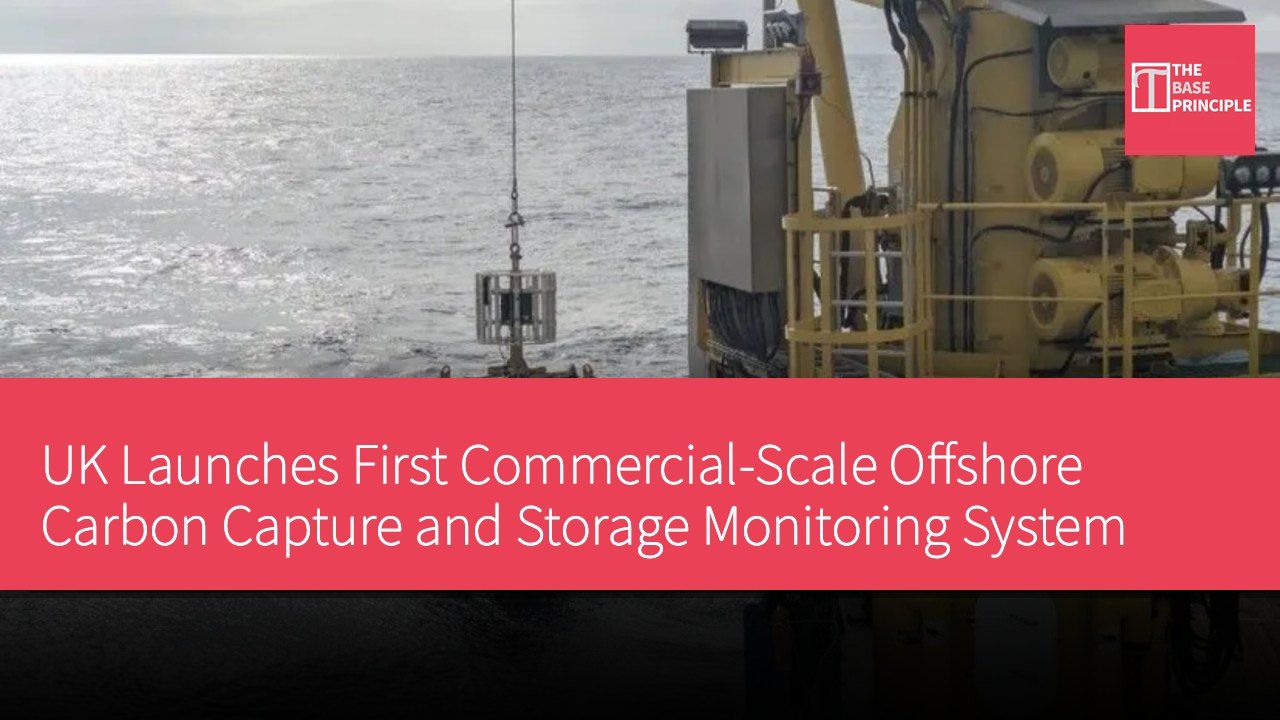
- The UK has launched the first commercial-scale offshore carbon capture and storage project monitoring system.
- The system consists of six seabed monitors that will operate before carbon dioxide injection.
- The monitoring plan will collect baseline data to ensure the safe storage of carbon dioxide.
- The Endurance project will be the UK's first operational commercial-scale offshore CCS project.
The UK has installed the first monitoring systems for its first commercial-scale offshore carbon capture and storage (CCS) project, marking a significant breakthrough towards developing facilities expected to permanently store up to 100 million tons of carbon dioxide in the North Sea. The system, consisting of six seabed monitors, has been deployed approximately 93 miles (150 kilometers) off the coast of Teesside at the Endurance CO₂ storage facility and will operate before the injection of carbon dioxide begins. According to the team, this new system will establish baseline conditions for the environment and seismic activity, enabling engineers to verify that the injected carbon dioxide is safely stored underground throughout the project's duration.
The system is being deployed under the Northern Endurance Partnership (NEP) project, a joint venture established by BP, Equinor, and TotalEnergies. This partnership is developing transportation and storage infrastructure for the East Coast cluster of the UK, which is a flagship industrial decarbonization initiative for the country.
Deployment and Functionality of the Monitoring System
The carbon dioxide injection plan is set to begin in 2028, at which point Endurance will become the UK's first operational commercial-scale offshore CCS project. Prior to carbon storage, this monitoring plan combines three autonomous environmental monitors built by Sonardyne (now part of Kraken Robotics) and three co-located TIAMAT passive seismic monitoring systems developed by Germany's K.U.M. The newly deployed system is collecting baseline data on seawater chemistry, ocean currents, seabed conditions, and natural seismic activity for reference comparisons before any carbon dioxide is injected into these storage systems.
Once the storage operations commence, these measurements will provide a benchmark for future changes.
The reservoirs beneath the seabed are located approximately 3,280 feet (1,000 meters) deep. At these depths, the porous rock layers are expected to permanently store captured industrial emissions transported from Teesside and Humber. Under the project's measurement, monitoring, and verification (MMV) plan, the monitoring equipment is designed to demonstrate that the stored carbon dioxide remains safely contained within geological formations for decades.
Sonardyne's monitors are designed to operate autonomously on the seabed for extended periods without the need for regular retrieval. Their onboard power management, edge data processing, and wireless underwater acoustic communication technologies facilitate remote operations and regularly transmit information to the surface. This allows engineers to collect data over long periods without the need to repeatedly retrieve instruments, reducing operational costs while maintaining continuous monitoring of the storage site. "Confidence in offshore carbon dioxide storage begins with good data," said Stephen Auld, Sonardyne's custom project business development manager.
He noted that reliable environmental and microseismic monitoring is crucial throughout the entire storage lifecycle, not just at a specific point in time.
Key Steps to Ensure Long-Term Safety
NEP states that establishing environmental and seismic baselines before operations begin is a key step in demonstrating the long-term safety of offshore carbon storage. "The deployment of these monitoring systems is a great example of how expertise and innovation can drive the implementation of CCS in the UK," said Mike Stephen, NEP's technical director. He added that the data collected will help verify the safe storage of carbon dioxide over the long term while supporting the necessary infrastructure to facilitate decarbonization of heavy industry in Teesside, Humber, and surrounding areas. Once operational, the Endurance project will provide offshore storage components for the East Coast cluster, transporting captured carbon emissions from industrial facilities to the North Sea for permanent underground storage.
During its first 25 years of operation, the site is expected to store up to 100 million tons of carbon dioxide, making it one of the largest planned offshore carbon storage projects in Europe.
Innovations and Challenges in Offshore Carbon Capture
The UK's offshore carbon capture and storage project marks a significant environmental advancement, particularly in the context of addressing climate change. As global demand for reducing carbon emissions rises, the development of such technologies becomes increasingly critical. The project's monitoring system not only provides essential data but also enhances public confidence in the long-term safe storage of carbon dioxide. As operations commence, this will offer valuable insights for other countries, promoting the global application of carbon capture technologies.