
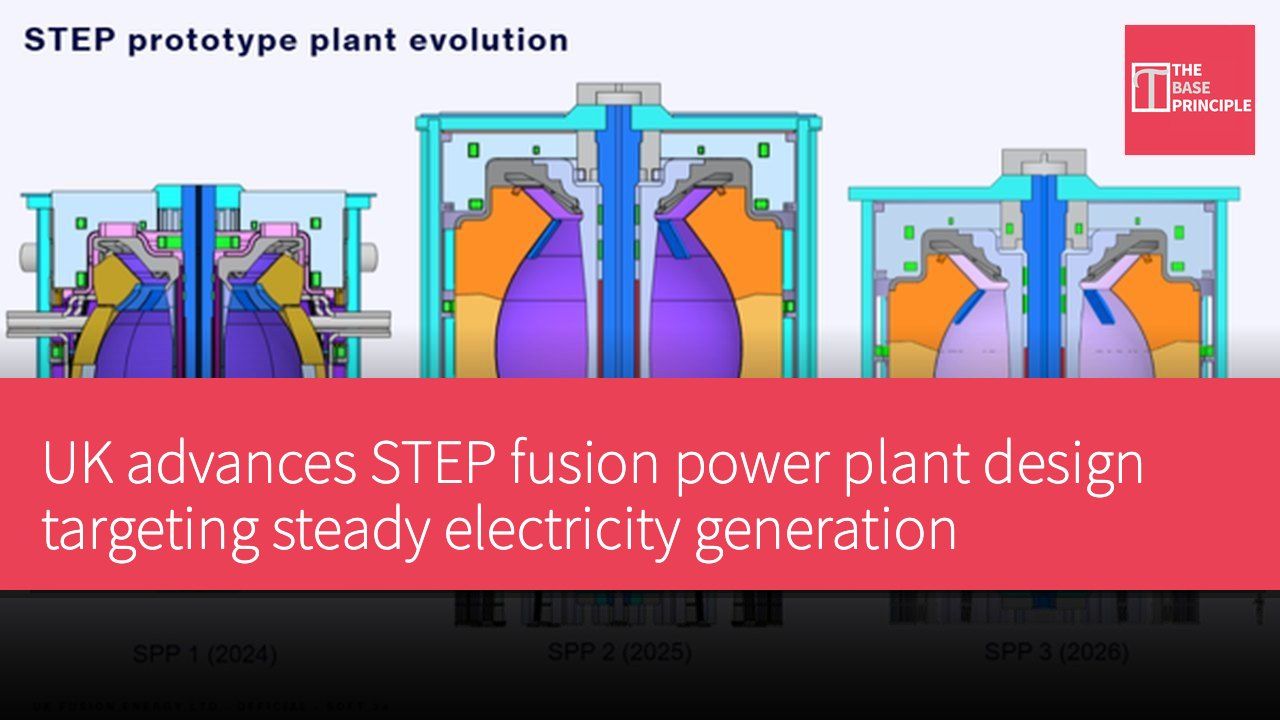
- STEP Fusion program unveils new design targeting steady electricity generation.
- SPP3 design delivers continuous energy flow through steady-state architecture.
- Plant will adopt stacked-ring architecture to simplify maintenance processes.
- Program aims to pave the way for global fusion power plant development.
The UK-led STEP Fusion program has recently breathed new hope into fusion energy, long regarded as perpetually 30 years away, and unveiled a series of blueprints. The UK Atomic Energy Authority (UKAEA) has advanced the design of its STEP fusion power plant, aiming to deliver clean, grid-connected fusion energy. At the 34th Symposium on Fusion Technology (SOFT 2026) held in Aix-en-Provence, France, the UK's flagship fusion project revealed its third-generation design iteration, SPP3, the latest version of its Spherical Tokamak for Energy Production prototype power plant.
The core challenge of fusion energy typically lies not in how to make it work, but in how to keep it operating long enough to turn a profit. SPP3 changes this dynamic through its compact, heart-shaped spherical tokamak design. This steady-state architecture enables the plant to run continuously, providing a stable energy flow to support reliable grid supply. "It's all very difficult, but we must stay focused on the benefits," said Sam Davis, Head of Tokamak Machine Engineering at STEP Fusion. "We are deliberately taking on some technical challenges and uncertainties because this will unlock steady-state operation and practical maintenance."
SPP3 Design's Steady-State Operation
To realize this vision, engineers focused on the plant's massive microwave heaters, known as gyrotrons. These systems can heat plasma to over 1.5 million degrees Celsius. Improving their efficiency means reducing the energy consumed solely to maintain internal temperatures. However, creating a self-sustaining miniature star is only half the battle. When it breaks, it must be repairable. Intense heat and high-energy neutrons rapidly damage the reactor interior. If replacing a component takes months, the plant becomes an expensive paperweight.
STEP's solution is a "stacked rings" architecture combined with a vertical maintenance approach, first publicly showcased at SOFT 2026. Technicians can vertically access internal reactor components without peeling back complex machinery layer by layer like an onion. "These innovations are designed to simplify access to internal reactor components, reduce maintenance downtime, and support the high availability levels required for future fusion power plants," the press release noted.
Innovations Simplifying Maintenance
Although the risks remain high, the engineering required to control a star in a commercial grid environment is almost absurdly complex. "Of course, we are going all out to de-risk, for example by testing everything we can test," Davis added. STEP Fusion is a pioneering UK technology and infrastructure program aimed at establishing a prototype fusion power plant. This facility will demonstrate net energy production, fuel self-sufficiency, and practical maintenance strategies, paving the way for the development of commercial fusion power plants worldwide.
Harnessing the natural process that powers stars offers a safe, abundant, low-carbon solution to humanity's growing energy challenges. The project plans to build on the site of a decommissioned coal-fired power station at West Burton in Nottinghamshire, UK, with a total budget of £2.5 billion, targeting delivery of approximately 100 megawatts of net electricity to the national grid by 2040. Beyond continuous power supply, SPP3 is also designed to breed its own rare tritium fuel, ultimately proving that fusion energy can transition from a high-risk physics experiment into a repeatable commercial power grid.
Commercialization Challenges and Opportunities for Fusion Energy
Fusion energy is seen as key to future clean energy, but its commercialization faces numerous challenges. The success of the STEP Fusion program depends not only on technological innovation but also on effective maintenance strategies to ensure high plant availability. Through the newly designed SPP3, engineers are attempting to solve long-standing operational stability issues, which are critical for realizing fusion energy in commercial grids. As technology advances, future fusion power plants have the potential to transform into sustainable and repeatable energy sources, thereby addressing growing global energy demand.