
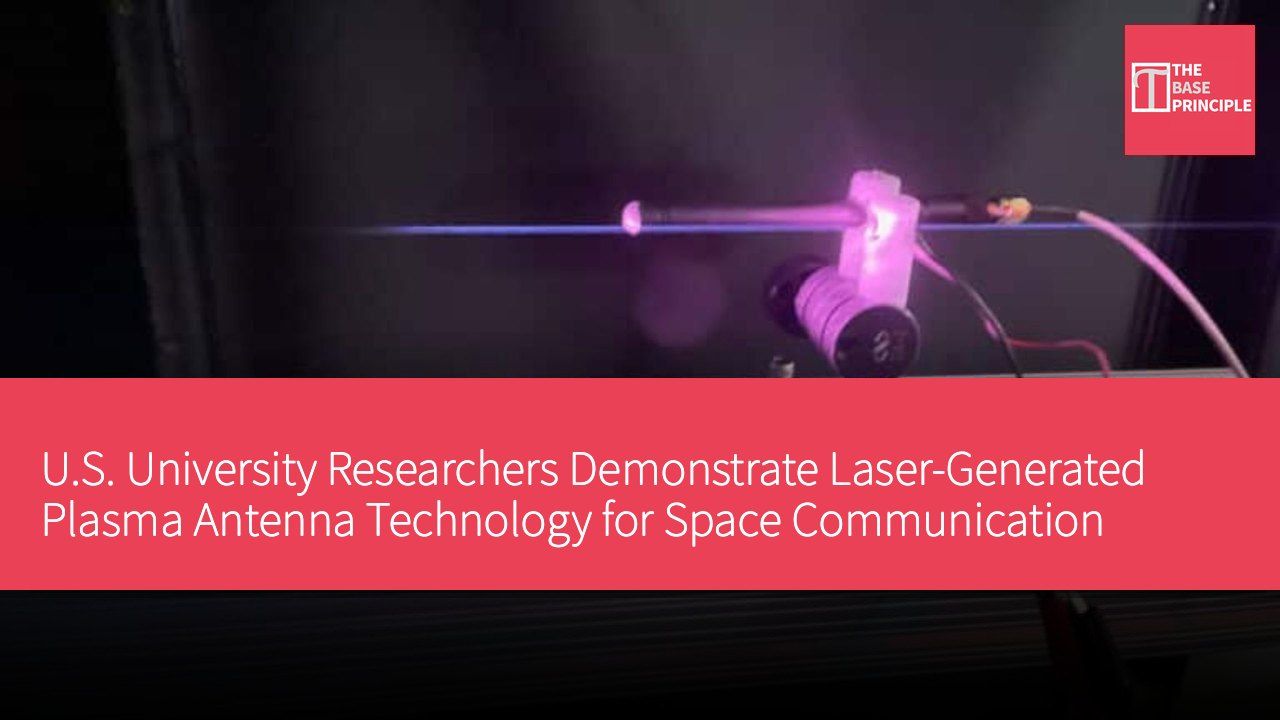
- Researchers demonstrated plasma antenna technology for space communication.
- Traditional metal antennas face installation issues and size limitations in space.
- Laser-generated plasma beam antennas can adjust in length and angle.
- Research is ongoing, with plans to enhance performance for space exploration applications.
Researchers at a U.S. university have developed a technology capable of creating plasma antennas that resemble "lightsabers," which can send and receive radio signals in space or aircraft without the need for complex mechanical installations. According to the scientists, these laser-generated plasma filament antennas have never been proven to work, claiming this is the first demonstration of the technology globally. The study's corresponding author, PhD student Prya Darshni from North Carolina State University, stated, "This is the first step, but it is a big step—this is the first time anyone has demonstrated that plasma filament antennas can work."
Traditional metal antennas are prone to installation issues in radio wave communication, especially in space. She emphasized that these antennas can bend or break when deployed. The drawbacks of physical antennas include their large and bulky size, which occupies more space, increasing mission costs and requiring expertise for effective use. Some may argue for budget cuts and reduced payload weight for antennas; however, simply shortening the antenna's length is not straightforward. Researchers noted that the length of the antenna is a key factor in determining which signals a radio antenna can transmit or receive.
Darshni stated, "The length of the antenna controls the frequencies of radio waves that can be transmitted and received."
Advantages of Plasma Antennas
"However, in certain applications, such as space exploration technology, manipulating the length of the antenna to scan the desired frequency range may pose challenges." To overcome these bottlenecks, the research team turned to lasers, generating plasma beam antennas that can be adjusted to any length or angle without requiring extra space or cumbersome adjustments to achieve faultless signals. In experiments, researchers fired a laser beam of specific power and diameter to ionize a thin strip of air, forming a glowing plasma beam or "filament" that resembles a "lightsaber."
Contactless Radio Signal Transmission
However, to give these laser-induced beams their mysterious capabilities, additional impetus is needed to establish a radio connection. This is a necessary condition for making the plasma antenna functional. To achieve this, researchers developed a contactless method to send radio signals to it. They placed a metal ring around the laser beam, allowing the beam to pass through the center. This ring acts as a capacitor, generating an electromagnetic field that transmits radio signals into the plasma without making contact. Subsequently, electromagnetic waves can transmit electrons in the air, which are pushed to the edges of the plasma, demonstrating that the laser-induced plasma filament can radiate electromagnetic waves like a typical antenna, the research report noted.
Darshni stated, "Now that we have proven this is possible, we can start improving its performance." She noted that the research is still in its early stages, and work is ongoing. "We have not yet demonstrated its capability as an antenna for receiving radio signals; there is no reason to believe it won't work as a receiver." Next, the team plans to transform this new "lightsaber" antenna from a potential solution into a real solution for space exploration by enhancing its radiation characteristics for radar applications.
Potential Impact of Plasma Antenna Technology
The development of this new technology could revolutionize traditional radio communication methods, especially in space exploration. The drawbacks of traditional metal antennas include their large size and susceptibility to damage, while plasma antennas offer a flexible solution that can be adjusted without the need for complex installations. Through laser technology, these antennas not only overcome spatial limitations but also enhance signal transmission efficiency. As research progresses, this technology has the potential to become a crucial component of future space missions, potentially reducing costs and risks.