
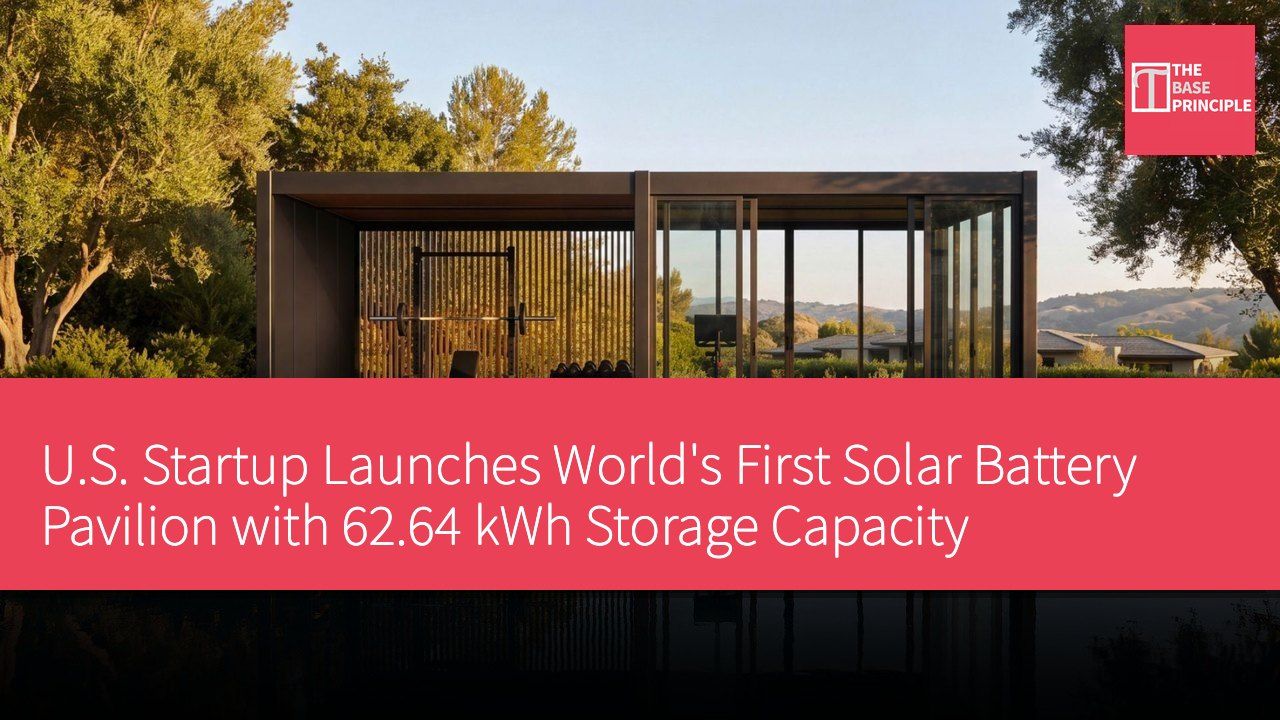
- Outer Spaces will present the OS1 pavilion at the RE+ conference, integrating solar power with a storage system.
- The OS1 is available in two sizes and can be configured with up to eight battery modules, offering a maximum storage capacity of 62.64 kWh.
- The system is designed to be modular for easy on-site assembly and supports large motor equipment.
- Outer Spaces plans to launch the product in Southern California in 2027, with specific pricing yet to be announced.
A California-based startup is transforming backyard decks into home energy systems. Outer Spaces will showcase its OS1 pavilion live for the first time at the RE+ conference, taking place from November 16 to 19, 2026, at the Las Vegas Convention Center. The company claims this is the "world's first" product that combines a solar pavilion with a battery deck. The OS1 installs solar panels on the pavilion roof, while the batteries are placed beneath the deck, providing homeowners with a way to generate and store electricity without altering their roof.
The full-size unit located at booth W17153 will demonstrate these two components and their connected electrical wall.
Design and Features of the OS1 Pavilion
Outer Spaces will offer two sizes of the OS1. The 12-foot x 12-foot model has approximately 2.5 kW of solar generation capacity, while the 12-foot x 24-foot version has about 5 kW. Below the deck, slim lithium iron phosphate battery modules are neatly housed in dedicated compartments, keeping the deck clear for furniture and appliances. Each module can store 7.83 kWh of electricity. Homeowners can configure one to eight modules, achieving a maximum storage capacity of 62.64 kWh.
The electrical wall of the pavilion includes a hybrid inverter, OS1 DC Hub, and distribution equipment. Liu Jiake, co-founder and CEO of Outer Spaces, stated, "We designed the OS1 around the battery from the start, so cooling, waterproofing, and wiring are all integrated into the frame. It is a modular system that is easy to assemble on-site."
The OS1 has a rated power output of up to 11.4 kVA. Outer Spaces indicates that the system can start large motor equipment, including air conditioners and heat pumps. Whether it can support an entire home during a power outage depends on the system's configuration and the connected devices. Homeowners can control the system via an app or web interface, allowing them to manage electricity usage based on storage purposes, time-of-use rates, or reserve power during outages. The system is also designed to participate in virtual power plants, connecting batteries with other distributed energy resources as permitted by regional programs.
Future Market Plans and Partnerships
Outer Spaces plans to launch the pavilion in Southern California in 2027, with licensed electricians responsible for the final connection to homes. The company aims to meet with builders and installers at the RE+ conference to recruit its first Southern California partners. The company was initiated in October with $8 million in seed funding led by Upfront Ventures, with participation from Unlock Venture Partners, Mucker Capital, and Genius Ventures.
Liu Jiake co-founded the company with Lin Derui and Liao Rongde, who also established the outdoor furniture brand Outer. Sales are expected to begin in 2027 in Southern California and other parts of the U.S. Outer Spaces plans to sell through online channels and partnerships with installers, builders, and developers. The company has not disclosed pricing for any model and anticipates announcing prices in early 2027.
Item Specifications Solar Generation Capacity 2.5 kW (12'x12') / 5 kW (12'x24') Battery Storage Capacity 7.83 kWh (per module), up to 62.64 kWh Rated Power Output Up to 11.4 kVA
Market Potential and Innovation of the OS1 Pavilion
The launch of the OS1 pavilion marks an innovation in home energy systems, combining solar power generation with battery storage to provide users with flexible energy management options. This design not only enhances energy self-sufficiency but also offers support during power outages, demonstrating its potential in addressing energy crises. Additionally, the modular design simplifies the installation process and enhances adaptability, suggesting that its future rollout in Southern California and other markets could transform home energy usage, attracting consumers with a demand for renewable energy.