
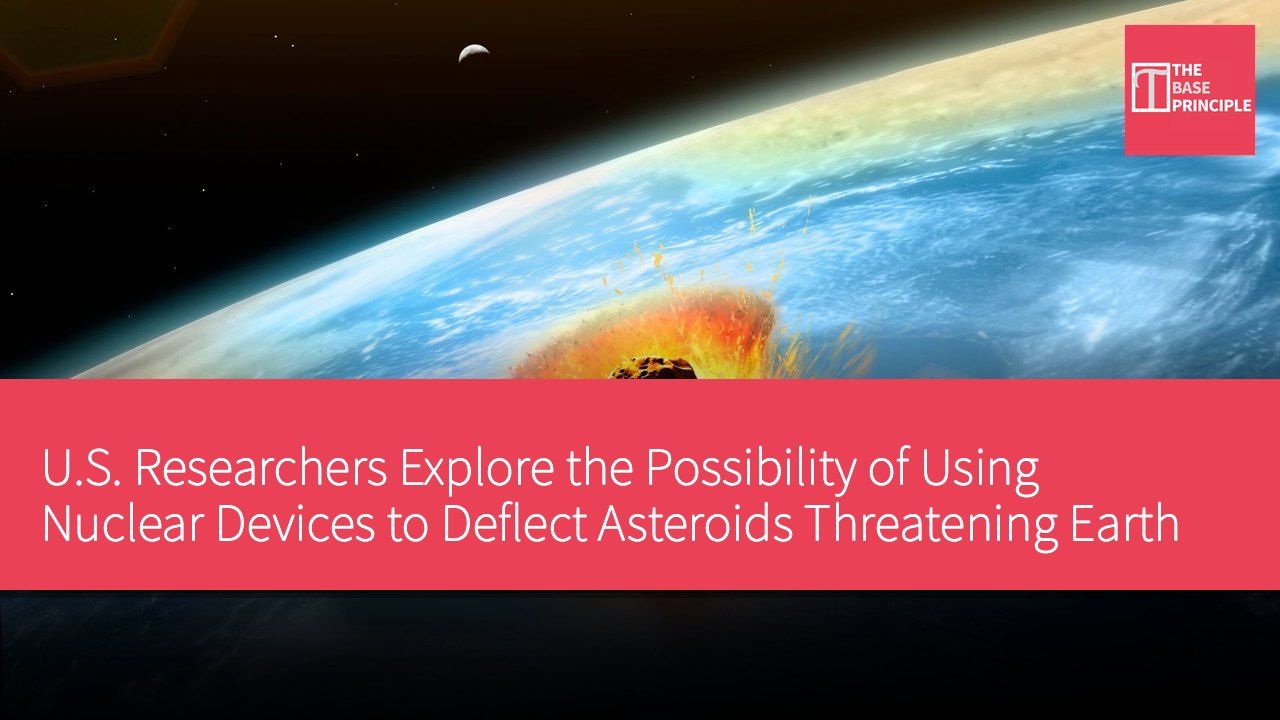
- Researchers are developing three-dimensional simulations to explore the possibility of deflecting asteroids with nuclear devices.
- Nuclear deflection is seen as an emergency option for large asteroids.
- Simulations show that the asteroid's response to nuclear deflection provides detailed insights.
- Spheral simulations help understand the effects of material damage and motion.
Researchers in the United States are developing three-dimensional simulations to examine how nuclear devices could be used to deflect or potentially disrupt asteroids that threaten Earth. A team from Lawrence Livermore National Laboratory (LLNL) is utilizing the Spheral simulation code to more accurately model the reactions of asteroids when a nuclear device detonates near their surface, due to the rapid heating and vaporization of materials by X-rays. After validating this approach against established asteroid deflection models, the researchers used Spheral to study three complex disruption scenarios.
Impacts from hazardous asteroids can potentially be prevented. The team revealed that, unlike many natural disasters, it is possible to prevent hazardous asteroid impacts if they are detected early. One method is deflection, which involves applying a small change in velocity to steer the asteroid away from Earth while largely maintaining its integrity. Another method is disruption, which intentionally fragments and disperses the asteroid, ensuring that no remaining parts pose a significant threat to Earth. NASA's Double Asteroid Redirection Test (DART) demonstrated a kinetic impact deflection method in 2022 by deliberately crashing into the asteroid moon Dimorphos.
Nuclear Deflection as an Emergency Option
According to a press release, nuclear deflection represents an alternative emergency option, particularly for larger objects or scenarios with shorter warning times, as it can provide more energy to the asteroid compared to the kinetic energy from a spacecraft impact. Two simulations showed strong signs of disruption, highlighting how high-fidelity three-dimensional modeling can help researchers better understand the asteroid's response to nuclear deflection attempts. Research leader Isaiah Santistevan stated, "These simulations provide us with a more detailed picture of how an asteroid might respond to nuclear deflection attempts."
Santistevan noted, "Being able to simulate damage, fracture, and material motion in three dimensions is an important step in improving our ability to assess planetary defense options." The researchers revealed that to test this approach, they compared over 1,500 one-dimensional Spheral simulations with asteroid deflection results from LLNL's established Ares simulation code. The calculations showed a close consistency between the two codes, giving researchers confidence to use Spheral for more complex three-dimensional disruption simulations.
Simulation Results Show Asteroid Damage
Santistevan revealed that Spheral is particularly suited for simulating issues involving material damage, fracture, and fragmentation. The researchers then simulated three disruption scenarios involving an irregularly shaped asteroid approximately 160 meters in size, varying the distance of the nuclear explosion and the ease of fracturing the asteroid's material. In the longest-running simulation, about 98% of the asteroid's material was completely damaged, indicating a severe loss of its ability to remain intact. The simulations also showed that about 97% of the material was moving at speeds exceeding the asteroid's escape velocity, with most material moving in the opposite direction, further indicating that the object was breaking apart.
Santistevan stated, "It is encouraging to see that the asteroid sustained extensive damage while the material's motion speed was sufficient to escape its gravity." He added, "These are all important indicators that the asteroid is undergoing disruption, and three-dimensional simulations allow us to examine this process in greater detail."
The Importance of Three-Dimensional Simulations for Asteroid Defense
The threat of asteroid impacts on Earth has long been a focus of the scientific community. With advancements in technology, researchers are using three-dimensional simulations to gain deeper insights into the effects of nuclear devices on asteroids, which is crucial for developing effective defense strategies. Through simulations, researchers can more accurately predict the behavior of asteroids under nuclear explosions, enhancing understanding of asteroids and aiding decision-makers in making more informed choices when faced with potential threats.