
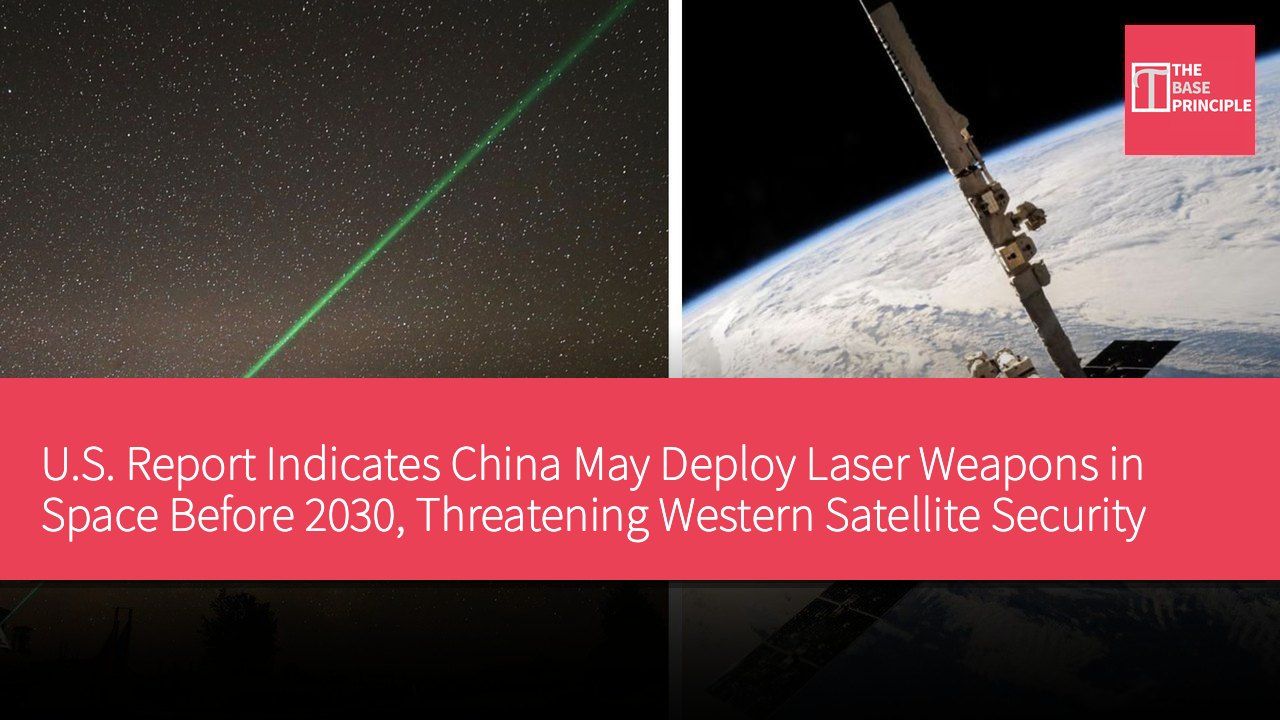
- China may deploy laser weapons in space before 2030, threatening the security of Western satellites.
- Anti-satellite weapons can permanently damage or destroy satellites, leading to long-term space debris issues.
- China views space superiority as a key component of modern information warfare.
- The report indicates that China possesses various ground-based laser weapons capable of threatening low Earth orbit satellites.
According to a recently released U.S. report, China may deploy laser weapons in space before 2030. The report, issued by the Defense Intelligence Agency, states that China, Russia, Iran, and North Korea are developing, testing, deploying, and using space capabilities in a manner that threatens all space systems and their associated interests. Titled "Challenges to Space Security," the report claims that China and Russia are developing a range of powerful offensive capabilities to degrade or destroy other nations' space services, encompassing everything from kinetic destruction to complex jamming and cyber operations. The actions of these countries often contradict the principles of a secure, reliable, and sustainable space environment.
Anti-space weapons can prevent, disrupt, temporarily disable, or permanently incapacitate space assets and the critical services they provide. Space services provided by military, civilian, and commercial providers may face risks from actors intentionally seeking to disrupt military space services, as commercial and civilian space services are sometimes linked to certain military capabilities. While many anti-space weapons or tactics are designed to temporarily degrade space services, the report notes that other weapons may permanently damage or destroy satellites. Anti-satellite (ASAT) missiles are designed to kinetically strike and destroy satellites, potentially creating a large amount of debris that could remain in orbit for decades or even centuries.
China's Space Superiority and Weapon Development
The report also emphasizes that the goals of the People's Liberation Army include achieving space superiority, as Beijing seeks to control the information domain in space and deny its adversaries access to space information and communication capabilities. China views space superiority as a key component of conducting modern "information warfare." China has developed and will continue to enhance weapons capable of jamming, damaging, and destroying satellites. It is continuously researching, developing, testing, and deploying various types of anti-space weapons, including ground-based anti-satellite missile systems capable of destroying satellites. Directed energy weapons (DEWs) can temporarily or permanently blind imaging satellites and affect overhead persistent infrared (OPIR) and meteorological sensors, thereby hindering monitoring, tracking, and strike capabilities against forces.
The report further claims that nuclear-armed countries can launch warheads on long-range rockets, such as intercontinental ballistic missiles (ICBMs) or space launch vehicles (SLVs), and may conduct high-altitude nuclear explosions or even place nuclear weapons in space. In any case, nuclear explosions in space or near space would cause widespread electromagnetic interference, potentially leading to damage or destruction of satellites. China is developing space launch capabilities to ensure it has an independent and reliable means of accessing space and competing in the international space launch market. Beijing set a national record for space launches in 2025, with a total of 93, including 25 commercial launches.
In the first quarter of 2026, 18 launches were conducted, six of which were commercial launches.
China is working to improve manufacturing efficiency and launch capabilities while expanding its crewed space and deep space exploration missions, including trips to the Moon and Mars. China is developing space-based technologies, including on-orbit anti-space weapons that pose risks to space systems. To study space debris removal, China has launched several satellites, such as the experimental satellite Shijian-21 in geostationary orbit, to conduct scientific experiments and test space maintenance technologies. These systems, including the satellite Shijian-17 with robotic arms, can be used to capture other satellites.
In January 2022, Shijian-21 moved a defunct Beidou navigation satellite to a higher orbit. In January 2025, China launched Shijian-25 in GEO, claiming it would test orbital refueling and maintenance capabilities.
China's Ground-Based Laser Weapon Capabilities
The report also highlights that China possesses various ground-based laser weapons with different power levels, capable of jamming, degrading, or damaging low Earth orbit satellites. By the late 2020s, China may deploy space-based directed energy systems and higher-powered ground-based directed energy systems that could threaten high-altitude satellites. In January 2021, PLA media claimed that laser weapons had entered a "golden age," mentioning temporarily blinding sensors (i.e., "dazzling") as one of the many tactical applications of laser weapons.
Potential Impacts of China's Space Weapon Development
China's actions to strengthen its space weapon development reflect its ambitions in the global military and technological competition. As space superiority becomes an essential aspect of modern warfare, China's anti-space capabilities not only threaten the security of other nations' satellites but may also impact global communications and intelligence gathering. The deployment of such weapons could raise concerns within the international community, prompting other countries to bolster their own space defense measures and further intensifying the space arms race.