
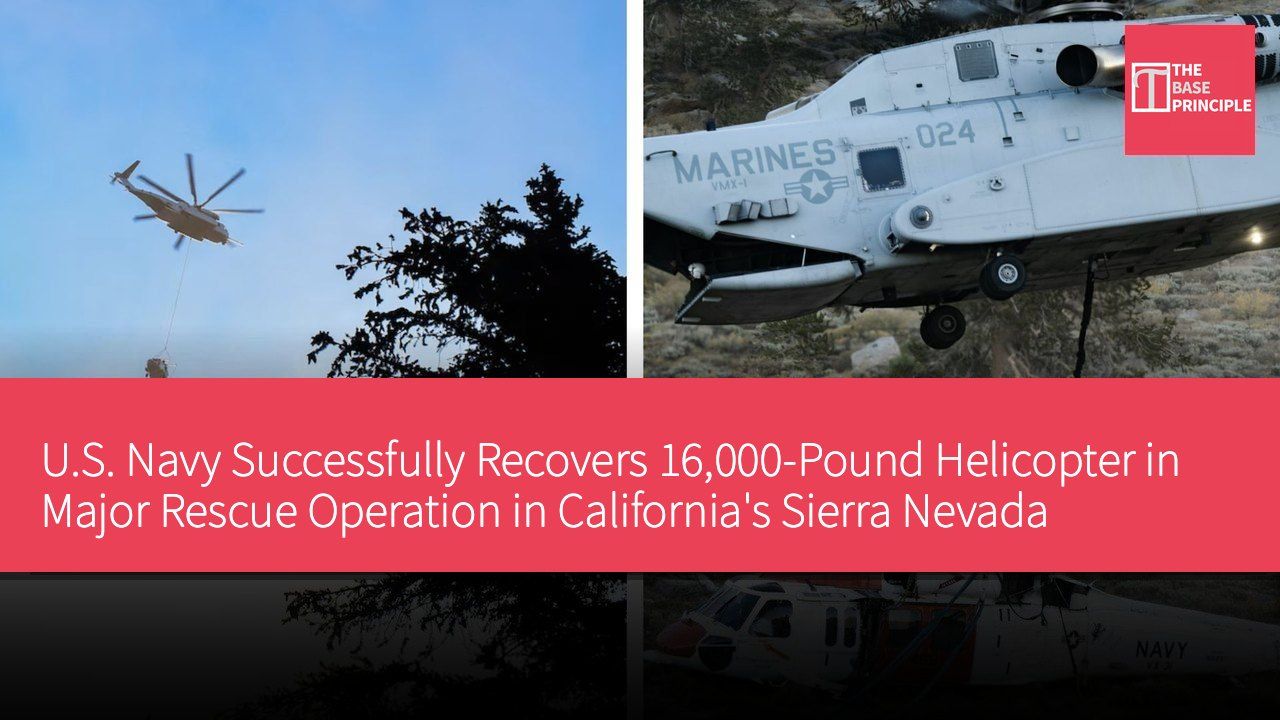
- The U.S. Navy successfully recovered a downed MH-60S helicopter, weighing approximately 16,000 pounds.
- The recovery operation was executed by a CH-53K King Stallion helicopter using a specialized lifting configuration.
- This recovery operation provided an opportunity to certify the CH-53K's application in lifting operations.
- Henderson noted that the CH-53K's power and precise control systems reduced the risks associated with the recovery.
A powerful U.S. Navy helicopter recently succeeded in recovering a downed MH-60S Seahawk helicopter. The recovery operation was carried out by a CH-53K King Stallion helicopter from the U.S. Marine Corps, which retrieved the nearly 16,000-pound MH-60S from the Sierra Nevada region. During the recovery process, the CH-53K utilized a "long line" technique employed by the Marine Corps Operational Test and Evaluation Squadron (VMX) 1, safely transporting the helicopter back to the Naval Air Weapons Station China Lake airport in California.
Since the MH-60S sustained no damage during the recovery process, it can be flown again without requiring extensive maintenance.
Technical Challenges During the Recovery
The helicopter recovery utilized a specialized lifting configuration developed in collaboration with the Naval Air Warfare Center Aircraft Division (NAWCAD) Cargo Lab and the Maritime Industrial Infrastructure and NAWCAD Structural Lab. Major Lee Henderson, a pilot and primary planner from VMX-1, stated, "The most challenging part of the recovery was not simply lifting the H-60, but ensuring it was done safely without causing any additional damage. We integrated existing MH-60S lifting procedures and slings, using a 70-foot long line to ensure proper load distribution and obstacle clearance."
The long line used in this recovery operation exceeded the standard equipment slings used by the U.S. Marine Corps in lifting operations, thus providing a certification opportunity for the CH-53K in this application. The MH-60S was unable to take off due to the terrain angle; it belonged to the Air Test and Evaluation Squadron (VX) 31 and had made a hard landing at 10,000 feet without sustaining damage. Due to the terrain, it was extremely difficult to transport personnel and equipment to the site, making it challenging to reduce the helicopter's fuel load to decrease weight.
Unique Capabilities of the CH-53K
The CH-53K King Stallion helicopter is the only aircraft capable of executing the recovery of the MH-60S, as it possesses the necessary power and ability to handle challenging terrain. The goal of the recovery was to maintain the integrity of the MH-60S as much as possible to avoid damaging any components. Experts from the Cargo and Structural Labs participated in the development of the lifting procedure, coordinating the testing and certification of the long line, and conducting long line tests and data processing to prepare the final report, while providing on-site support during the recovery process.
The H-60 fleet support team from the U.S. Marine Corps' Marine Corps Air Station Cherry Point also provided guidance on the MH-60S lifting configuration and assisted in weight reduction recommendations. Henderson noted that the readily available power of the CH-53K, its precise flight control system, and its ability to calculate instantaneous available power based on real-time engine performance and environmental conditions significantly reduced the risks involved in this complex recovery process, ensuring precise and efficient execution. This mission showcased the collaborative operational efficiency of the Navy and Marine Corps in challenging environments.
How the Marine Corps Overcame Terrain Challenges
This recovery operation highlighted the capability of the U.S. Marine Corps to execute complex missions in harsh environments. The MH-60S helicopter was unable to take off due to terrain limitations, and the recovery process had to consider the challenges of weight and terrain. The powerful capabilities and precise control systems of the CH-53K King Stallion enabled it to effectively address these challenges, ensuring safety and efficiency during the recovery process. This not only demonstrated the technical prowess of the Marine Corps but also emphasized the collaborative operational capabilities among various departments.