
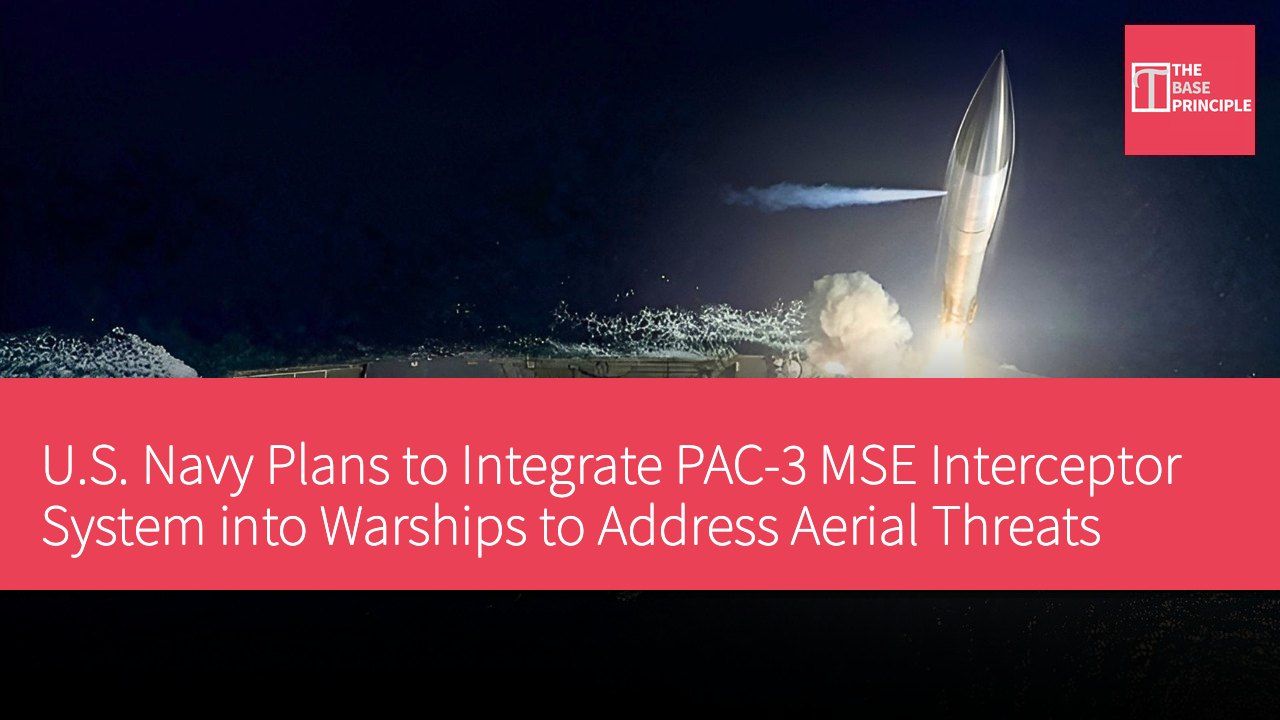
- The U.S. Navy plans to integrate the PAC-3 MSE interceptor onto warships to address aerial threats.
- Lockheed Martin has secured a contract to integrate the PAC-3 MSE with the Aegis combat system.
- The integration process will require significant engineering changes and the development of a new communication architecture.
- PAC-3 MSE employs hit-to-kill technology to counter a variety of aerial threats.
The U.S. Navy is working to integrate the Army's PAC-3 MSE interceptor onto its warships, providing the fleet with options to counter incoming missiles and other aerial threats. Lockheed Martin received a second-phase development contract in late September to integrate the interceptor with the Navy's Aegis combat system. The plan will modify the Patriot Advanced Capability-3 Missile Segment Enhancement (PAC-3 MSE) for launch from the Mk 41 Vertical Launch System (VLS). Lockheed Martin plans to conduct land-based flight tests in 2027, followed by shipboard tests in 2028, with the Navy aiming to deploy the integrated system by 2029.
The signing of this contract is based on an earlier $93 million contract that formalized the PAC-3 MSE as part of the Navy's program. Lockheed Martin is also investing $120 million of its own funds to prepare the missile for maritime operations.
Technical Challenges of the Integration Process
Transitioning the PAC-3 MSE from land-based launchers to Navy warships requires significant engineering changes. The missile must operate in conjunction with the ship's existing launch infrastructure and combat management architecture. Lockheed Martin is developing a new communication architecture with S-band and X-band capabilities. This design will support future upgrades to enable the Navy to address emerging threats. Engineers are also modifying the missile's launch sequence timing software, along with other tasks including new container fire control software and redesigning launch tubes compatible with the Mk 41 VLS and PAC-3 MSE.
The Mk 41 system faces specific integration challenges, as its launch tubes must accommodate the interceptor for launch without damaging it. Lockheed Martin recently completed a propulsion test to verify that the PAC-3 MSE can be launched through the Mk 41 launch tube without sustaining damage. Jason Reynolds, vice president and general manager of Lockheed Martin's Integrated Air and Missile Defense, stated that the Navy's collaboration will introduce a combat-proven interceptor into its maritime defense architecture.
The program has already passed early launch milestones. In 2024, Lockheed Martin and the U.S. Department of Defense's office conducted a vertical launch of the PAC-3 MSE from the Mk 70 VLS launcher. This test also integrated the interceptor with a virtual Aegis weapon system, marking the first vertical launch of the PAC-3 MSE in an Aegis integrated configuration. Upcoming tests will further advance this work. The land-based flight tests in 2027 will precede shipboard flight tests in 2028, and these evaluations will help verify the integration, after which the Navy will begin deploying this capability.
PAC-3 MSE uses hit-to-kill technology to destroy incoming threats through direct impact, with its current mission set including tactical ballistic missiles, cruise missiles, and aircraft. Lockheed Martin has also listed hypersonic missiles as one of the threats the interceptor can address.
Production Expansion and Demand Context
As the U.S. military expands production of the PAC-3 MSE, the initiation of the Navy's program comes at a pivotal time. On July 29, the Army awarded Lockheed Martin a $58 billion contract to accelerate production. This agreement supports a broader production expansion aimed at tripling production capacity. Demand is driven by the Army, the Navy's planned adoption, and international customers. Lockheed Martin is also collaborating with the Army to improve production processes within its supplier network, efforts aimed at addressing manufacturing bottlenecks and component delivery issues. The Navy variant will share production lines at Lockheed Martin's All-Up Round III facility in Camden, Arkansas, which will support production and help the Navy move towards
the 2029 deployment goal.
Strategic Significance of Navy Interceptor System Integration
Integrating the PAC-3 MSE interceptor onto Navy vessels demonstrates the U.S. military's commitment to enhancing maritime defense capabilities. As global aerial threats increase, this plan not only strengthens the Navy's defensive architecture but also creates synergistic effects with the Army's defense systems. Lockheed Martin's technological innovations and production expansion will also support the Navy's needs, ensuring it maintains an advantage in the face of emerging threats.