
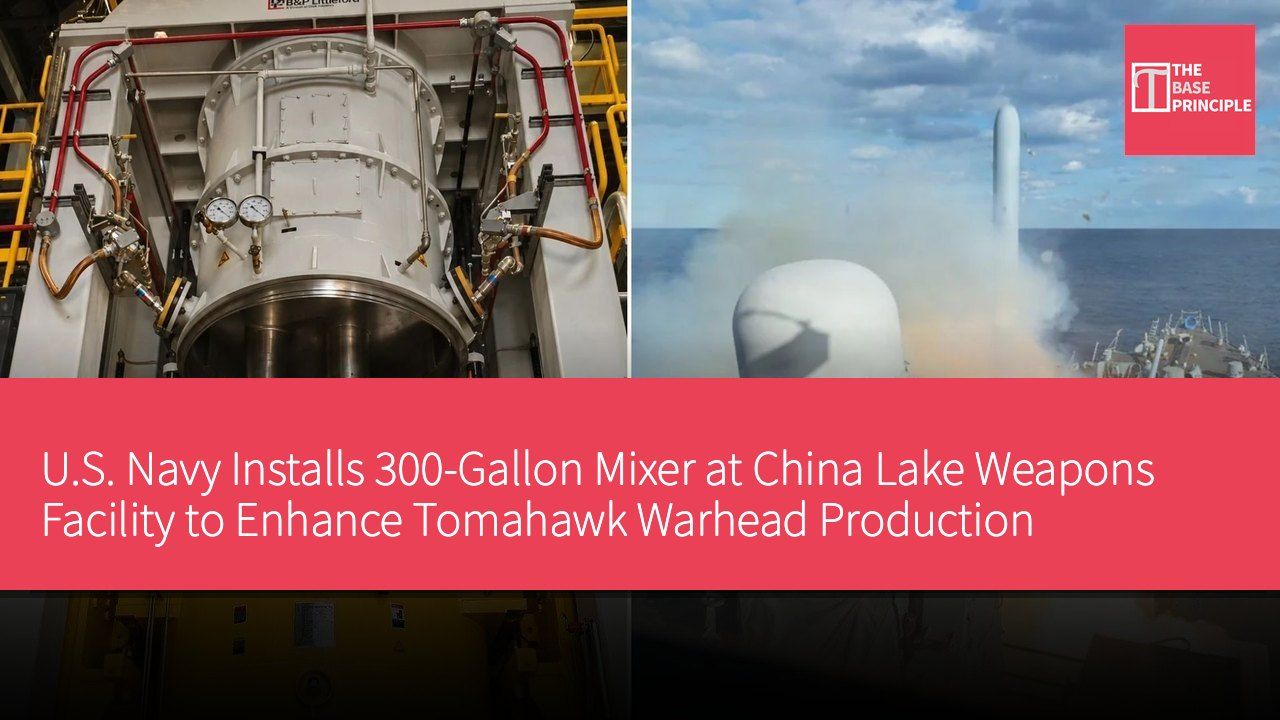
- The U.S. Navy is establishing new production capabilities at the China Lake facility to support Tomahawk warhead production.
- The new 300-gallon mixer will enhance production efficiency and reduce material transfer times.
- This expansion stems from a seven-year contract signed by the Navy with Raytheon to accelerate production.
- China Lake will become a reliable source of Tomahawk warheads to meet future demand increases.
The U.S. Navy is preparing to establish new production capabilities at the China Lake weapons facility in California to assist Raytheon in ramping up production of Tomahawk cruise missile warheads. The plan includes a new industrial mixer, revamped manufacturing facilities, and qualified additional warhead producers. The Naval Air Warfare Center Weapons Division (NAWCWD) recently completed inspections of seven initial Tomahawk warheads, marking a significant step in establishing China Lake as an additional production source. These units were assembled using the existing 150-gallon mixer, while the new 300-gallon system, expected to be operational by June 2027, will also come online.
The Navy marked the installation of the larger mixer on November 9 at the revamped motor assembly plant. Once operational, the equipment is expected to enable the facility's energy team to achieve its planned production rates and timely supply warheads to support additional Tomahawk missile deliveries.
Background of the Expansion Plan
This expansion follows the Navy's award of a seven-year contract worth approximately $22.9 billion to Raytheon (RTX) in August 2026 to accelerate Tomahawk production. The agreement covers over 7,000 new, recertified, and modernized missiles, with an annual production target exceeding 1,000 units. The new role of China Lake is intended to complement existing industrial production rather than replace it. Raytheon is the primary contractor for the Tomahawk missile, while General Dynamics' Ordnance and Tactical Systems is responsible for producing the warhead casing. L3Harris is currently in charge of the warhead's explosive filling.
The Navy hopes that China Lake will undertake part of the work through a public-private partnership with L3Harris. This agreement, signed in September 2026, aims to expand the manufacturing capacity for missile components and provide another means for the service to respond to rising demand.
The seven initial warheads represent the first units built at China Lake as a new producer for inspection. They must pass the required inspections to become qualified production units. The Navy has not disclosed the facility's final annual warhead production capacity. Preparing this additional source involves more than just installing machinery. The Navy has spent significant time over the past year updating warhead specifications and its approved supplier list. Since some components may take up to a year to arrive, the Navy has also procured materials in advance. More than a dozen new employees will join the energy team. They will undergo approximately a year of training under the guidance of experienced technicians before taking on independent production responsibilities, according to NAWCWD.
Impact of the New Mixer
The new 300-gallon mixer is central to the expansion. Manufactured by B&P Littleford, it is designed to handle specialized materials used in military energetic manufacturing. Its capacity is double that of the previous 150-gallon mixer. The new facility layout is also intended to reduce the time required to move materials between manufacturing stages. Previously, the work team mixed materials in one building and then transported them about half a mile to another building for casting. In the revamped factory, the mixing bowl can move to an elevator within the same facility, reducing the transfer time from about an hour to approximately 15 minutes.
This is crucial because the handling window for materials after mixing is limited. The Navy stated that the new arrangement could recover about 45 minutes, providing more time for subsequent production steps.
These facilities are part of a larger reconstruction effort. The earthquake in July 2019 destroyed three energetic facilities in the China Lake salt well area. Construction of their replacements began in April 2022, and the ceremony on November 9 marked an important milestone in the reconstruction complex. The Tomahawk is a long-range cruise missile launched from U.S. Navy surface ships and submarines. It can strike land targets from considerable distances, allowing naval forces to conduct precision strikes without bringing launch platforms close to enemy territory. Thus, expanding missile production requires more than just increasing final assembly capacity.
Warheads, propulsion systems, guidance components, and other specialized parts must also be available at the required pace. This effort at China Lake illustrates how the Navy is leveraging its technical facilities to help address these industrial constraints.
The energy team has decades of experience producing warheads, including the air-launched SLAM-ER missile. NAWCWD describes the facility as a pilot plant that can support development work while enhancing industry when additional capacity is needed. The current goal is to establish China Lake as a reliable source of Tomahawk warheads to help prevent delays in broader missile production efforts due to component shortages.
Strategic Significance of the China Lake Facility
The expansion plan at China Lake demonstrates the U.S. Navy's commitment to enhancing Tomahawk missile production, particularly in response to anticipated future demand increases. The construction of the new facility will not only improve production efficiency but also ensure the supply of warheads and other critical components, reducing production delays caused by component shortages. This initiative is not only a restoration of past earthquake losses but also a forward-looking strategy to meet future strategic needs, reflecting the U.S. commitment to ongoing investment and emphasis on military capabilities.