
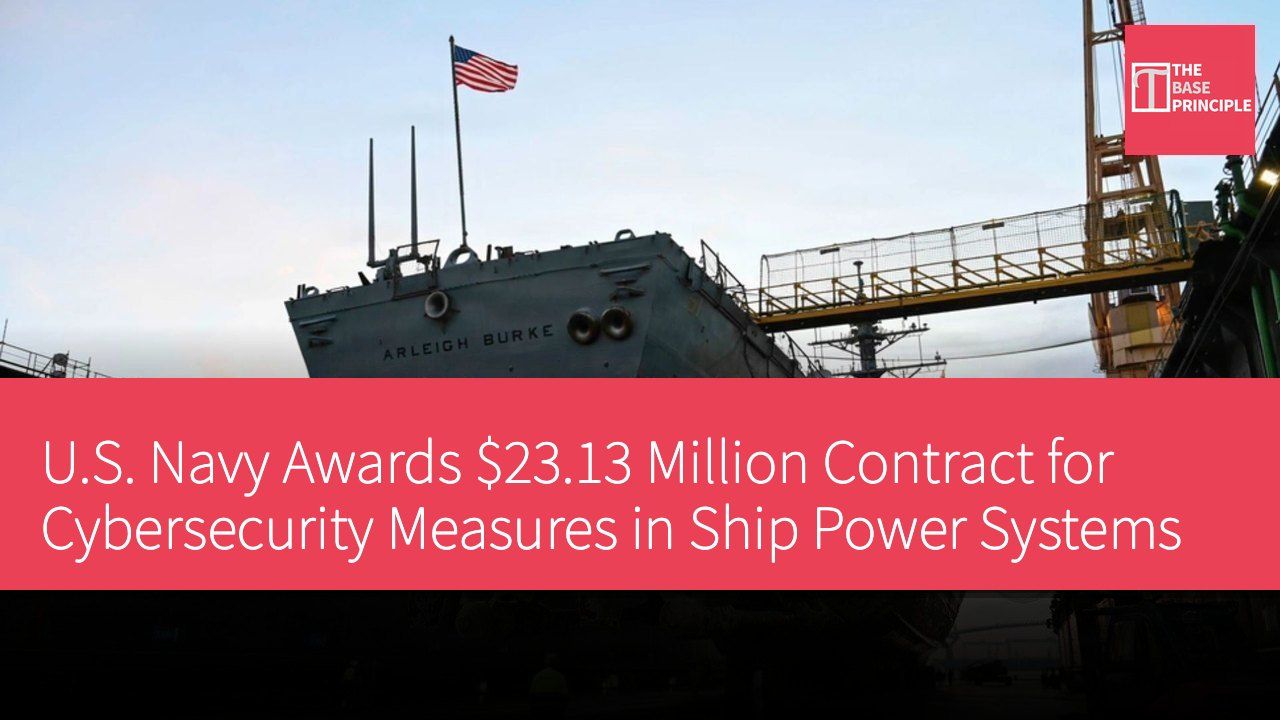
- The U.S. Navy has awarded Integer Technologies a $23.13 million contract to develop cybersecurity measures for power systems.
- The contract spans six years, including a base period and an option period, with completion expected by 2030.
- Ship power systems need to defend against cyberattacks to ensure critical operations and system stability.
- The research will explore a zero-trust architecture to enhance the security and resilience of ship power systems.
The U.S. Navy has signed a $23.13 million contract with Integer Technologies, based in South Carolina, to develop cybersecurity defenses for ship power systems, helping naval platforms withstand cyberattacks without compromising critical operations. The U.S. Department of Defense announced the contract on October 28, funding research into the Threat Resiliency Integrated Defense (TRIDENT) program aimed at enhancing naval technology's threat resistance. Integer Technologies will collaborate with Florida State University and its Advanced Power Systems Center to develop a zero-trust security framework tailored for ship power networks.
The contract spans six years, including a 36-month base period and a 36-month option period starting 12 months after execution, with work expected to be completed by October 2030. The Navy has allocated $10.13 million to fund the base period.
Security Needs for Ship Power Systems
Why do ship power systems require cybersecurity? The power networks on ships do more than supply lighting and operate everyday equipment; they also distribute power to machinery, control systems, sensors, and other mission-critical devices. On ships equipped with integrated power systems, electricity can also support advanced weapons and high-power sensors. The Navy's Office of Naval Research believes that secure control methods and reliable power distribution are essential requirements for future naval power systems. Cyberattacks targeting these networks could disrupt monitoring or control functions, making it harder for crews to understand system status or respond to failures.
Protecting these systems requires more than just securing traditional IT networks, as the associated digital systems interact directly with physical equipment. The challenge lies in maintaining network security without slowing down the time-sensitive control processes necessary for secure power distribution.
Challenges and Applications of Zero Trust Design
The zero-trust design for ship power grids, TRIDENT, will investigate a threat-based Zero Trust Architecture (ZTA), a security model that does not automatically trust users, devices, or connections simply because they are inside the network. Instead, access must be verified, permissions limited, and system behavior monitored. Security controls can also isolate connected systems, reducing the impact of compromised components on other parts of the network. However, for ship power systems, these measures must consider low-latency requirements and the coexistence of legacy equipment with new technologies. Some older systems may have limited security capabilities or may not support modern authentication methods without significant modifications.
The Navy's research aims to help ships maintain awareness of their network and physical operational status, dynamically adjust their defenses, and continue operating during hostile attacks.
In April 2026, the Cybersecurity and Infrastructure Security Agency and other federal agencies released guidance on applying zero trust to operational technology. This guidance emphasizes that security measures must consider the reliability and security requirements of systems controlling physical processes. The research may help maintain ships' operational capabilities under attack. Integer Technologies and its research partners will explore how to apply these principles to naval power networks while maintaining system performance. The contract announcement did not specify which classes of ships would receive the technology, nor did it confirm whether a deployable system has been developed.
This work is part of a larger initiative aimed at making naval systems more resilient to cyber disruptions. The Navy's Office of Naval Research's Cyber Resilience Program also focuses on protecting complex naval systems that combine legacy hardware, software, and interconnected controls. If the TRIDENT research yields effective solutions, the Navy will gain new methods to detect suspicious activity, limit unauthorized access, and maintain power system performance during cyber incidents. In an era where warships increasingly rely on interconnected power and digital systems, the goal is to ensure that cyberattacks do not lead to the loss of critical ship functions.
Enhancing Cybersecurity for Ship Power Systems
Ship power systems not only supply basic operations but also support critical mission equipment, making their cybersecurity essential. As the Navy increasingly relies on interconnected power systems, the risk of cyberattacks also rises. The TRIDENT research aims to develop a zero-trust architecture to ensure that ships can remain operational even under attack. This will not only protect ship operations but also enhance the overall resilience of the system, which is significant for the future development of naval technology.