
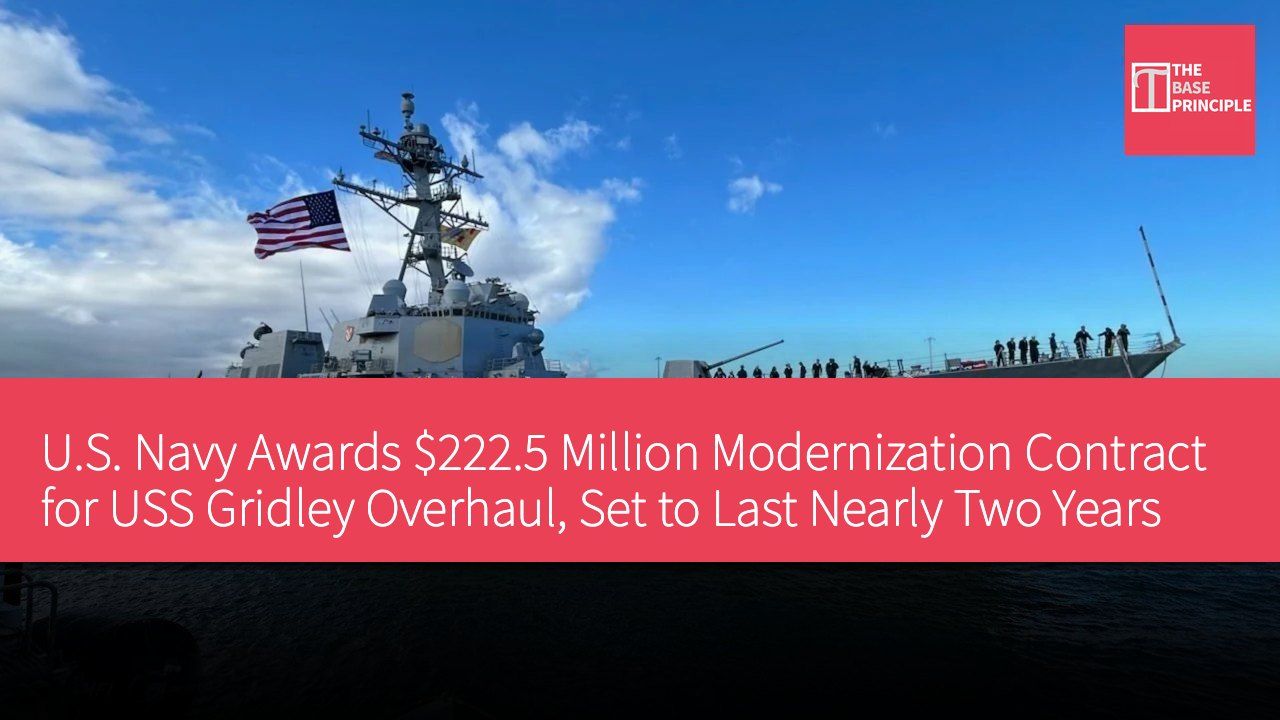
- The U.S. Navy has signed a $222.5 million modernization contract for the USS Gridley.
- The ship will temporarily be taken out of service for nearly two years for overhaul work.
- The contract funds will primarily be used for new ship systems and routine maintenance.
- Vigor Marine will carry out the work in Seattle, with a significant increase in contract value.
The U.S. Navy has awarded a $222.5 million contract to Vigor Marine for the modernization of the USS Gridley (DDG 101), an Arleigh Burke-class destroyer that will temporarily be taken out of service for nearly two years. The destroyer has a full load displacement of approximately 10,300 tons. This overhaul comes after the ship has undergone a demanding operational period, during which it was deployed in the Middle East, Indo-Pacific, and Latin America. The work will be conducted at Vigor's shipyard in Seattle, Washington, and is expected to be completed by December 2028.
Contract Funding Allocation and Uses
Additional contract options could increase the total value to $232.5 million. Most of the contract funds will be used for new ship systems, with $207.1 million (approximately 93% of the initial funding) allocated from the Navy's procurement fund for fiscal year 2027, along with $2 million from the procurement fund for fiscal year 2026. These funds are intended for the purchase and installation of new equipment on existing Navy vessels. The remaining $13.4 million comes from operations and maintenance funds, used for routine repairs and maintenance, accounting for about 6% of the initial contract value and set to expire at the end of the current fiscal year.
The work includes labor, equipment, production, testing, and quality assurance conducted under the availability guidance of the Chief of Naval Operations. The Navy describes the project as encompassing "critical modernization, maintenance, and repair plans," but has not disclosed the specific systems or equipment to be installed. Vigor Marine, headquartered in Portland, Oregon, will perform the work under an agreement with the Navy's procurement executive in Washington, D.C. The contract amount represents a significant increase over Vigor's previous work. The Navy restricted contract bidding under 10 U.S.C. 3204(a)(3), which allows federal agencies to limit bids to maintain industrial capability in potential national emergencies.
This arrangement also helps protect ship repair facilities located near major concentrations of the Navy fleet. Vigor's facility in Seattle is one of the few private shipyards in the Pacific Northwest capable of handling destroyers like the Gridley.
Maintenance Delays and Upgrade Challenges
The value of this new contract is nearly six times that of the previous contract awarded to the company for the same vessel. In February 2023, Vigor received a $37.4 million contract to maintain and modernize the Gridley at its home port in Everett, Washington. This work was scheduled for completion in October of the same year. The Gridley returned to Naval Station Everett on December 12, 2025, after a nine-month deployment as part of the Nimitz Carrier Strike Group, covering areas of the U.S. 5th and 7th Fleets.
It went back to sea in February 2026 for another deployment, this time supporting U.S. Southern Command. The destroyer provided escort for the aircraft carrier USS Nimitz (CVN 68) during "Southern Seas Operations" in South America. The strike group visited Valparaíso, Chile, in April, and then transitioned to "Southern Shield Operations" in June to support U.S. military counter-drug operations in the Western Hemisphere.
On August 13, 2026, Secretary of Defense Pete Hegseth visited the ship during the Panamax 2026 exercises in Panama City. The Gridley was preparing to transit the Panama Canal to operate in the Eastern Pacific with joint task forces in the Western Hemisphere. "Homeland defense continues aboard the USS Gridley," Secretary Hegseth stated. With maintenance delays facing the destroyer, modernization work has become particularly critical.
The Gridley was built by Bath Iron Works in Maine and was commissioned in 2007. It is a Flight IIA variant of the Arleigh Burke-class, equipped with a hangar for two MH-60R helicopters and carrying 96 Mk 41 vertical launch systems for launching various missiles, including Standard missiles, Tomahawk missiles, and evolved Sea Sparrow missiles. Now nearing 20 years in service, the ship is approaching the midpoint of its planned 40-year service life, during which major modernization work is typically scheduled, but maintenance delays remain a challenge.
A report from the Congressional Budget Office in December 2025 found that maintenance for Arleigh Burke-class destroyers could consume 27% of their service life (over nine years) for maintenance. Only 4% of overhauls are completed within the Navy's originally scheduled timelines. Other Flight IIA vessels are facing similar upgrade challenges. For example, the USS Pinckney (DDG 91) will undergo maintenance until 2028, becoming the first destroyer to receive the complete DDG MOD 2.0 upgrade, including the SPY-6(V)4 radar.
Item Specification Full Load Displacement 10,300 tons Contract Amount $222.5 million (approximately HK$173.5 million) New Contract Amount $232.5 million (approximately HK$181.4 million) Maintenance Contract Amount $37.4 million (approximately HK$29.14 million)
Importance of the USS Gridley Modernization Contract
The modernization contract for the USS Gridley reflects the U.S. Navy's commitment to vessel maintenance and upgrades, particularly in the face of an increasingly complex global security environment. This destroyer has undergone multiple deployments, highlighting its significant role in naval operations. As the ship's service life extends, undertaking major modernization work becomes crucial, not only for the vessel's performance but also for the Navy's overall operational capability. The substantial increase in contract value also indicates a demand for enhancing naval industrial capacity, especially in potential national emergencies.