
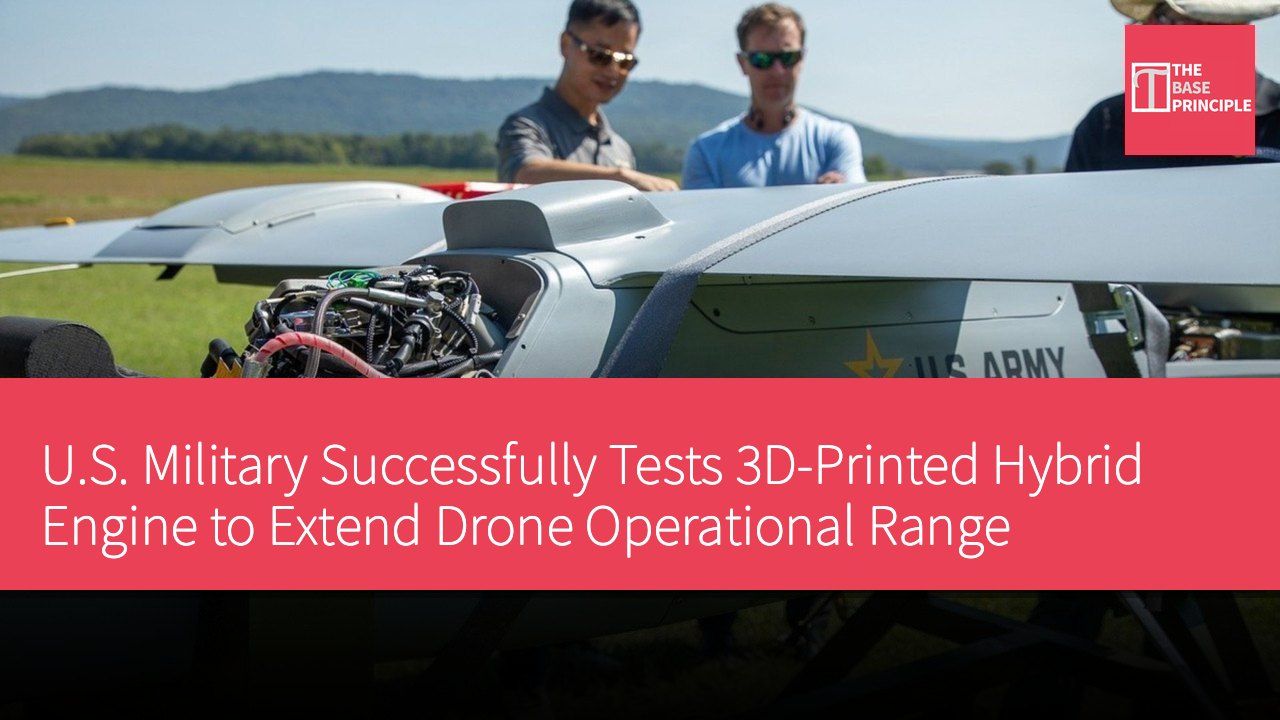
- The U.S. Army successfully tested a drone equipped with a new hybrid engine.
- 3D printing technology allows for rapid testing and adjustments of engine components.
- The new engine design effectively extends the operational range and endurance of the drone.
- The project aims to advance drone coordination into autonomous swarms, enhancing operational efficiency.
The U.S. Army, in collaboration with Griffon Aerospace, has successfully completed the first demonstration flight of its medium tactical drone, VICTOR, equipped with a newly tested hybrid engine. This engine utilizes 3D-printed metal components and standard battlefield fuel, representing a significant solution to a major challenge in military aviation. This technology enables medium drones to achieve operational ranges and endurance greater than larger platforms without complicating the supply chain.
Frontline units rely on standard logistics fuel, commonly referred to as heavy fuel. While diesel and kerosene-based fuels are safer and more widely available for transport, burning these fuels cleanly in small rotary engines is quite challenging. Heavy fuels do not vaporize easily in compact combustion chambers, often leading to incomplete combustion, power loss, and fuel leakage. The U.S. Army stated in a press release, “ARL researchers used advanced computational fluid dynamics modeling and a novel design approach to address the challenges of effectively burning heavy fuels in rotary engines.”
Advantages of the New Engine Design
Advanced 3D metal printing technology allows engineering teams to test, adjust, and reprint complex engine components within days. This manufacturing method enables the engine to rely entirely on ambient air for cooling, eliminating pumps, radiators, and liquid coolants that typically add bulk and weight. The air-cooled rotary engine drives a 400-volt motor generator in a series hybrid configuration, with the power system providing the high power needed for vertical takeoff and landing, while the fuel engine supports long-range cruising.
Dr. Chol-Bum “Mike” Kweon from the Army Research Laboratory, responsible for the project, noted that eliminating the need for refined fuels and bulky cooling systems will fundamentally change the capabilities of medium drones. It extends their operational range beyond the horizon, allowing commanders to gather intelligence and coordinate missions from a safer distance, effectively reducing risks to ground personnel. The propulsion tests have laid the groundwork for military tactical drone operations in contested airspace.
Future Autonomous Swarm Program
Data from the test flights is being integrated into an operational program called PULSAR. Under this program, the armed forces aim to coordinate multiple VICTOR drones into an autonomous swarm capable of real-time allocation of surveillance, reconnaissance, and transport missions. This decade-long project has generated dozens of patents, published hundreds of academic papers, and involves over 30 universities and 20 defense contractors. Army researchers now plan to hand over the drone and hybrid propulsion design to military evaluation units for tactical field exercises, while commercial partners apply these manufacturing technologies to a broader aerospace context.
Kweon summarized, “For operators, this program has transformed research outcomes into industry partnerships to promote maturity and integration capabilities, enabling medium drones to operate beyond visual range, expanding the operational scope of ground commanders and reducing risks to soldiers. Advanced manufacturing technologies, including 3D metal printing, allow us to rapidly redesign engine components based on lessons learned from experiments.”
Impact of New Technology on Military Operations
This new technology from the U.S. Army not only enhances the operational range of drones but also addresses the issue of incomplete combustion of traditional fuels in small engines. Through 3D printing technology, engineering teams can quickly adjust designs, which is crucial for the flexibility of military operations. As drone capabilities improve, commanders can conduct intelligence gathering from safer distances, reducing risks to ground personnel. Furthermore, coordinating multiple drones into autonomous swarms will further enhance operational efficiency, demonstrating the potential of this technology in future military operations.