
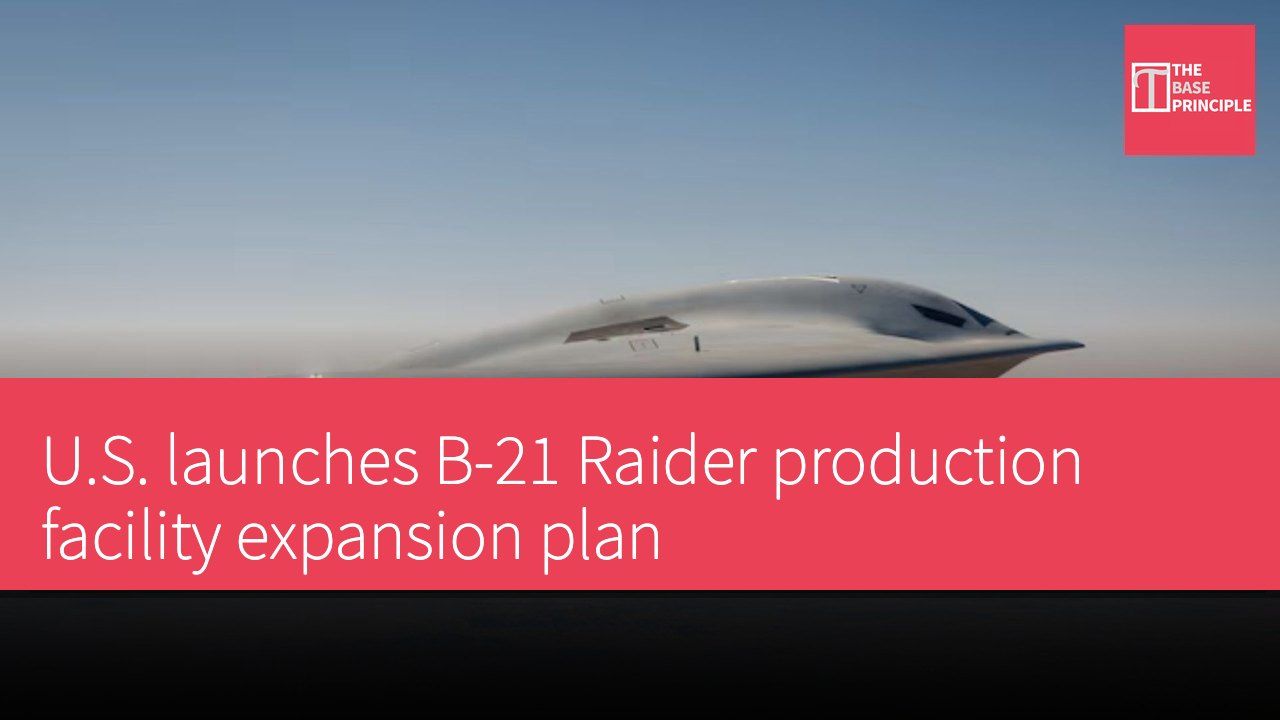
- The United States will establish a new facility to support B-21 Raider production capacity.
- Annual B-21 production capacity will increase by 25% to accelerate delivery of operational capability.
- The B-21 Raider is the foundation of future long-range strike capability, enhancing rapid deployment ability.
- Expanded facilities must match supplier delivery reliability and technical workforce availability.
The United States is set to establish a new facility to support B-21 Raider production capacity. Recently, the Department of the Air Force and Northrop Grumman held a groundbreaking ceremony for a new final assembly line at Air Force Plant 42. This development marks an important step in expanding B-21 Raider production capacity, aimed at accelerating the delivery of operational capability to the joint force.
Annual B-21 production capacity will increase by 25%. The groundbreaking ceremony marks the launch of new facilities that will support the previously announced B-21 Raider production capacity expansion, totaling more than one million square feet. This effort is part of an agreement between the Department of the Air Force and Northrop Grumman that aims to increase annual B-21 production capacity by 25% while maintaining cost, schedule and performance. Maj. Gen. Dale White, Program Executive Officer for Key Major Weapon Systems and Direct Report Programs at the Department of the Air Force, said: "This groundbreaking is more than just construction; it represents our nation's enduring commitment to delivering capability at the speed required by a secure environment."
B-21 Raider production capacity boost
The B-21 Raider is the foundation of the Air Force's future long-range strike capability, and this investment enhances the industrial capacity needed to rapidly deploy that capability."
The Department of the Air Force is leveraging $4.5 billion in funding that was previously authorized and appropriated under the Fiscal Year 2025 Continuing Resolution to accelerate the procurement plan for 100 B-21s, based on the program's demonstrated performance, to shorten the delivery timeline for the next-generation stealth bomber fleet. Col. Nicholas Jordan, B-21 System Program Director, said: "The B-21 team has established the foundation for responsibly accelerating production. This investment in Palmdale will provide the infrastructure, workforce and manufacturing capacity needed to deliver the Raider to the Air Force at a higher rate."
Significance of the expanded facilities
The B-21 Raider is a long-range penetrating strike aircraft designed to operate in highly contested environments. According to released information, it integrates advanced stealth technology, robust networking and a modernized data-driven command and control architecture to support the joint force's ability to deter and, if necessary, defeat emerging threats. The program underscores the growing importance of the defense industrial base in delivering results at speed for military modernization plans. Advanced combat aircraft require highly specialized components, manufacturing processes and technical expertise. Therefore, expanding final assembly facilities must be matched by reliable deliveries from suppliers and sufficient technical workforce across the entire production network.
More broadly, this expansion illustrates how advanced technology, industrial investment and acquisition reform are becoming increasingly intertwined in modern defense planning. As the B-21 progresses through testing and production, the ability to deliver aircraft at scale will be as critical as its technological sophistication. If the expansion meets its goals, it could help the United States strengthen its long-range strike posture, reinforce strategic deterrence and prepare its bomber fleet for an increasingly competitive global security environment.
Strategic significance of the B-21 Raider expansion plan
The B-21 Raider production expansion plan is not only a technical upgrade but also a key step for the United States to enhance strategic deterrence in the global security environment. As the defense industrial base grows in importance, this investment will help boost U.S. long-range strike capability, ensuring an advantage in highly contested environments. With increased production capacity, the Air Force will be able to deploy advanced combat aircraft more quickly to counter emerging threats, which is critical for future military operations.