
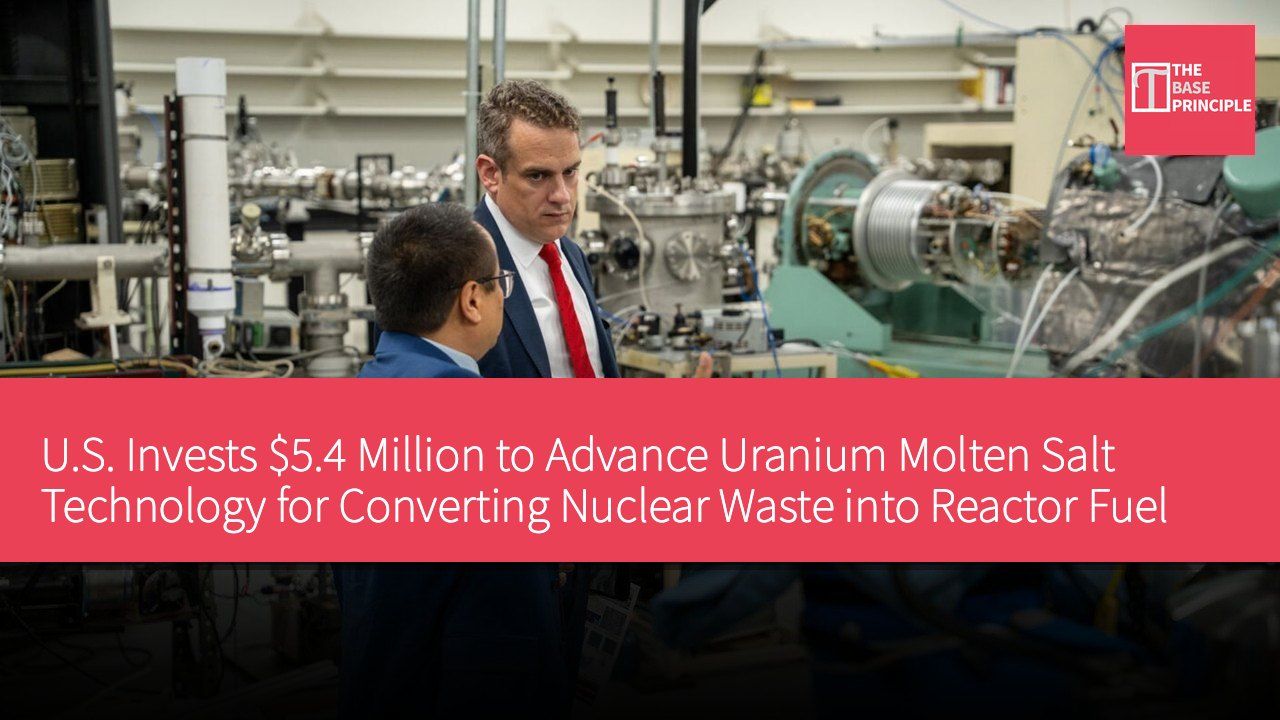
- The U.S. Department of Energy will award $5.4 million to Texas A&M University to promote nuclear waste conversion technology.
- The project is led by Professor Lin Shao and focuses on the development of uranium molten salt reactor technology.
- The research will integrate various technologies, including fuel preparation, experimental testing, and reactor design.
- Other U.S. laboratories are also exploring alternative nuclear fuel recycling technologies to reduce waste storage times.
As the United States expands nuclear energy to provide reliable, carbon-free power, it faces a significant challenge: managing the radioactive waste left by used reactor fuel. To address this issue, Deputy Secretary of Energy James P. Danly announced on Thursday that the Department of Energy will award $5.4 million to the Texas A&M Engineering Experiment Station (TEES) for the development of technology that can convert long-lived nuclear waste into new reactor fuel. Danly stated, "The future of America's energy relies on bold innovation and strong partnerships between the federal government, national laboratories, universities, and industry."
This project demonstrates how we can tackle the long-term challenges of nuclear waste while advancing technologies that enhance our nation's energy security."
Research on Uranium Molten Salt Reactor Technology
The funding provided by the Department of Energy (DOE) supports a project led by Professor Lin Shao from the Department of Nuclear Engineering at Texas A&M University. According to the university, Professor Lin is researching how to use uranium molten salt reactors to convert nuclear waste into fuel. In this project, in addition to investigating methods to address the long-term burden of radioactive nuclear waste, there will be a focus on developing advanced reactor technologies that can provide reliable energy for future generations. Researchers will integrate fuel preparation, experimental testing, computational modeling, and reactor design throughout the project.
Researchers in Texas will collaborate with scientists from the Savannah River National Laboratory and industry partner Natura Resources. Meanwhile, other U.S. laboratories are exploring alternative nuclear fuel recycling technologies to reduce the storage time of radioactive waste from thousands of years to hundreds of years. Scientists at Argonne National Laboratory (ANL) have begun developing technologies to recycle used fuel for advanced reactor use. Researchers are turning to thermal processing techniques, which utilize high-temperature physical or chemical changes to solid materials, to convert used fuel into materials that can be reused in advanced nuclear reactors.
Methods for Permanent Disposal of Radioactive Waste
In addition to funding research to recycle nuclear waste into fuel, the Department of Energy is also funding studies to find methods for the permanent disposal of radioactive waste left after recycling used nuclear fuel. According to a study published by the Department of Energy about a month ago, researchers found that deep boreholes could provide a safe and relatively low-cost method for the permanent disposal of radioactive nuclear waste. A California-based company, Deep Isolation, founded ten years ago, is working to realize the practical application of underground disposal of used nuclear fuel and hazardous nuclear waste. The company launched a full-scale deep borehole disposal system commercialization pilot in Cameron, Texas, in January 2026 to demonstrate its deep borehole disposal system.
Underground disposal of nuclear waste is also a focus for other countries, including Finland, Sweden, and France. However, the technologies used in these countries differ from the deep borehole technology in the United States. The former approach involves constructing geological repositories by blasting and excavating massive underground tunnels, shafts, and caverns. Finland's Eurajoki facility is the world's first permanent underground storage site for used nuclear fuel, built in over 400 meters (1,312 feet) of 1.9 billion-year-old crystalline bedrock, designed to encapsulate and permanently dispose of nuclear waste, expected to last over 100,000 years, and placed in disposal canisters designed to completely isolate radioactive used fuel.
Innovative Challenges in U.S. Nuclear Waste Management
As the demand for nuclear energy grows, effectively managing nuclear waste has become a significant challenge in U.S. energy policy. The funding from the Department of Energy not only promotes the development of uranium molten salt reactor technology but also encourages collaboration among multiple parties to seek innovative solutions. These studies not only help reduce the long-term environmental impact of nuclear waste but also provide assurance for future energy security. At the same time, the technological differences internationally highlight the varying strategies countries employ in nuclear waste management, offering diverse perspectives for global nuclear energy development.