
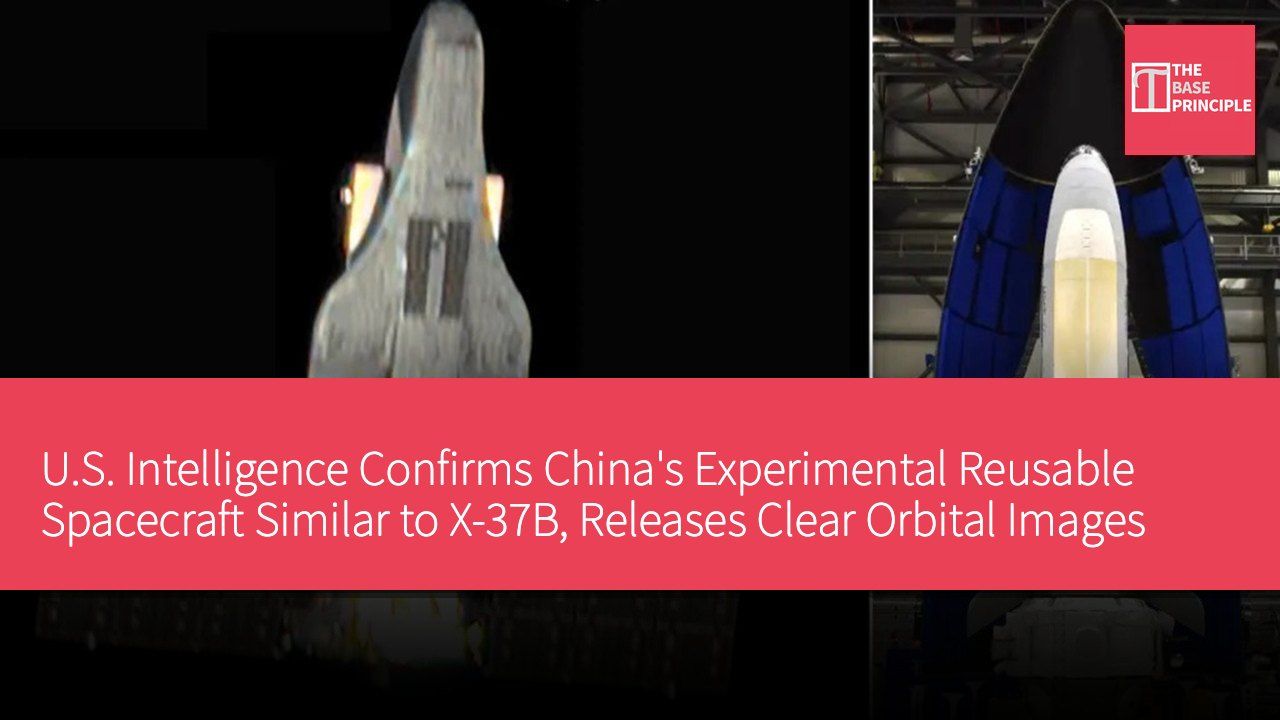
- China's reusable spacecraft resembles the U.S. X-37B, with clear images obtained.
- The Defense Intelligence Agency report mentions China's main models as "Shenlong" and "Tengyun."
- Chinese spacecraft have conducted multiple orbital missions since 2020, releasing unknown objects.
- The reusable design reduces the cost of entering orbit, holding significant military implications.
China's experimental reusable spacecraft, long visible only in blurry images, has now been captured in clear orbital photographs released by U.S. intelligence agencies, resembling the U.S. X-37B. The Defense Intelligence Agency published the image in its latest unclassified report titled "Challenges to Space Security." The photograph was taken by a Maxar satellite, currently operated by Vantor, and is marked with a copyright date of 2024. The Defense Intelligence Agency refers to the spacecraft as the "Chinese spaceplane."
Design Features of the Chinese Spaceplane
The similarities between the two are hard to overlook. Both are mini spacecraft equipped with small wings and dual vertical stabilizers. There is an upward-opening door above the central payload bay, and the tail section has solar panels that extend on both sides. The two pods at the bottom appear to house the main landing gear, similar to the three-wheel layout used by the X-37B. The most noticeable visual difference lies in the wings, which are significantly wider from front to back on the Chinese spacecraft. The Defense Intelligence Agency did not specify which design of the Chinese spaceplane is shown in the photograph. The report mentions "Shenlong" and "Tengyun" as China's main models, with "Shenlong" typically associated with the spacecraft currently in flight.
The image itself is not new. A more blurry version appeared in a report by then U.S. Space Force Korea Commander Colonel John Patrick in 2024, but at that time, neither the Space Force nor Maxar disclosed what the image depicted. The Defense Intelligence Agency's release has removed this ambiguity and added further details. Since 2020, China is believed to have conducted four orbital missions with the spacecraft. During the third mission, from December 14, 2023, to September 6, 2024, the spacecraft was observed releasing several smaller objects, the purpose of which remains unknown.
The fourth mission was launched on February 7, 2026, and there are no public indications that it has returned.
The Economics of Reusable Design
In contrast, the U.S. Space Force currently operates two X-37Bs, which have completed eight missions since 2010, the most recent being OTV-8 in August 2025. Satellite imagery shows that the landing site for the Chinese spacecraft is a remote air force base in northwestern China, with a runway approximately 16,400 feet (5,000 meters) long. The Defense Intelligence Agency's report specifically highlights spaceplanes, as their reusable and highly flexible nature makes them suitable for missions that conventional satellites cannot accomplish. Defense analysts warn that these features enable them to easily approach other spacecraft, whether for inspection, intelligence gathering, or, in the worst-case scenario, interference.
The reusable design also alters the economics. Recovering and refurbishing rocket stages, fairings, and pods can significantly reduce the cost of entering orbit, and this cost advantage is one of the main reasons for the technology's importance. The spaceplane is just one of many exhibits in the Defense Intelligence Agency report, which covers a broader scope. The 2026 edition of the report is the third in a series from the Defense Intelligence Agency, detailing the space defense and military objectives of China, Russia, and emerging space powers Iran and North Korea, including their strategies, plans, and intentions.
The report tracks the growing inventory of dual-use space systems that can serve both civilian and military purposes and notes the increasing space cooperation among U.S. adversaries. It also examines the orbital environment itself, including dangers such as space debris. The Defense Intelligence Agency states that its goal is to provide the public with a clearer understanding of who is operating in space, what they are using, and why.
Competition in Space Technology Between China and the U.S.
China's reusable spacecraft demonstrates its advancements in space technology, particularly in its similarity to the U.S. X-37B. This not only reflects China's development in the aerospace sector but also highlights its military potential. As competition in space intensifies, the control and utilization of space resources become increasingly important for nations. The reusable design not only lowers costs but also provides flexibility for military and civilian missions, which will have far-reaching implications for future space strategies and international relations.