
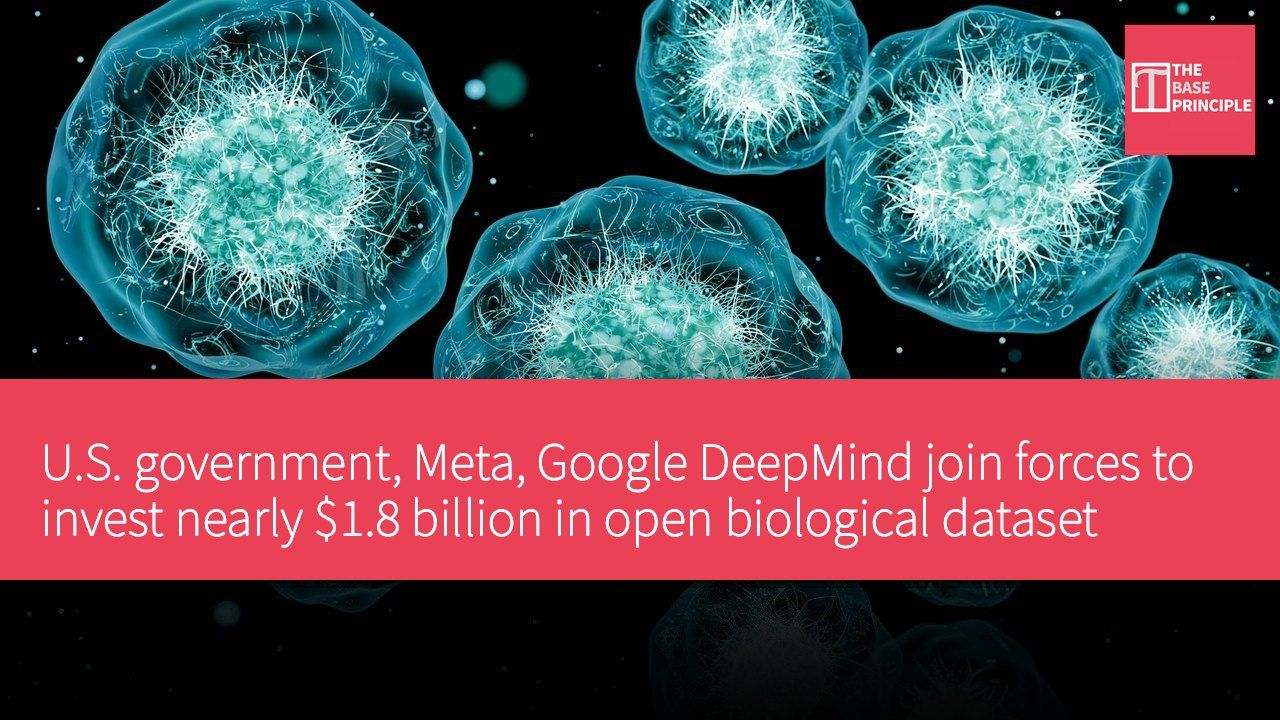
- U.S. government and tech companies collaborate to invest nearly $1.8 billion to establish biological dataset.
- The project aims to address the need for standardized data in biology.
- Biohub will collaborate with the National Institutes of Health to standardize information for model training.
- NVIDIA will provide computing infrastructure and technical expertise to support the initiative.
The U.S. government, Meta, Google DeepMind, and other partners are combining nearly $1.8 billion in funding and existing resources to establish an open biological dataset aimed at predicting the behavior of living cells. The project expands Biohub's virtual biology initiative, with the goal of developing a "virtual cell" that researchers could ultimately use to predict cellular responses and conduct some biological experiments in a digital environment. Biohub is a nonprofit research organization focused on combining computational tools with biology. Google DeepMind, drug discovery company Isomorphic Labs, and Meta are jointly investing $300 million in the initiative.
Funding Sources and Partners
The U.S. Department of Energy will provide more than $500 million over five years for biological measurement, modeling, and computation. The National Institutes of Health will coordinate datasets, databases, and other resources developed through more than $500 million in prior federal investments. Biohub will collaborate with the NIH to standardize information for use in training predictive models.
The project aims to address a major barrier to applying advanced computational models to biology: researchers need large amounts of standardized experimental data to show how cells behave and respond when conditions change. Biohub says the resulting datasets will be open to researchers. The goal is not simply to categorize cells, but to provide sufficient measurement data so that models can predict cellular responses to interventions, which could help researchers investigate diseases and treatments before conducting laboratory experiments. "Accurate biological predictive models can significantly accelerate scientific discovery, allowing scientists to conduct experiments in a digital environment."
Biohub scientific lead Alex Rives said as much. "The insights gained will unlock a deeper understanding of disease and open entirely new therapeutic avenues." Biohub had already committed $500 million when it launched the virtual biology initiative in April, of which $400 million will go toward measurement technologies, including cryo-electron tomography that can reveal near-atomic structures inside cells and microscopy techniques aimed at imaging millions to billions of cells in living tissue. Another $100 million will support research outside Biohub.
The Importance of Standardized Data
The expanded initiative combines these efforts with federal laboratory infrastructure and additional private investment. The Energy Department's contribution will leverage the capabilities of U.S. national laboratories, including supercomputers, X-ray and neutron scattering, cryo-electron microscopy and tomography, and autonomous laboratories. The National Institutes of Health will provide existing biomedical resources through its BioGenesis mission, including national databases and the Developmental Biology Atlas, common data standards, and plans for datasets suitable for computational modeling. Other organizations participating in the broad effort include the Allen Institute, the Broad Institute, the Gladstone Institutes, the Human Cell Atlas, the Human Protein Atlas, and the Wellcome Sanger Institute.
NVIDIA will provide accelerated computing infrastructure, specialized software, and technical expertise.
Biohub plans to create common identifiers, shared standards, and a single access point so that datasets generated by different institutions can work together. This standardization will be critical because biological data can come from different instruments, experiments, cell types, and measurement methods. The ultimate goal remains aspirational rather than proven. The initiative has not yet produced a universal virtual cell capable of accurately predicting arbitrary biological responses. Instead, the nearly $1.8 billion commitment aims to establish the experimental data, measurement technologies, and computational infrastructure to develop and test such models.
Future Potential and Challenges of Biological Datasets
The project is not only an infusion of funding but also a model of collaboration between technology companies and government agencies. Through standardized data, researchers will be able to more effectively use computational models for biological research. This is crucial for accelerating scientific discovery and the development of new therapies. However, building accurate virtual cell models still faces challenges, because it requires integrating data from different sources and ensuring its quality and consistency. If successful, it will help unlock a deeper understanding of disease and advance biomedicine.