
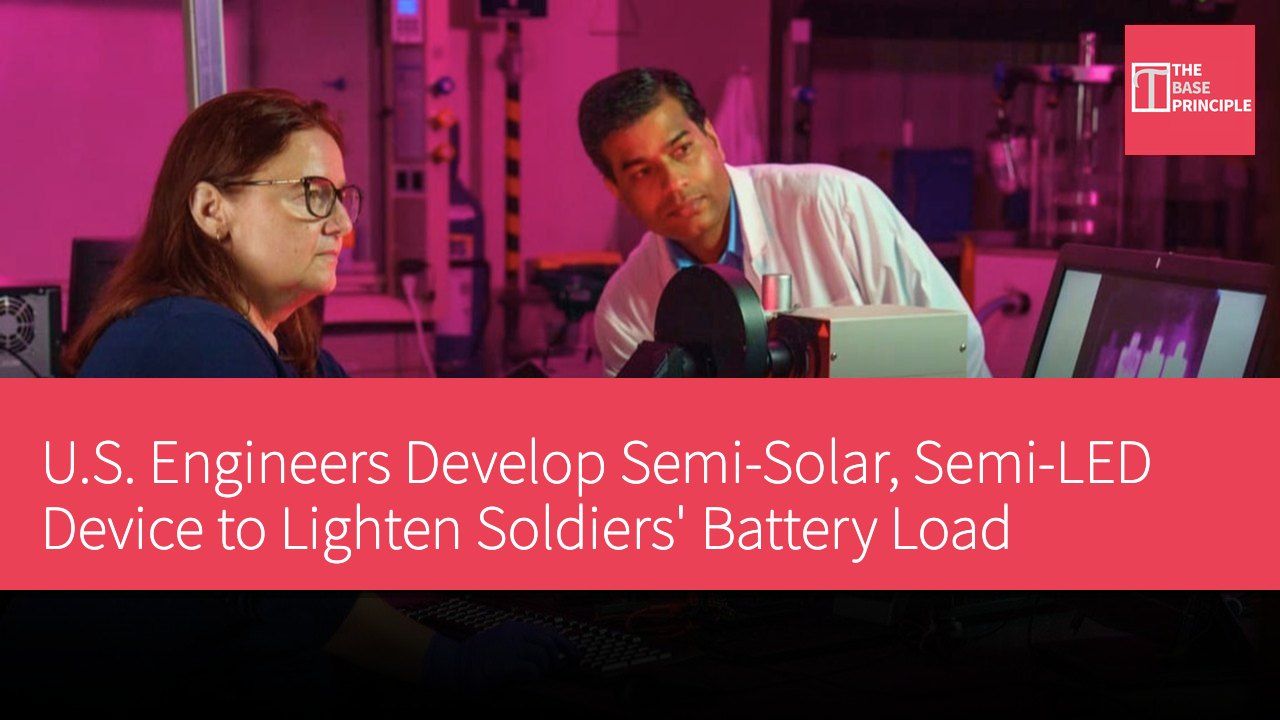
- The SOLED device combines solar cells and LEDs to reduce soldiers' battery load.
- The device has a power conversion efficiency of up to 22% and can emit nearly 11% light.
- This technology can decrease reliance on traditional batteries and generators, enhancing energy resilience.
- The team is working to improve the brightness of the panels to expand their applications.
A U.S. soldier can carry up to 20 pounds of batteries for radios and other electronic devices during missions. Engineers at Florida International University have developed a thin device that can alleviate this burden by converting sunlight into electricity while also serving as a light source. The device, named SOLED, combines solar panels and light-emitting diodes (LEDs). The project received $10 million in funding from the Department of Defense, and the device is ultra-thin, allowing it to be sewn into military uniforms or gear, providing a quiet power generation method for troops in remote areas without the noise, heat, or bulk associated with generators.
SOLED is made from a multifunctional semiconductor perovskite, which can convert sunlight into electricity with an efficiency of up to 22% when functioning as a solar cell, according to the team, a level comparable to commercial solar technology. When operating in reverse, it emits light with an efficiency of nearly 11%, a significant improvement over earlier versions. Although the light source is not bright to the naked eye, its peak is at 818 nanometers, just beyond the edge of visible light, emitting a faint pink glow. However, night vision sensors, biometric scanners, and medical imaging devices can detect such wavelengths.
The team is currently working to make the panels brighter.
Enhancing Energy Resilience
Lead researcher Daniela Radu stated that the panels capable of generating electricity and light can reduce reliance on batteries, generators, and resupply. "This is how we can enhance energy resilience at the individual soldier level." Radu also noted that this technology could promote the development of new displays, sensors, and other optoelectronic devices, providing flexibility when supply lines are threatened.
Regarding expanding applications, FIU assistant research professor Neetesh Kumar mentioned that laboratory tests of perovskite solar cells typically use samples of about 0.1 square centimeters (approximately 0.016 square inches) as this is the design range of standard equipment. The team has scaled SOLED up to 1.1 square centimeters (approximately 0.17 square inches) while maintaining a power conversion efficiency above 20%, and is then expanding it to 2.1 square centimeters (approximately 0.33 square inches), again maintaining strong performance.
While scaling up presents challenges due to the panel's thinness and multiple layers, Kumar stated that the team has not encountered any issues so far.
Challenges in Expanding Applications
This work stems from funding by the Department of Defense, which supports the Center for Integrated Resilient Energy and Storage (CIREES), led by Radu. FIU is responsible for this multi-year project and collaborates with partners at Penn State University, aiming to elevate the energy resilience of operational personnel as a national security priority. FIU has not yet provided a timeline for a wearable version. Current results show that the power conversion efficiency remains steady above 20% when exceeding the minimum laboratory sample size. This research has been published in the journal Nano Energy.
Item Specifications Power Conversion Efficiency Up to 22% Reverse Operation Efficiency Nearly 11% Panel Size 1.1 square centimeters (approximately 0.17 square inches) Expanded Panel Size 2.1 square centimeters (approximately 0.33 square inches)
Impact of SOLED Technology on Soldiers
The development of the SOLED device not only alleviates the battery load on soldiers during missions but also enhances their operational capabilities in remote areas. By combining solar and LED technology, soldiers can continuously obtain power without relying on traditional power sources, which is crucial for improving energy resilience. Furthermore, the successful application of this technology could foster the development of new displays and sensors, further enhancing operational flexibility. Facing future challenges, the team still needs to overcome the technical difficulties associated with scaling up applications.