
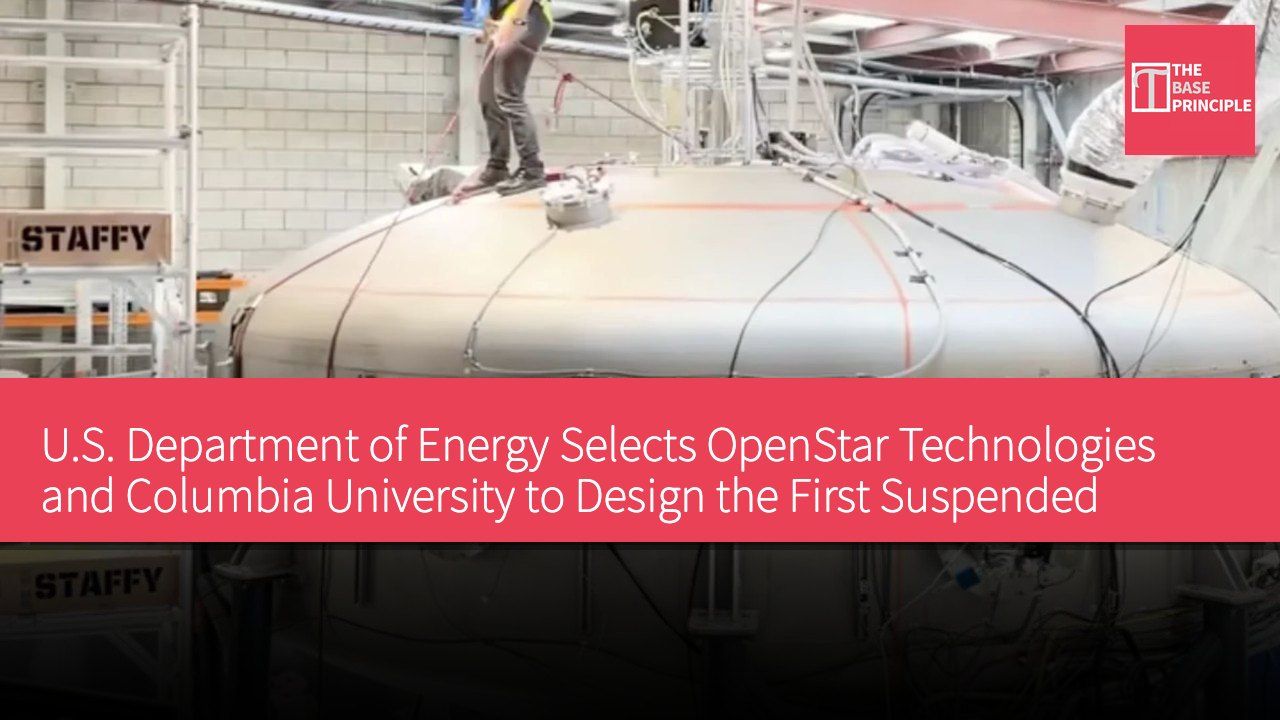
- The U.S. Department of Energy has selected OpenStar and Columbia University to design the exhaust system for a suspended dipole fusion reactor.
- The suspended dipole eliminates the primary pathway for heat leakage, maintaining plasma stability.
- Researchers will use advanced software tools to simulate the heat and particle behavior of the dipole magnetic field.
- This project marks a resurgence of the dipole pioneer, which will drive the development of fusion energy.
The U.S. Department of Energy (DOE) has selected OpenStar Technologies and Columbia University to design the world's first exhaust system for a suspended dipole fusion reactor. Commercial fusion relies on confining superheated gases (i.e., plasma) within a magnetic field. However, each reactor must safely remove heat and stray particles to prevent melting the internal walls of the equipment. Typical fusion devices address this issue through a "divertor," which directs escaping plasma to a cooled target plate. To date, no divertor has been constructed for the suspended dipole.
Unlike traditional toroidal reactors, the suspended dipole suspends a single superconducting magnet within a vacuum chamber, simulating the natural magnetic fields of planets like Earth and Jupiter. The removal of physical support structures eliminates the primary pathway for heat leakage, thereby maintaining plasma stability.
Advantages of the Suspended Dipole
Professor Ben Zhu, an assistant professor at Columbia Engineering, stated, "The magnetic dipole is an elegant and relatively simple fusion concept that remains underexplored. A viable exhaust solution is one of the most pressing challenges facing any fusion energy system, so the knowledge we gain here will directly advance the broader pursuit of commercial fusion energy."
Over the next 12 months, researchers will map the heat and particle behavior at the edge of the dipole magnetic field. This geometry creates a true magnetic field null point, known as the X point. This forces engineers to move beyond standard reactor models. To this end, Columbia University will combine two advanced software tools: TokaMaker and an open-source edge modeling code called Hermes-3. The team will test its simulation results against actual data from OpenStar's existing New Zealand prototype, Junior.
In February of this year, OpenStar successfully suspended a 0.5-ton magnet in a five-meter vacuum chamber using a $10 million machine, effectively confining plasma at temperatures exceeding one million degrees Celsius.
Dr. Christopher Hansen, a research scientist at Columbia University, remarked, "In collaboration with OpenStar, we will explore how to extend our fundamental physics knowledge into modeling tools."
Resurgence of the Dipole Pioneer
This project marks a resurgence of the dipole pioneer. Columbia University previously collaborated with the Massachusetts Institute of Technology on the original suspended dipole experiments, while OpenStar's Chief Scientist Dr. Darren Garnier served as the lead experimentalist. He will co-lead this new work with OpenStar Chief Scientist Dr. Jerome Guterl. Their final divertor design will debut on OpenStar's next machine, Tahi.
Tahi will be built to achieve fusion-relevant conditions and initially produce neutrons for medical radioactive isotopes, serving as a stepping stone toward a grid-scale fusion power plant.
Guterl summarized, "We are excited to combine Columbia University's exceptional expertise in edge plasma modeling with the decades of experience learned from divertor research in tokamaks to develop energy and particle exhaust solutions for Tahi and future dipole projects." This partnership is supported by the DOE's Innovation Network for Fusion Energy (INFUSE). This year, the program will allocate $8.5 million in funding across 28 collaborative projects involving private companies, national laboratories, and universities. OpenStar received this funding through its U.S. subsidiary, OpenStar USA.
The company also won a second INFUSE award in this round to develop plasma diagnostic technology in collaboration with the University of California, San Diego.
Potential and Challenges of Suspended Dipole Technology
The design of the suspended dipole fusion reactor represents a novel technological pathway aimed at enhancing the stability and efficiency of fusion. By eliminating physical support structures found in traditional reactors, this design effectively reduces heat leakage, thereby maintaining plasma stability. This research not only aids in understanding plasma behavior but also propels further development of commercial fusion. With the collaboration between OpenStar and Columbia University, future research may provide crucial scientific foundations and technical support for the practical application of fusion technology.