
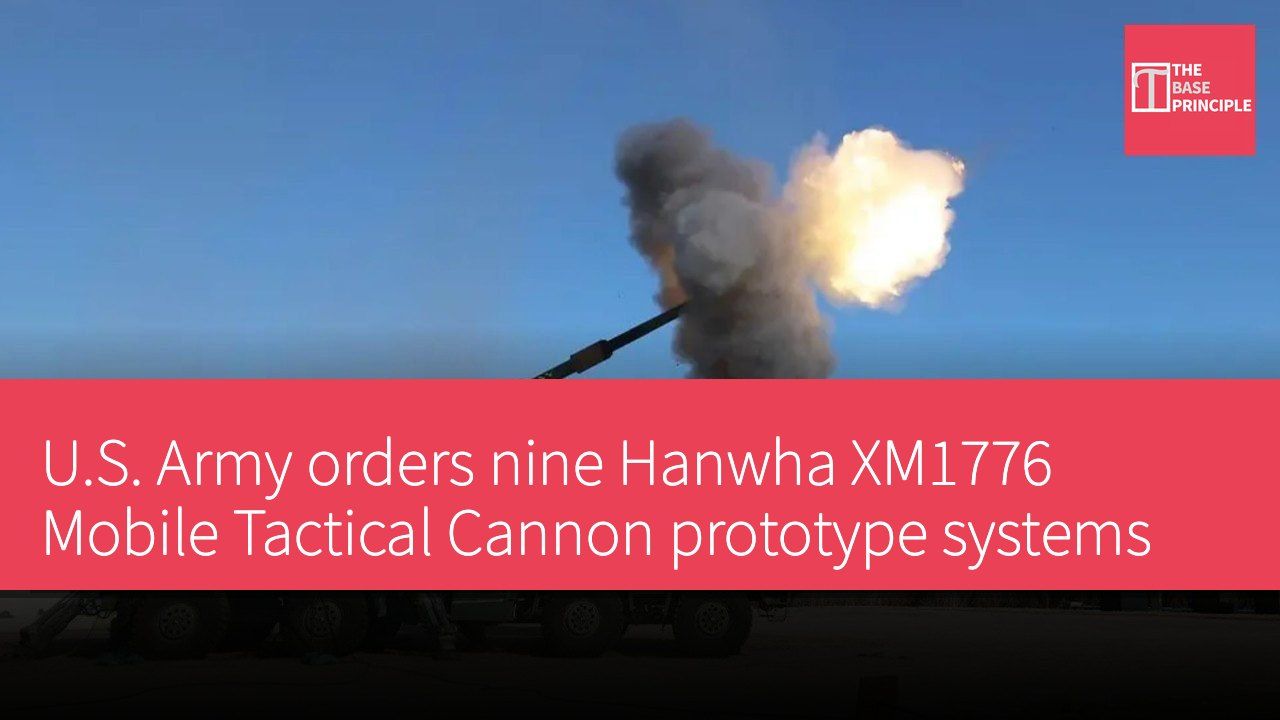
- The U.S. Army ordered nine XM1776 prototype systems and retained an option for nine more.
- The XM1776 combines 155 mm cannon firepower with the mobility of a wheeled platform.
- Hanwha plans to boost U.S. artillery production capacity, establishing an integration and test center.
- The system remains a prototype, requiring further testing to determine performance and reliability.
The U.S. Army has ordered nine prototype XM1776 Mobile Tactical Cannon systems and retained an option for an additional nine, enabling Hanwha Defense USA to expand U.S. artillery production capacity. Hanwha Defense USA (HDUSA) unveiled the XM1776 naming ceremony on Oct. 12, 2026, at the Association of the U.S. Army annual meeting in Washington, D.C., and introduced the U.S. designation for Hanwha's K9 Mobile Howitzer, a wheeled artillery system based on the established K9 artillery technology of the South Korean defense manufacturer.
XM1776 System Design and Advantages
The company said the Army ordered nine prototypes and retained a procurement option for nine additional systems. The announcement follows a prior prototype agreement and establishes a larger vehicle evaluation group. The XM1776 is designed to support the Army's modernization goals by combining 155 mm cannon firepower with the mobility of a wheeled platform. Unlike towed artillery that requires a separate vehicle to move the weapon, a self-propelled howitzer integrates its gun and mobility system into a single vehicle, giving artillery units greater flexibility when moving between firing positions.
The XM1776 is based on Hanwha's K9 Mobile Howitzer, adapting the technology of the company's K9-series tracked self-propelled howitzers to a wheeled configuration. The U.S. designation reflects the system's adaptation for the U.S. Army, but the prototype still must be evaluated against U.S. military requirements. Wheeled artillery can offer advantages in road mobility and operational flexibility, especially when units need to redeploy rapidly to keep pace with maneuver forces. The self-propelled system also reduces reliance on separate towing vehicles, simplifying movement between firing positions.
At today's naming ceremony, CEO Michael Coulter, COO Mike Smith and U.S. Army leaders unveiled the new name for our K9 Mobile Howitzer: XM1776. New name, proven foundation — welcome to the unfair fight.
These capabilities are critical on the battlefield because drones, surveillance systems and counter-battery weapons can help adversaries locate artillery positions. Post-firing mobility reduces the time guns are exposed to retaliatory strikes. However, the Army must test the XM1776 to determine its performance, reliability and suitability for operational service. The system remains a prototype effort, not an approved full-rate production weapon. The latest announcement does not lock in a production timeline or confirm the total number of systems the Army may ultimately procure.
Boosting U.S. Artillery Production Capacity
Hanwha plans to boost U.S. artillery production capacity. Alongside the unveiling, Hanwha Defense USA outlined plans to expand the domestic industrial infrastructure supporting the program. The company is establishing a Phase 1 facility in Opelika, Alabama, that will serve as the U.S. integration and test center for the XM1776 and other Hanwha K9 Mobile Howitzer family systems. HDUSA also plans to meet with more than 70 existing and potential suppliers to develop an artillery industrial base consortium.
The initiative aims to accelerate supply chain localization and expand U.S. participation in artillery production. "The XM-1776 Mobile Tactical Cannon represents the launch of the U.S. Army's new long-range precision fires modernization effort," HDUSA Chief Operating Officer and President of Ground Systems Mike Smith said in the announcement.
Hanwha is leveraging its K9 howitzer family's international production experience. The company says it has deployed more than 2,500 K9 howitzers worldwide. This existing industrial base can provide a foundation for scaling production and supporting allied cooperation, though the extent of shared components and maintenance arrangements for the U.S. variant remains to be determined. As the United States seeks to strengthen its defense industrial base and improve its ability to produce and sustain artillery systems, domestic integration and test facilities and a broader supplier network can support the program if the Army decides to move beyond the prototype phase.
XM1776's Impact on U.S. Military Modernization
The development of the XM1776 system is not only part of the U.S. Army's modernization but also reflects the need for rapid deployment and flexibility. With the increasing threat of drones and counter-battery weapons in modern warfare, artillery systems with rapid mobility capabilities are especially important. Hanwha's plans not only help enhance U.S. artillery production capacity but also strengthen cooperation with allies, further consolidating the U.S. position in the global defense industry.