
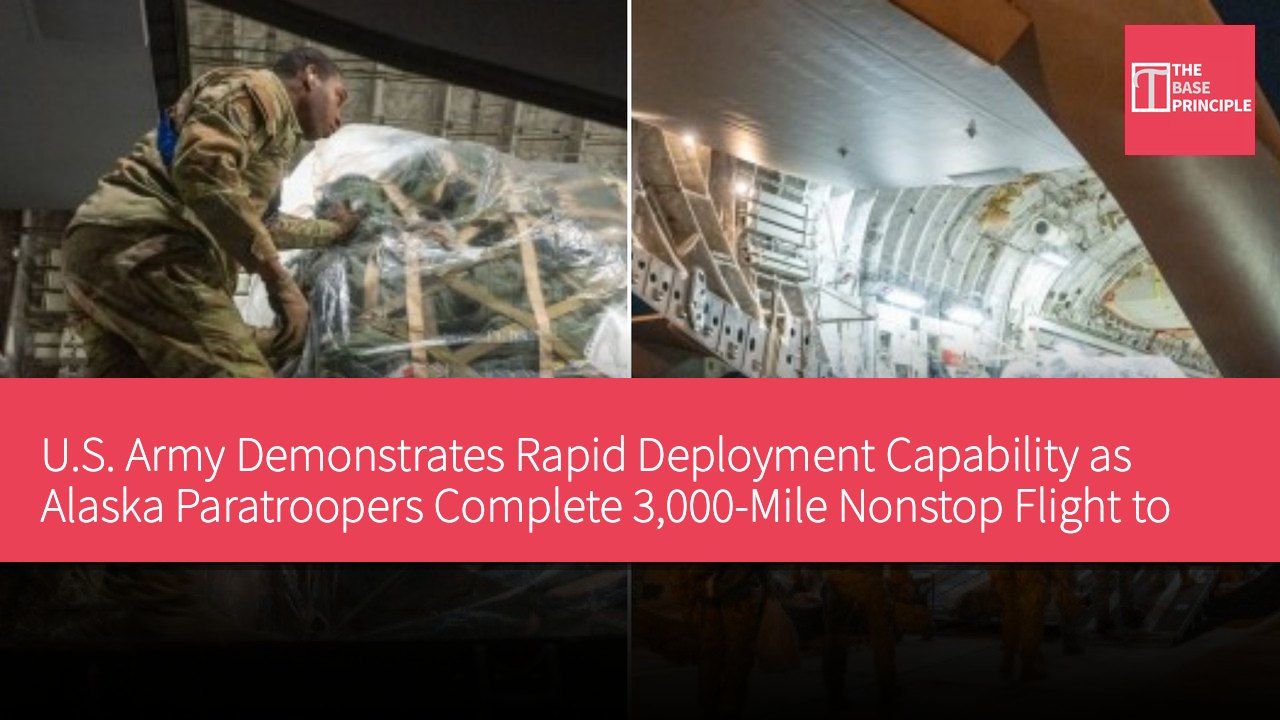
- The U.S. Army demonstrated its ability to rapidly deploy airborne forces.
- Soldiers from the 11th Airborne Division prepared parachutes and equipment during the flight.
- The exercise tested the ability to project combat power in the Indo-Pacific region.
- The operation showcased the military's long-range transportation and coordination capabilities in the Pacific.
The U.S. Army demonstrated how quickly it can transport airborne troops to the Pacific, with paratroopers from Alaska flying nearly 3,000 miles nonstop to conduct a joint airborne assault in Hawaii. This operation, named "Arctic Aloha," took place on November 5, 2026, as part of the Joint Pacific Multinational Readiness Center (JPMRC) rotation 27-01.
Soldiers from the 11th Airborne Division departed from Joint Base Elmendorf-Richardson in Alaska, preparing parachutes and combat gear during the flight, and coordinated with an infantry company from Japan before executing a unified battalion-level airborne insertion. The exercise tested the division's ability to project combat power in the Indo-Pacific region while maintaining communication with commanders and coordinating with other services.
Preparation of Aerial Equipment
A key element of this operation was the aerial equipment. Soldiers did not board the aircraft wearing parachutes and full combat gear but completed these preparations during the flight. This process involved donning, adjusting, and checking parachutes and equipment inside the aircraft until reaching the drop zone. According to the Army, this allowed paratroopers to avoid carrying extra weight during the nearly eight-hour flight, helping them maintain their stamina before landing. The operation also required coordination among aircraft departing from different locations. The main force flying from Alaska conducted an aerial rendezvous with the infantry company returning from Japan after participating in Operation Keen Sword, forming a unified battalion task force for the insertion into Hawaii.
Subsequently, approximately 300 paratroopers conducted an airborne assault on the island of Hawaii, demonstrating the capability of troops to arrive from different locations.
Operational Framework of the Exercise
"Arctic Aloha" also served as a practical demonstration of the Army's operational guidance "How the Army Fights," issued in October 2026. This framework organizes ground operations around four interrelated elements: integration, strike, close combat, and endurance. During the exercise, I Corps coordinated space, cyber, and electronic warfare capabilities to establish operational advantages, showcasing integration capabilities. Theater forces and the 25th Infantry Division then simulated strikes against enemy air defenses, representing the strike element. With these conditions established, the 11th Airborne Division initiated close combat by parachuting into designated areas to seize critical infrastructure and secure terrain.
The fourth element, endurance, involves the ability to sustain and project combat power under long-distance and challenging operational conditions. The flight from Alaska to Hawaii tested this requirement by maintaining communication with I Corps, U.S. Army Pacific Command, and joint forces in Hawaii while crossing the Pacific.
This approach reflects the challenges of operating in the Indo-Pacific region, where military forces must cover vast distances between islands while coordinating air and naval units. The importance of the 11th Airborne Division cannot be overstated, as it is the Army's only dedicated unit for Arctic and Pacific airborne operations, stationed in Alaska. Its soldiers are trained to operate in extreme cold, mountainous terrain, and Indo-Pacific island environments. The division's commander stated that this exercise demonstrated its capability to directly project battalion-level task forces into the Pacific theater. He also emphasized its potential to operate from the Arctic to Northern Europe.
After the operation in Hawaii, these paratroopers plan to return to Alaska and conduct another airborne assault at the Richardson Training Area.
JPMRC 27-01 involved approximately 10,000 soldiers from the U.S. Army, Air Force, Navy, and Marine Corps, working alongside international allies and partners. This larger rotation also brought together the 11th Airborne Division and the 25th Infantry Division to enhance joint coordination capabilities. "Arctic Aloha" demonstrated that projecting military power in the Pacific requires not only long-range transport aircraft but also the ability to coordinate forces in-flight, maintain command links, and prepare for operations. As the U.S. military prepares for operations in the vast and dispersed Indo-Pacific region, these capabilities will become increasingly important.
Military Challenges and Responses in the Indo-Pacific Region
This exercise highlighted the complexities of U.S. Army operations in the Indo-Pacific region, particularly the distances between islands and the coordination required. The specialized training of the 11th Airborne Division enables effective deployment in extreme environments, which is crucial for future military actions. As geopolitical dynamics shift, enhancing rapid response capabilities and coordinated operations will become a focus for the U.S. military, ensuring an advantage in the face of potential threats.