
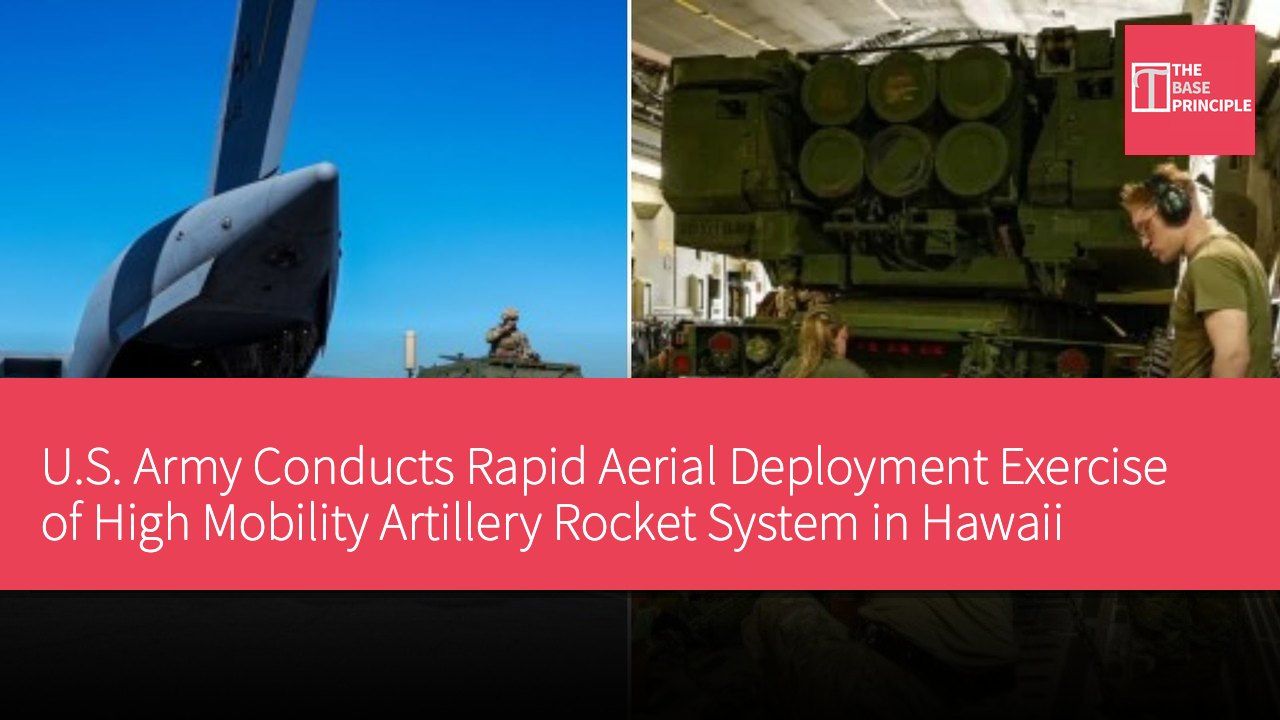
- The U.S. Army conducted a HIMARS rapid deployment exercise in Hawaii, simulating precision strikes.
- The exercise tested the rapid movement and coordination capabilities of artillery teams, enhancing concealment.
- The HIMARS system is highly mobile, suitable for the complex environments of the Indo-Pacific region.
- The exercise emphasized inter-service coordination to ensure artillery units can respond quickly to deployment.
Exercise Objectives and Content
The operation tested the speed at which artillery teams could transfer launchers from aircraft to firing positions and their ability to coordinate simulated strikes. The teams practiced not only remaining in fixed positions but also preparing the systems for immediate movement after completing the exercise. This approach aims to make long-range artillery harder for adversaries to locate and target, especially in the vast and geographically dispersed Indo-Pacific region. The airlift of HIMARS via HIRAIN is designed to quickly insert HIMARS launchers into locations where traditional ground transport is inconvenient or too slow.
During the exercise on Kauai Island, U.S. Air Force transport aircraft delivered the launchers to an airfield, where Army teams subsequently unloaded the launchers and transitioned to firing posture. The Army did not specify the exact aircraft model in its report, but the 15th Wing operates the C-17 Globemaster III transport aircraft. This model is capable of transporting heavy military equipment over long distances and can take off and land at multiple airfields. This process requires close coordination between Army artillery teams and Air Force personnel. The specialists responsible for loading must ensure the launchers are securely fastened during flight, while the ground teams need to quickly unload and prepare the systems after landing.
Once in position, the HIMARS teams can receive target information and execute fire missions. In this exercise, the missions were conducted as live-fire drills, meaning no rockets were actually launched. Subsequently, the launchers were secured and prepared for further movement. This rapid redeployment is central to the HIRAIN concept: launchers that can quickly move to firing positions, complete missions, and depart swiftly are less exposed to potential counterfire.
In the Pacific region, the importance of rapid deployment cannot be overstated. HIMARS is a truck-mounted rocket artillery system capable of firing guided rockets and long-range missiles from interchangeable launch pods.Its mobility allows Army units to reposition between firing locations rather than relying solely on fixed artillery positions. The system has become a critical component of the U.S. Army's long-range precision fire capabilities. Compared to heavier artillery systems, its mobility and relatively low logistical demands make it particularly useful in expeditionary operations. However, transporting these systems in the Indo-Pacific region presents additional challenges. The area spans vast distances, including island chains, limited infrastructure, and dispersed operational locations. Units may need to transport equipment by air or sea to establish firing positions.
The Importance of Inter-Service Coordination
The exercise conducted by the 25th Infantry Division also highlighted the importance of coordination between services. While the HIMARS teams operated on Kauai Island, joint forces coordinated capabilities and simulated effects in Hawaii as part of a broader JPMRC rotation. Army commanders stated that the exercise tested the ability to connect communications, target information, logistics, and precision fire under challenging conditions. The goal is to ensure artillery units can respond to deployment in a short timeframe while maintaining connectivity with larger forces. The division is also preparing for future deployments to the Philippines, part of a series of regional exercises and engagements in U.S. Army Indo-Pacific partnerships.In remote areas with limited infrastructure, the ability to rapidly deploy, fire, and reposition long-range artillery may become a crucial component of sustaining dispersed forces.
Strategic Significance of HIMARS in the Indo-Pacific Region
The rapid deployment capability of the HIMARS system is particularly important in the Indo-Pacific region, where geographical features and infrastructure limitations make traditional ground transport challenging. Through air transport, HIMARS can quickly insert into the battlefield and swiftly withdraw after completing missions, reducing the risk of being targeted by the enemy. Furthermore, the inter-service coordination emphasized during the exercise demonstrates the necessity of multi-service cooperation in modern warfare, which is vital for enhancing operational efficiency and response speed.